


Article · Issuance, Distribution & Listings
Secondary Liquidity: What a Listing Does & Does Not Promise
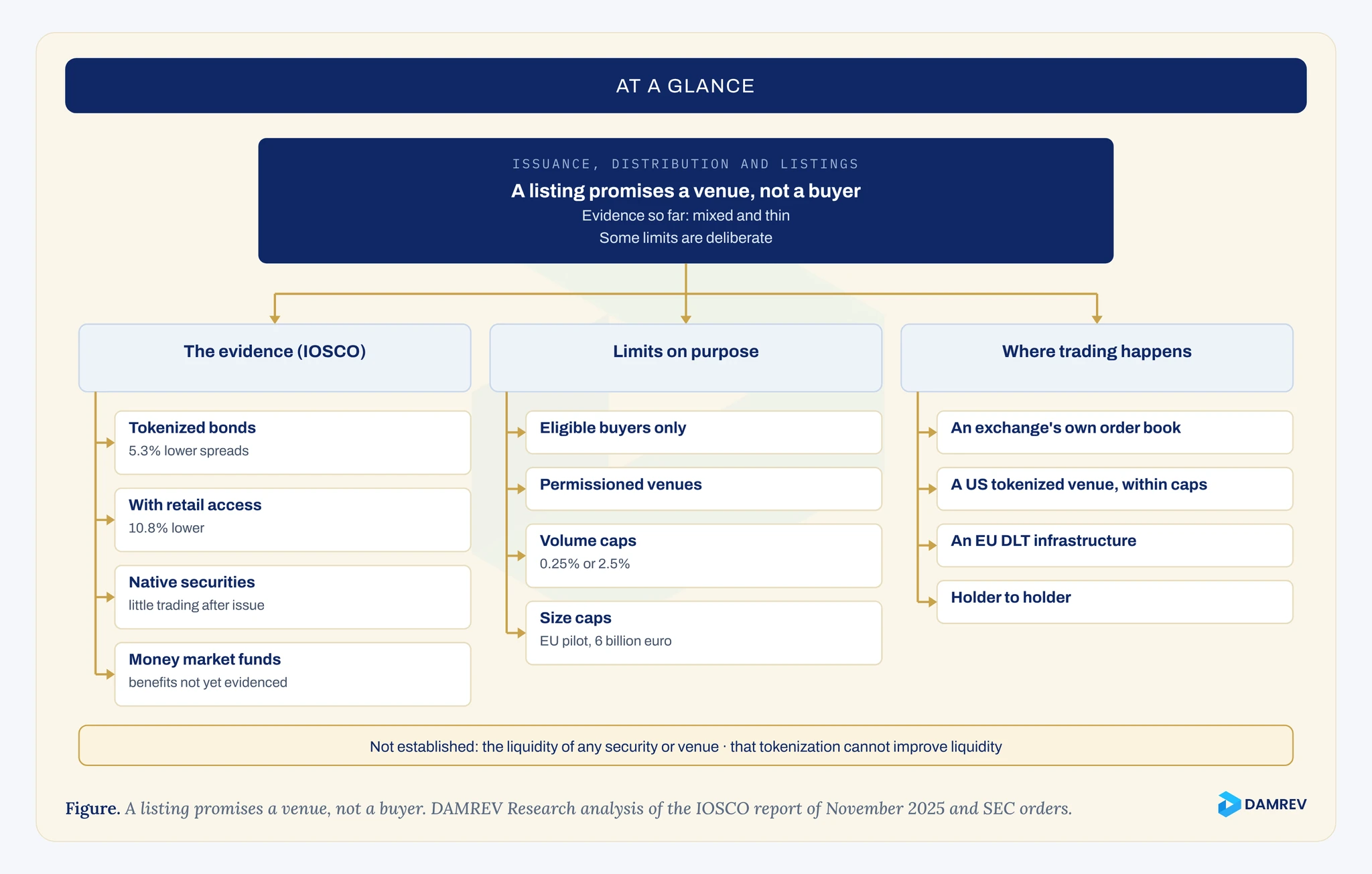
A listing promises a venue and its rules, not a buyer or a price. The report of the International Organization of Securities Commissions (IOSCO) of November 2025 found that securities issued natively on a ledger have so far shown low secondary market liquidity, and it found the promised liquidity benefits of tokenized money market funds not yet clearly evidenced1.
Some of the limits are deliberate: eligibility rules, transfer restrictions, and venue caps narrow who may trade and how much2, 3.


In this article
01 · The promise
What does a listing promise a holder of a tokenized security?
A listing promises a holder of a tokenized security a place to trade and rules for trading there, not that anyone will buy, at what price, or in what size. That is true of any listing, and tokenization does not change it1.
Liquidity is often listed among the benefits of tokenization, and the reasoning is easy to follow. A token can move at any hour, settle quickly, and be divided into small units, so more buyers can reach it more easily. IOSCO's report of November 2025 sets out those arguments fairly, then tests them against what has happened1.
The distinction that matters is between transferability and liquidity. Transferability is a property of the instrument: whether it can move. Liquidity is a property of the market: whether someone will take the other side, near a fair price, when the holder wants to sell. A ledger can guarantee the first. Only buyers supply the second.
Tokenization can lower some barriers on the way. Smaller units let investors buy in smaller sizes, and faster settlement frees capital sooner1. Those are real gains in the cost of trading. They change how cheaply a willing buyer can trade, not whether one exists.
A listing makes the market visible and orderly. It sets who may trade, how orders meet, how trades settle, and what is disclosed. Each of those supports liquidity without creating it.
02 · The evidence
What does the evidence show so far?
The evidence on tokenized securities liquidity so far is mixed and thin: IOSCO cites research showing narrower spreads on tokenized bonds, but finds that native securities have so far traded little after issue, and that liquidity benefits for tokenized money market funds are not yet clearly evidenced1.
- Lower bid-ask spreads on tokenized bonds than on conventional bonds, in research IOSCO cites1
- 5.3%
- The same improvement where the tokenized bonds were accessible to retail investors, in the same research1
- 10.8%
The spread findings are the strongest evidence for the liquidity case, and IOSCO reports them with their cause: faster settlement, fewer intermediaries, and fractional units that lower the barrier to entry1. They come from research on bonds, and IOSCO presents them as findings it cites, not as its own measurement.
The same passage carries the counterweight. IOSCO notes that native securities "have thus far exhibited low levels of secondary market liquidity", largely because industry experiments have focused on infrastructure, primary issuance, settlement, and repo rather than active secondary trading1.
The resulting lack of liquidity disincentivizes investors from holding native securities for active trading.1
For tokenized money market funds, IOSCO is direct. Many of the promised benefits, "particularly around secondary market liquidity", it says, "are not clearly evidenced in the use-cases yet"1. It observes that a substantial part of the order and trading flow for one large fund still runs through conventional infrastructure1.
03 · Limits by design
Which rules limit liquidity on purpose?
Eligibility rules narrow who may buy, transfer restrictions narrow who may resell, and new venue regimes cap how much may trade. Each protects something, and each reduces the pool of buyers2, 3.
Eligible buyers only
A security sold under a private placement can be resold only to buyers and through routes the rules allow, whatever the token's code permits; the article on transfer restrictions sets these out.
Permissioned venues
Under the innovation exemption of the US Securities and Exchange Commission (SEC), only permissioned participants may trade on a tokenized securities venue2.
Volume caps
The same order caps each tokenized stock at 0.25 or 2.5 percent of the underlying stock's prior-month average daily volume, depending on its tier2.
Size caps
The European Union (EU) pilot regime for distributed ledger technology (DLT) market infrastructures, the DLT Pilot Regime, limits the shares a DLT venue may admit by issuer size, and its overall book to 6 billion euro5.
None of these limits is a defect. They are designed, in the order's words, "to mitigate potential risks to the broader markets" while participants experiment2. The SEC's caps are the clearest example: they keep a tokenized line of a share small relative to the main market while the exemption is tested2.
The consequence for a holder is plain. A token that may be held only by approved investors, traded only on a permissioned venue, and only up to a capped volume is usually less liquid than the same security on an open exchange, not more.
04 · Where trading happens
Where does trading in a tokenized security actually happen?
Trading in a tokenized security happens in one of four places, and the choice shapes liquidity. A token that shares an exchange's order book shares its liquidity; a token on a separate venue or traded bilaterally has only what that market draws2, 4, 5.
| Venue | How it works | What it means for liquidity | Source |
|---|---|---|---|
| An exchange's own order book | Nasdaq's approved rule lets a fungible tokenized share trade on the same book, with the same priority, as the conventional share | The token draws on the whole market for the share | 4 |
| A tokenized securities venue (US) | Automated market maker pools for permissioned participants, under volume caps | Liquidity is what the pools hold, within the caps | 2 |
| A DLT market infrastructure (EU) | A venue under the DLT Pilot Regime, for smaller issuers, within an overall cap | A separate market with its own participants | 5 |
| Bilateral transfer | Holder to holder, under the security's restrictions | Depends on finding a counterparty | None |
The first route is the most liquid because it adds nothing new: the token is one form of a share that already trades. The Nasdaq rule makes this explicit by requiring the token to be "fungible with" the conventional share and to share its Committee on Uniform Securities Identification Procedures (CUSIP) number4.
Fragmentation is the opposite risk, and IOSCO names it, pointing to interoperability problems between ledgers "resulting in liquidity fragmentation of tokenized products"1.
A third-party token adds a further layer. Its buyer takes on the third party as well as the share, and the SEC staff note that holders "may be exposed to risks with respect to the third party, such as bankruptcy"3.
Where the third party redeems tokens for the underlying shares, the redemption terms, not the venue, decide how easily a holder can leave.

05 · What it does not establish
What does this not establish?
As of 7 October 2026, the IOSCO report and the SEC orders read here do not establish the liquidity of any security or venue, or that tokenization cannot improve liquidity. The evidence reviewed is early, and some of it points the other way1.
| Question | Position | Source |
|---|---|---|
| Liquidity of a particular token or venue | Not assessed; this article measures no market and ranks no venue | None |
| Whether tokenization improves liquidity | Some research finds narrower spreads on tokenized bonds; native securities have so far traded little | 1 |
| The US volume caps | Set by the order; only the Commission can change them | 2 |
| Price or prospects of any instrument | Outside this article | None |
Common questions
What else do people ask?
Short answers to the questions people ask most about this topic.
Does tokenizing a security make it easier to sell?
Not by itself. IOSCO found that securities issued natively on a ledger have so far shown low secondary market liquidity, largely because industry work has focused on infrastructure, issuance, settlement, and repo rather than active trading1.
Does 24-hour transferability mean 24-hour liquidity?
No. A token that can move at any hour still needs an eligible buyer, a venue or counterparty, and a lawful basis for the transfer1, 3.
Why does the SEC's innovation exemption cap trading volumes?
The order limits each tokenized stock to a share of the underlying stock's average daily volume, which keeps most trading on the main market while the exemption runs2.
Is there evidence that tokenization improves liquidity?
Some. IOSCO cites research finding narrower bid-ask spreads on tokenized bonds than conventional ones. It sets that against the low secondary liquidity of native securities generally1.
Where should you go next?
The pages below pick up where this one ends. Start with the one closest to where your asset or programme stands today.
- What an Exchange Asks for Before a Tokenized ListingAn exchange applies its ordinary listing rules, then asks whether the token is the same security, how it settles, and who keeps the register.
- Tokenized Stocks Are Not One Product: Issuer Shares, Security Entitlements, & Synthetic Exposure ComparedA tokenized stock can be the company's own share, a custodian's security entitlement, or synthetic exposure, each with a different issuer and rights.
- The SEC's Innovation Exemption of 17 September 2026: What Tokenized Securities Venues & Tokenized NMS Stock May Now DoSince 17 September 2026 a tokenized securities venue may run automated liquidity pools in tokenized listed stock without registering as an exchange, on conditions.
- Tokenized or ConventionalWhere tokenized and conventional listings actually differ, and the three questions that decide which route suits your company.
References
- 1.International Organization of Securities Commissions, Tokenization of Financial Assets, Final Report FR/17/25, published 11 November 2025. https://www.iosco.org/library/pubdocs/pdf/IOSCOPD809.pdf
- 2.US Securities and Exchange Commission, Order Granting Exemptions for Tokenized Securities Venues, Exchange Act Release No. 34-106402, 17 September 2026. https://www.sec.gov/files/rules/exorders/2026/34-106402.pdf
- 3.SEC Divisions of Corporation Finance, Investment Management, and Trading and Markets, "Statement on Tokenized Securities", 28 January 2026. https://www.sec.gov/newsroom/speeches-statements/corp-fin-statement-tokenized-securities-012826
- 4.US Securities and Exchange Commission, Order Approving a Proposed Rule Change to Enable the Trading of Securities on the Exchange in Tokenized Form, Release No. 34-105047, File No. SR-NASDAQ-2025-072, 18 March 2026. https://www.sec.gov/files/rules/sro/nasdaq/2026/34-105047.pdf
- 5.Regulation (EU) 2022/858 on a pilot regime for market infrastructures based on distributed ledger technology, Article 3. https://eur-lex.europa.eu/legal-content/EN/TXT/HTML/?uri=CELEX:32022R0858
This article is analysis of public sources, not legal advice. Last updated:




