


Article · Issuance, Distribution & Listings
Tokenized Stocks Are Not One Product: Issuer Shares, Security Entitlements, & Synthetic Exposure Compared
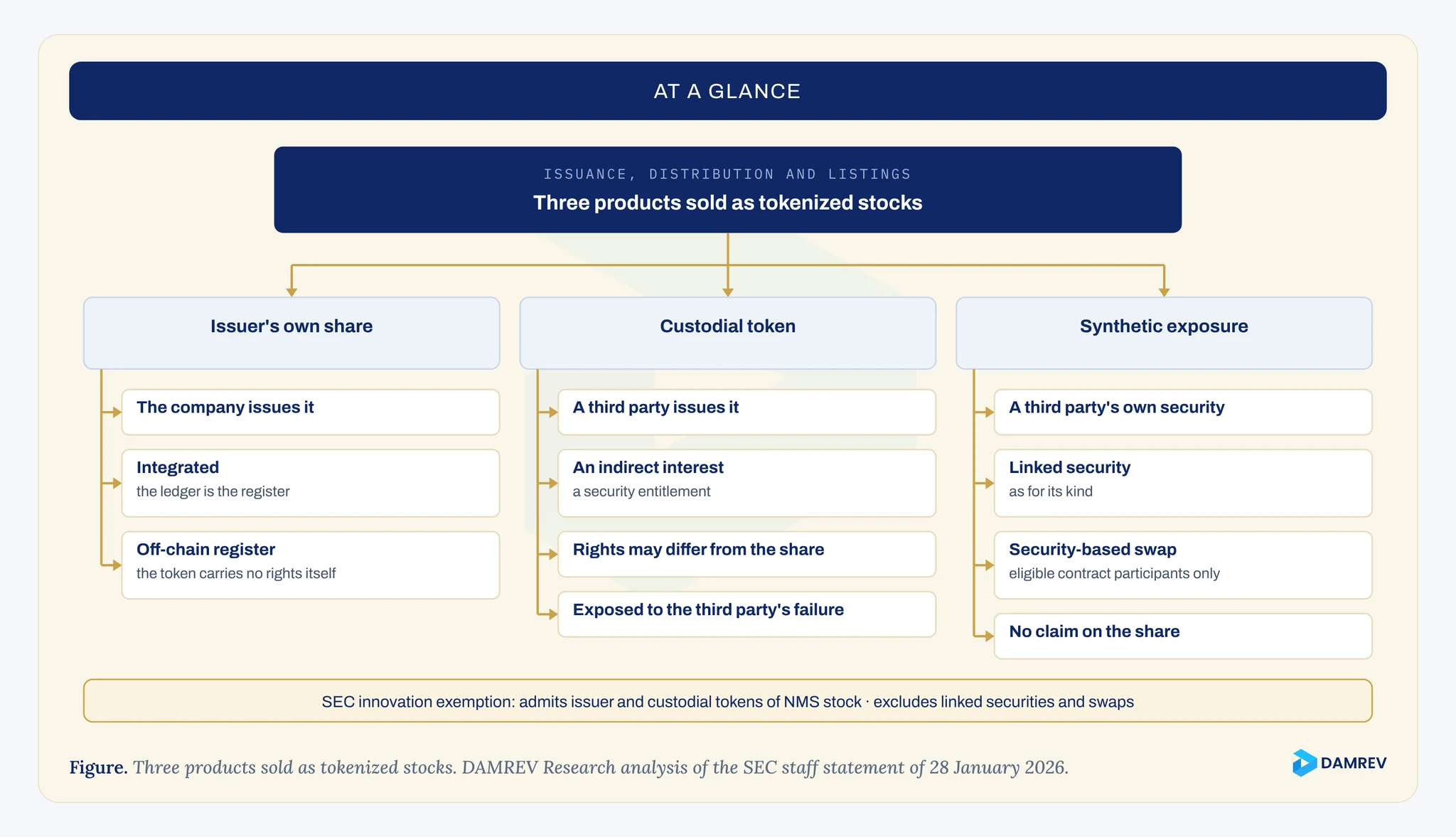
A token sold as a tokenized stock can be one of three different instruments: the company's own share in a new format, a third party's security entitlement to a share it holds in custody, or a third party's own security that only tracks the share's price, known as synthetic exposure1.
The three differ in who the issuer is, what rights the holder has, and whose failure the holder is exposed to, and the later instruments of the US Securities and Exchange Commission (SEC) treat them differently1, 3.


In this article
01 · Three instruments
Which instruments are sold as tokenized stocks?
The SEC staff identify three instruments sold as tokenized stocks: the company's own share issued as a token, a third party's custodial token representing a share it holds, and a third party's own security giving synthetic exposure to the share1.
The SEC staff statement of 28 January 2026 sorts tokenized securities first by who tokenizes them: "securities tokenized by or on behalf of the issuers of such securities", and "securities tokenized by third parties unaffiliated with the issuers"1.
It then splits the third-party group in two. In the custodial model the third party holds the share and the token evidences the holder's interest in it. In the synthetic model the third party issues "its own security that provides synthetic exposure to the underlying security"1.
The label on a trading screen does not tell a buyer which of the three is on offer. A token called by a company's name and priced against its share could be any of them.
As powerful as blockchain technology is, it does not have magical abilities to transform the nature of the underlying asset.2
Commissioner Peirce's statement of July 2025 made the same point before the staff did, and named the risk that follows from it: purchasers of third-party tokens "may face unique risks, such as counterparty risks"2.
The staff statement is not a rule. It states the staff's views and "has no legal force or effect"1. Its value is the map it draws, which the Commission's own order of September 2026 now follows3.
02 · The issuer's own share
What does the holder own when the company tokenizes its own shares?
A holder owns the company's share itself when the token is integrated into the company's register. If the register stays off-chain and the token only triggers transfers, the staff say the token itself conveys no rights of the security1.
In the integrated form, the issuer or its agent builds the ledger into the master securityholder file, "such that a transfer of the crypto asset on the crypto network results in a transfer of the security on the master securityholder file"1.
In the staff's words, the only difference from a share in traditional format is that the issuer keeps its register on one or more crypto networks rather than in conventional off-chain records1. The holder is a shareholder of the company, with whatever rights the class carries.
The staff describe a second form that is easy to confuse with the first. The company keeps its register off-chain and issues a token alongside the share. Here "the crypto asset does not convey any rights, obligations, or benefits of the security", and moving the token only notifies the issuer or its agent to record the transfer1.
Two ways an issuer can tokenize its own share, as described by the SEC staff

- What does the holder own when the company tokenizes its own shares?
- Integrated: The ledger is the register: A token transfer is a transfer of the share on the master securityholder file. (Step 1, [1])
- Off-chain register: The token is a messenger: The token carries no rights of the security; its transfer tells the issuer's agent to update the off-chain register. (Step 2, [1])
A further choice sits inside the issuer model: the class. A company may issue the token as the same class as its existing shares or as a separate class.
If the tokenized security is of "substantially similar character" and its holders enjoy "substantially similar rights and privileges", it may be treated as the same class for certain purposes1. That is a design decision with consequences for reporting, listing, and fungibility, and it is made in the company's constitutional documents, not on the ledger.
03 · The custodial token
What does the holder own in the custodial model?
A holder of a custodial token owns an indirect interest in a share held by a third party, usually a tokenized security entitlement. The holder's rights are whatever the third party's terms give, and the holder carries the third party's risk1.
An indirect interest
The token "represents the holder's indirect interest in the underlying security via the security entitlement"1.
Rights may differ
The token "may or may not confer upon the holder of the crypto asset any rights as a holder of the underlying security"1.
The third party's risk
Holders "may be exposed to risks with respect to the third party, such as bankruptcy", which a direct shareholder would not necessarily face1.
One model, two names
The staff treat the "digital custodial receipt" as part of the tokenized security entitlement model, not a separate one1.
This model is familiar in substance. An investor who holds listed shares through a broker already holds a security entitlement, and the staff point to the long-standing indirect holding system when they describe it1.
The token changes how the third party keeps its records. It does not change the fact that the holder's claim runs to the third party, which runs to the share.
The model has also reached the centre of the US market. In December 2025 the staff gave The Depository Trust Company no-action relief for a pilot service to tokenize assets it holds in custody4.
For a holder, the questions are practical. Who is the custodian, where is the share held, are the holder's entitlements segregated from the custodian's own assets, and what happens to votes and dividends? The answers sit in the third party's terms1, 5.
04 · Synthetic exposure
What is synthetic exposure, and who may buy it?
Synthetic exposure is a third party's own security whose return tracks a share it need not hold. That security is either a linked security or a security-based swap, and a swap carries distribution limits that a linked security does not1.
| Question | Linked security | Security-based swap | Source |
|---|---|---|---|
| Who issues it | The third party, as its own security | The third party, as its own security | 1 |
| What it gives | Synthetic exposure; "not an obligation of the issuer of the referenced security" | Synthetic exposure; typically no "equity, voting, information, or other rights" | 1 |
| Typical form | A structured note or exchangeable stock | A tokenized swap on a single security or a narrow index | 1 |
| Who may buy | As for any security of its kind: registered or exempt | Only eligible contract participants, unless registered and traded on a national securities exchange | 1 |
| How it is classified | By its economic reality, not its name | By its economic reality, not its name | 1 |
The line between the two forms turns on the exclusions from the definition of a swap. A note or bond that is a security is excluded, so structured notes typically are linked securities rather than swaps1. The staff say the economic reality of the instrument, "rather than the name given to the instrument", decides which exclusion applies1.
The distinction matters most for distribution. A tokenized security-based swap "may not" be offered or sold to persons who are not eligible contract participants unless a registration statement is in effect and the trades take place on a national securities exchange1.
Commissioner Peirce described the consequence: a token that does not give legal and beneficial ownership of the share could be a security-based swap "that cannot be traded off exchange by retail persons"2.
Synthetic issuers can raise a further question. The staff note that, depending on the facts, the third party may be deemed an investment company1.

05 · What it does not establish
What does this comparison not establish?
As of 7 October 2026, the SEC staff statement and the Commission's order read here do not establish which product is lawful in a given offering, how the models are treated outside the United States, or that the staff's map binds anyone. The staff statement is staff analysis, with assumptions stated1.
| Question | What the sources say | Source |
|---|---|---|
| Legal force | None: the statement is staff views, not a Commission rule or guidance | 1 |
| Assumptions | Parties comply with applicable law, transfers are effective under Article 8 of the Uniform Commercial Code (UCC), and the issuer imposes no transfer restriction | 1 |
| Trading on a new venue | The innovation exemption admits issuer and custodial tokens of national market system (NMS) stock with the same rights, and excludes linked securities, security-based swaps, and rights and warrants | 3 |
| Other jurisdictions | Not addressed; the statement reads US federal law only | 1 |
| A specific product | Not addressed; the staff invite enquiries about particular facts | 1 |
The staff's assumptions are the part most readers skip. The statement assumes that tokens "are not subject to any restriction on transfer imposed by the issuer" and that each token transfer is an effective transfer under state law1. Real offerings often carry restrictions, and whether a transfer is effective depends on documents the statement never sees.
What the comparison does settle is the first question to ask of any token sold as a stock: who issued it, and what does the holder own? The answer fixes the holder's rights, the holder's risk, and which rules govern its sale.
Common questions
What else do people ask?
Short answers to the questions people ask most about this topic.
Does a tokenized stock give me a vote at the company's meetings?
Only if it is the company's own share, or a security entitlement whose terms pass votes through. The SEC staff say a third party's token may or may not confer any rights as a holder of the underlying security, and a security-based swap typically conveys no voting rights1.
Can a third party tokenize a company's shares without the company's consent?
The staff statement describes third parties unaffiliated with the issuer doing so1. For trading on a venue under the SEC's innovation exemption, the issuer must receive written notice and may object within the period the order sets3.
Is a synthetic tokenized stock illegal in the United States?
No. It is a security in its own right, a linked security or a security-based swap, and must be offered and traded under the rules for that instrument. A security-based swap may not be sold to persons who are not eligible contract participants unless it is registered and traded on a national securities exchange1.
Is a token that tracks a share the same as owning the share?
No. A linked security confers no rights or benefits from the issuer of the referenced share, and its holder depends on the third party that issued it1.
Where does the holder's protection come from in the custodial model?
From the third party's records and terms, and from the law that governs security entitlements, which the staff statement assumes is complied with, citing Article 8 of the Uniform Commercial Code1.
Where should you go next?
The pages below pick up where this one ends. Start with the one closest to where your asset or programme stands today.
- Does Tokenizing a Security Change Whether It Is a Security?In the United States, the European Union, Guernsey, and Jersey, tokenizing a security does not change whether it is one, only which one is held.
- The SEC's Innovation Exemption of 17 September 2026: What Tokenized Securities Venues & Tokenized NMS Stock May Now DoSince 17 September 2026 a tokenized securities venue may run automated liquidity pools in tokenized listed stock without registering as an exchange, on conditions.
- Corporate Actions on a Tokenized ShareDividends and votes go to whoever the register shows on the record date. A tokenized share changes where the register is, not that rule.
- Tokenized or ConventionalWhere tokenized and conventional listings actually differ, and the three questions that decide which route suits your company.
References
- 1.SEC Divisions of Corporation Finance, Investment Management, and Trading and Markets, "Statement on Tokenized Securities", 28 January 2026. https://www.sec.gov/newsroom/speeches-statements/corp-fin-statement-tokenized-securities-012826
- 2.Commissioner Hester M. Peirce, "Enchanting, but Not Magical: A Statement on the Tokenization of Securities", 9 July 2025. https://www.sec.gov/newsroom/speeches-statements/peirce-statement-tokenized-securities-070925
- 3.US Securities and Exchange Commission, Order Granting Exemptions for Tokenized Securities Venues, Exchange Act Release No. 34-106402, 17 September 2026. https://www.sec.gov/files/rules/exorders/2026/34-106402.pdf
- 4.SEC Division of Trading and Markets, no-action letter to The Depository Trust Company, 11 December 2025. https://www.sec.gov/files/tm/no-action/dtc-nal-121125.pdf
- 5.Cooley, "SEC staff statement on tokenized securities", 4 February 2026. https://www.cooley.com/news/insight/2026/2026-02-04-statement-on-tokenized-securities
This article is analysis of public sources, not legal advice. Last updated:




