


Article · Issuance, Distribution & Listings
Corporate Actions on a Tokenized Share
A corporate action reaches whoever the company's register shows as the holder on the record date, and a tokenized share does not change that rule1, 2.
What changes is where the register is: if the company's ledger is its register, the token holder is the shareholder of record; if a third party issued the token, the holder's dividends and votes arrive only as the third party's terms pass them through2, 3.


In this article
01 · The record
Who receives a dividend or a vote on a tokenized share?
A dividend or a vote on a tokenized share goes to the holder the company's register shows on the record date, the ordinary rule of corporate law, which nothing in the texts reviewed changes for tokens. The question is which record counts as the register1, 2.
Corporate actions run on a simple mechanism. The board fixes a record date, and the people on the register on that date receive the dividend, the notice, or the vote.
Delaware law, used here as the example, puts it in two provisions. The board may fix a record date for a meeting and, separately, for dividends, distributions, and other lawful action1. And the stock ledger "shall be the only evidence as to who are the stockholders entitled" to vote or to examine the stockholder list1.
A tokenized share inherits this structure rather than replacing it. If the token is on the company's register, its holder is a holder of record. If it is not, the holder of record is someone else, usually a custodian or a depository, and the token holder's entitlement depends on what that person passes on2.
So every corporate action question on a tokenized share starts with the same two facts. Is the ledger the register? And who issued the token?

02 · Issuer tokens
How does a corporate action reach the holder of an issuer's own token?
A corporate action reaches the holder of an issuer's own token directly when the ledger is the register: the company, or its agent, takes the record from the ledger, maps wallet addresses to holder details it keeps off-chain, and pays or notifies the holders it finds1, 2.
Delaware's corporate records provision allows it. Records, including the stock ledger, "may be kept on, or by means of" electronic networks or databases, "including 1 or more distributed electronic networks or databases", provided they can be converted into legible paper form1.
The US Securities and Exchange Commission (SEC) staff describe the same model from the federal side: the issuer or its agent associates on-chain information, such as "wallet address, quantity of security owned, and issue date", with off-chain information, such as "security holder name and address"2.
A corporate action on an issuer-sponsored token where the ledger is the register
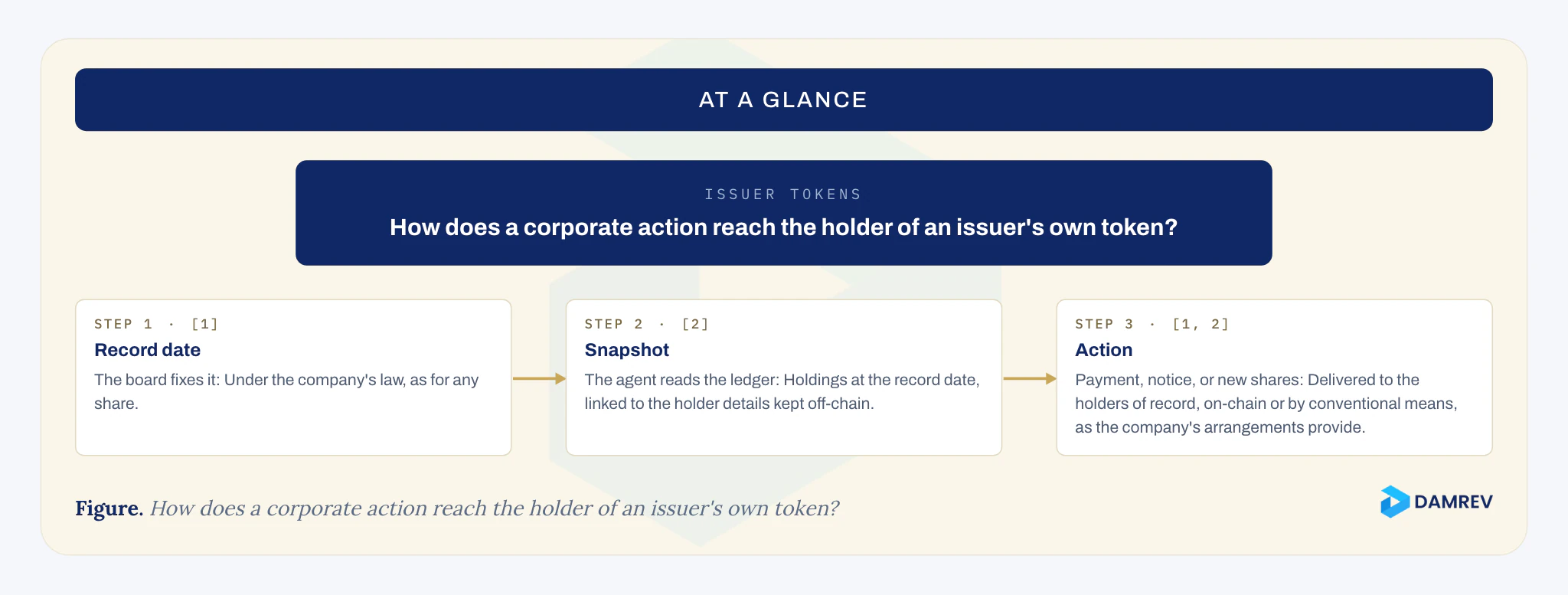
- How does a corporate action reach the holder of an issuer's own token?
- Record date: The board fixes it: Under the company's law, as for any share. (Step 1, [1])
- Snapshot: The agent reads the ledger: Holdings at the record date, linked to the holder details kept off-chain. (Step 2, [2])
- Action: Payment, notice, or new shares: Delivered to the holders of record, on-chain or by conventional means, as the company's arrangements provide. (Step 3, [1, 2])
The mapping is the working part. A wallet address on its own is not a shareholder; the company must know whom it belongs to, to send notices, check voting authority, and meet its obligations to the holder.
The SEC's transfer agent proposal of September 2026 asks for comment on whether the rules should let a transfer agent associate a wallet address and quantity held with off-chain records5.
Splits and other changes to the capital work the same way in principle: the register is updated, and the ledger is the register. The company's documents and the token's design must agree on how that update is made.
03 · Third-party tokens
What does the holder of a third-party token receive?
The holder of a third-party token receives whatever the third party's terms pass through, because the company pays and notifies its holder of record, which is not the token holder. On a US tokenized securities venue, the order requires the same dividends and votes and free proxy materials2, 3.
| Model | Holder of record | Dividends and votes reach the token holder | Source |
|---|---|---|---|
| Issuer-sponsored, ledger is the register | The token holder | Directly, from the company or its agent | 1, 2 |
| Issuer-sponsored, off-chain register | The holder on the off-chain register | Directly; the token itself carries no rights of the security | 2 |
| Third-party custodial | The custodian or its depository | Only as the third party's terms provide | 2 |
| Third-party synthetic | The third party, if it holds the share at all | Not as rights; any payment is under the third party's own contract | 2 |
The SEC staff are explicit that a third-party token "may or may not confer upon the holder of the crypto asset any rights as a holder of the underlying security"2. A security-based swap "typically does not convey to the holder any equity, voting, information, or other rights"2.
The innovation exemption sets a floor for third-party tokens on the new venues. A venue must verify that a token provides "the same rights and privileges" as the share, which the order says includes a right to "the same dividends" and "the same voting rights"3. It adds a specific condition on communications:
regardless of the mechanism used to pass through any voting rights of the underlying NMS stock, a TSV can only make available for trading an NMS stock tokenized by a third party that is unaffiliated with the issuer of the underlying NMS stock if the third party distributes or otherwise makes available to holders of the Tokenized NMS Stock any related proxy materials or other issuer communications at no cost to the issuer or the shareholders.3
For a holder of a third-party custodial token, redemption is the route back to the company. Exchanging the token for the underlying share, where the terms allow it, moves the holder off the third party's records and onto a position the company recognises.
The terms that govern that exchange matter as much as the token itself, because they decide whether the holder can ever become a holder of record.
04 · Through the market
How do corporate actions work when tokenized shares trade through an exchange?
Corporate actions on tokenized shares traded through an exchange work through the existing chain. In Nasdaq's approved tokenized trading, the tokens are fungible with the conventional shares and The Depository Trust Company (DTC) handles the tokenized form, and the order records Nasdaq's statement that tokenized trading "would not be expected to alter the existing proxy distribution process"4.
One security
The token must be fungible with, and carry the same rights as, the conventional share, so a corporate action applies to both alike4.
The depository in the chain
The tokenized form is created and settled by DTC under its pilot, so holders reach the company through the same depository chain4.
Proxy unchanged
The order records that tokenized trading "would not be expected to alter the existing proxy distribution process"4.
This route is the least disruptive for corporate actions because it changes the least. The register, the depository, and the proxy chain stay where they were, and the token is a form in which a participant's position is held. It also means the token does not, by itself, put the investor on the company's register.

05 · What it does not establish
What does this not establish?
As of 7 October 2026, the Delaware provisions and SEC texts read here do not establish how any company handles a particular action, what happens when keys are lost, how laws other than Delaware's treat a ledger, or the tax on a distribution. This article sets out the structure, not a procedure1, 2.
| Question | Position | Source |
|---|---|---|
| Lost or compromised keys | Not addressed in the texts reviewed; set by the issuer's terms and the law of the register | None |
| Companies outside Delaware | Each corporate law decides how its register may be kept; not reviewed here | 1 |
| Transfer agent duties on corporate actions | Under the current rules and, if adopted, the September 2026 proposal | 5 |
| Withholding and tax on dividends | Outside this article; ask your own tax adviser | None |
The most practical gap is the lost key. A holder of record who loses access to a wallet is still the holder of record, but the company needs a way to recognise a replacement address without opening the register to fraud. That is a matter for the company's documents and its agent, and the texts reviewed leave it there.
The structure itself is not new. Corporate law has always paid the person on the register, and tokenization changes where the register can be kept, not who it pays.
Common questions
What else do people ask?
Short answers to the questions people ask most about this topic.
If I hold a company's tokenized share in my own wallet, will I receive dividends?
If the company issued the token and its ledger is its register, the holder shown on the record date is the holder entitled. How the payment is made, on-chain or to a bank account, depends on the company's arrangements1, 2.
Do third-party tokenized stocks carry votes?
Only if the third party's terms pass them through. The SEC staff say a third-party token may or may not confer any rights as a holder of the underlying security2.
Can a Delaware company keep its stock ledger on a blockchain?
Delaware law allows corporate records, including the stock ledger, to be kept on or by means of one or more distributed electronic networks or databases, provided they can be converted into legible paper form1.
Does a tokenized share change how proxy materials reach shareholders?
For Nasdaq's approved tokenized trading, the order records that it would not be expected to alter the existing proxy distribution process4.
What happens to my dividends if I lose the keys to my wallet?
The texts reviewed do not address lost keys. A holder of record who loses access to a wallet is still the holder of record, and how the company recognises a replacement address is set by the issuer's terms and the law of the register.
Where should you go next?
The pages below pick up where this one ends. Start with the one closest to where your asset or programme stands today.
- Tokenized Stocks Are Not One Product: Issuer Shares, Security Entitlements, & Synthetic Exposure ComparedA tokenized stock can be the company's own share, a custodian's security entitlement, or synthetic exposure, each with a different issuer and rights.
- Tokenized Securities Investor Eligibility: Who May Buy in the US, the EU, South Africa, Mauritius, & JerseyTokenizing a security does not change who may buy it. The test comes from the issuer's offering route, in the place where the investor is.
- The SEC's Innovation Exemption of 17 September 2026: What Tokenized Securities Venues & Tokenized NMS Stock May Now DoSince 17 September 2026 a tokenized securities venue may run automated liquidity pools in tokenized listed stock without registering as an exchange, on conditions.
- Tokenized or ConventionalWhere tokenized and conventional listings actually differ, and the three questions that decide which route suits your company.
References
- 1.Delaware General Corporation Law, Title 8, Chapter 1, Subchapter VII, sections 213, 219, and 224. https://delcode.delaware.gov/title8/c001/sc07/index.html
- 2.SEC Divisions of Corporation Finance, Investment Management, and Trading and Markets, "Statement on Tokenized Securities", 28 January 2026. https://www.sec.gov/newsroom/speeches-statements/corp-fin-statement-tokenized-securities-012826
- 3.US Securities and Exchange Commission, Order Granting Exemptions for Tokenized Securities Venues, Exchange Act Release No. 34-106402, 17 September 2026. https://www.sec.gov/files/rules/exorders/2026/34-106402.pdf
- 4.US Securities and Exchange Commission, Order Approving a Proposed Rule Change to Enable the Trading of Securities on the Exchange in Tokenized Form, Release No. 34-105047, File No. SR-NASDAQ-2025-072, 18 March 2026. https://www.sec.gov/files/rules/sro/nasdaq/2026/34-105047.pdf
- 5.US Securities and Exchange Commission, Transfer Agent Rules, proposed rule, Release No. 34-106246, File No. S7-2026-30, 1 September 2026. https://www.sec.gov/rules-regulations/2026/09/s7-2026-30
This article is analysis of public sources, not legal advice. Last updated:




