


Article · Issuance, Distribution & Listings
Tokenized Securities Investor Eligibility: Who May Buy in the US, the EU, South Africa, Mauritius, & Jersey
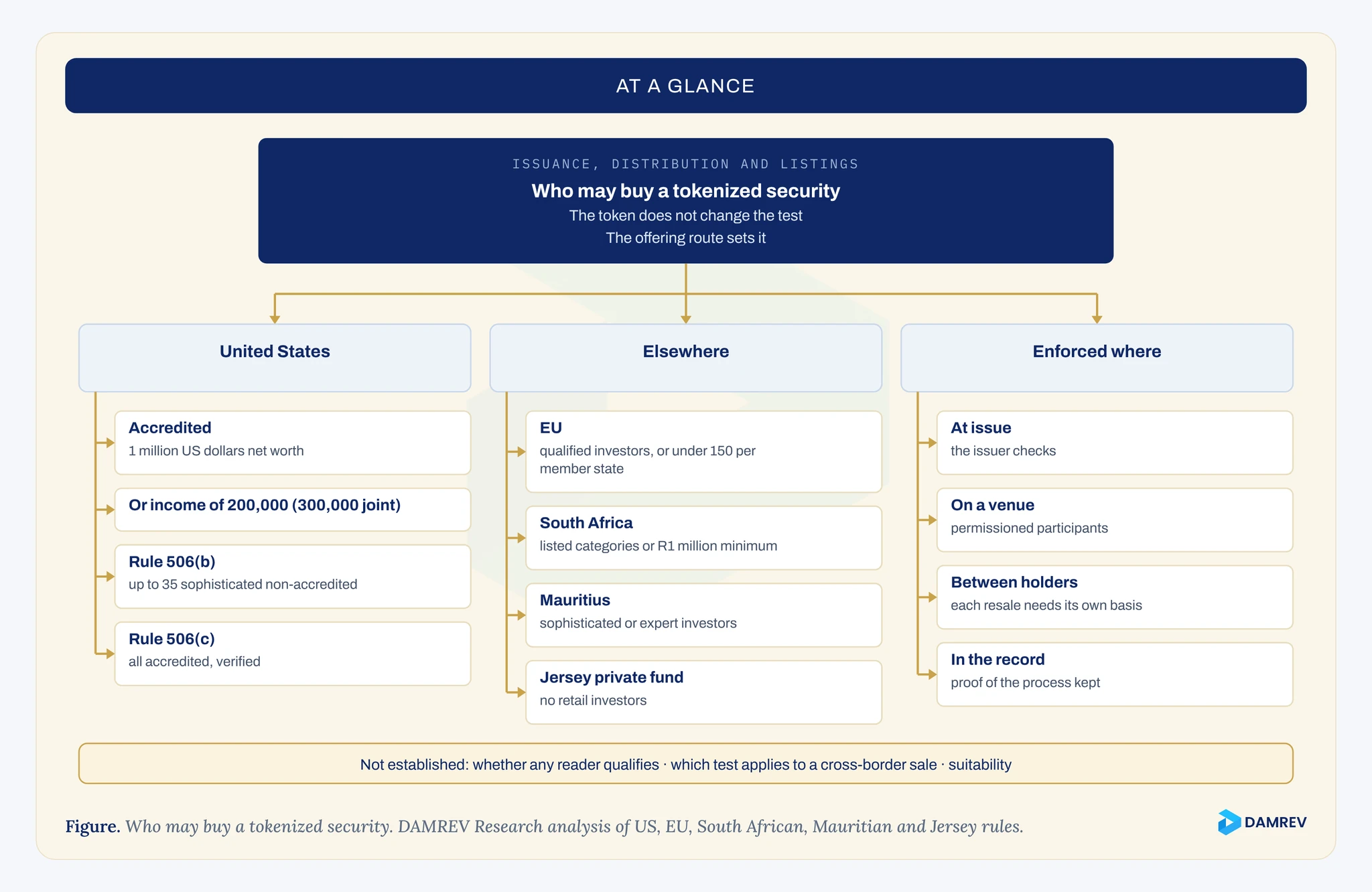
Tokenizing a security does not change who may buy it: the eligibility test comes from the exemption or prospectus route the issuer uses, in the place where the investor is1, 2.
In the United States that is usually the accredited investor test; in the European Union, the qualified investor test; in South Africa, Mauritius, and Jersey, their own professional or minimum-investment tests3, 5, 6, 7, 8.


In this article
01 · Where the test comes from
Where does the eligibility test for a tokenized security come from?
The eligibility test for a tokenized security comes from the offering route and the place of the offer. A security offered as a token uses the same registration, prospectus, or exemption routes as any other, and each route carries its own test of who may buy1, 2.
The US Securities and Exchange Commission (SEC) staff put the point directly: "regardless of its format, the Securities Act requires that every offer and sale of a security must be registered with the Commission unless an exemption from registration is available"1.
The European Union (EU) reaches the same place through its Prospectus Regulation, whose exemptions turn on who the offer is addressed to, not how the security is recorded2.
So the question of who may buy has two halves. The first is the route: a public offering with a registered prospectus is open to the public, while a private placement or exempt offer is open only to the investors its exemption names.
The second is geography. An investor's eligibility is tested under the rules of the place where that investor is offered the security, which may not be the issuer's home.
Tokens add one thing to this picture and remove nothing. They make it possible to check eligibility at the moment of every transfer, not only at issue. They do not make an ineligible buyer eligible.
02 · United States
Who may buy in a US private offering?
In a US private offering, mainly accredited investors may buy. One route is a US private offering that permits general solicitation when every buyer is verified as accredited; a route without general solicitation allows a limited number of non-accredited but sophisticated purchasers3.
The accredited investor definition in Rule 501(a) is a list of categories. It covers named institutions and entities, and natural persons who meet a wealth, income, or credential test3. A person is also treated as accredited if "the issuer reasonably believes" they come within a category at the time of sale3.
- US dollars of net worth, alone or with a spouse or spousal equivalent, for a natural person to be accredited3
- 1,000,000
- US dollars of individual or joint income in each of the two most recent years, with a reasonable expectation of the same3
- 200,000 · 300,000
- The most non-accredited purchasers a US private offering without general solicitation allows within the period the rule sets, each of whom must be sophisticated; their presence triggers disclosure duties3
- 35
A US private offering that permits general solicitation when every buyer is verified as accredited is where tokenized offerings meet verification. The issuer "shall take reasonable steps to verify" that every purchaser is accredited3.
In March 2025 the staff accepted that a high minimum investment, with written representations from the investor, can form part of those reasonable steps10. On 21 July 2026 the staff added that those representations may be given "programmatically through the tokenized security via a digital attestation", provided the issuer keeps sufficient records of the process4.
[W]hether an issuer has taken reasonable steps to verify that a purchaser is an accredited investor is an objective determination by the issuer (or those acting on its behalf), in the context of the particular facts and circumstances.4
03 · Elsewhere
Who may buy a tokenized security in the EU, South Africa, Mauritius, and Jersey?
The EU, South Africa, Mauritius, and Jersey each set their own test: the EU uses qualified investors; South Africa uses categories and a minimum acquisition cost; Mauritius uses sophisticated and expert investors; Jersey's private funds use professional and eligible investors2, 6, 7, 8.
| Jurisdiction | Main test | What it means | Source |
|---|---|---|---|
| European Union | Qualified investors | Defined in Article 2(e): the professional client categories of Annex II of Directive 2014/65/EU (MiFID II), clients treated as professional on request, and recognised eligible counterparties, unless they have agreed to be treated as non-professional; offers solely to them need no prospectus | 2, 5 |
| European Union | Size of offer | Fewer than 150 non-qualified persons per member state, or at least 100,000 euro per investor or per unit | 2 |
| South Africa | Not an offer to the public | Offers only to listed categories, such as persons whose ordinary business is dealing in securities, or where each addressee acting as principal pays at least the prescribed amount, set at 1 million South African rand | 6 |
| Mauritius | Preferential offer | A private placement, or an offer "made only to sophisticated investors"; an expert fund requires an initial investment of at least 100,000 US dollars | 7 |
| Jersey | Jersey Private Fund | Professional or eligible investors; "No retail investors are permitted to invest (directly or indirectly) in a JPF", save in two cases set out in Annex A of the guide | 8 |
The tests differ in what they measure. The EU and South African tests start from who the investor is in business terms; the Mauritian expert fund and the Jersey eligible investor tests use a minimum commitment, which in Jersey is "not less than two hundred and fifty thousand pounds sterling" or its equivalent2, 6, 7, 8.
An issuer offering in several places must meet each test for the investors in that place.
None of these rules mentions tokens as a reason to change the test. The Mauritian guidance applies the existing Securities Act offering routes to security tokens7. The South African provision is the Companies Act's ordinary definition of what is not an offer to the public6.
04 · At transfer
How is eligibility enforced when a token changes hands?
Eligibility is enforced by the issuer's or venue's controls when a token changes hands, not by the ledger alone. A token can carry a rule that only approved addresses may hold it, but the law still asks whether each buyer was eligible and whether the record proves it4, 9.
At issue
The issuer checks each buyer against the route's test and, in a US private offering that permits general solicitation when every buyer is verified as accredited, keeps records of the steps it took3, 4.
On a venue
Under the SEC's innovation exemption, only permissioned participants may trade, under standards the venue sets9.
Between holders
The staff describe a transfer of the token as "a securities transaction", so a resale needs its own basis under the rules that apply1.
In the record
Where eligibility is attested through the token, the staff expect the issuer to keep sufficient records of the process used via the token standard4.
The practical design follows from the law. A token that can move only between addresses the issuer or its agent has approved makes an ineligible transfer hard to complete. It does not prove that the approval was right. The SEC staff's July 2026 interpretation puts the weight on the records behind the attestation, not the attestation itself4.
The resale question deserves its own treatment, because restricted securities carry limits that survive any number of transfers. That is the subject of the article on transfer restrictions.

05 · What it does not establish
What do these tests not establish?
As of 7 October 2026, the eligibility tests read here do not establish whether any reader qualifies, which jurisdiction's test applies to a given sale, or what follows for tax. The tests also say nothing about whether a tokenized product is suitable for anyone3, 4.
| Question | What the sources say | Source |
|---|---|---|
| Whether a particular person qualifies | A matter of facts and, in the US, of the issuer's own objective determination | 3, 4 |
| Which test applies to a cross-border sale | Depends on where the investor is offered the security; treated in the cross-border article | 2, 6 |
| Suitability or appropriateness | A separate duty of the firm advising or selling, not part of the offering test | 5 |
| Tax and reporting | Outside this article; a reader should ask their own tax adviser | None |
| Whether a token changes the test | No source reviewed says it does | 1, 2, 7 |
The tests are gates, not judgements. Meeting a wealth or minimum-investment threshold allows a sale under an exemption; it does not mean the product is right for the buyer, and none of the rules above says so.
They also move. The accredited investor definition, the EU prospectus thresholds, and the South African prescribed amount are each set by rule or regulation, and each can change without the token changing2, 3, 6. This article states them as of 7 October 2026.
A tokenized issue built for accredited or professional investors stays with them unless it is registered or prospectus-approved for a wider public.
Common questions
What else do people ask?
Short answers to the questions people ask most about this topic.
Can a retail investor buy a tokenized security?
If the issuer uses a route open to retail investors, such as a registered or prospectus offering, yes. The token does not decide it; the offering route does1, 2.
Can an investor's eligibility be confirmed on-chain?
In the United States, the SEC staff accept that, in a US private offering that permits general solicitation when every buyer is verified as accredited, and where the minimum-investment method is used, investors may give their representations through the tokenized security by a digital attestation, provided the issuer keeps sufficient records4.
Does the investor test change for a tokenized fund?
Not because of the token. A fund's own regime sets its test: in Jersey, for example, a Jersey Private Fund is open only to professional or eligible investors, and retail investors may not invest directly or indirectly, save in two limited cases the guide sets out8.
Is the accredited investor test the same as the EU qualified investor test?
No. The US test turns largely on wealth, income, entity type, or certain credentials. The EU test is defined in the Prospectus Regulation, principally by reference to MiFID II's professional client categories and eligible counterparties2, 3, 5.
Does a token holder have to re-verify eligibility on each transfer?
Each transfer needs its own basis. The SEC staff describe a transfer of the token as "a securities transaction", so a resale needs its own basis under the rules that apply, and on a venue under the SEC's innovation exemption only permissioned participants may trade, under standards the venue sets1, 9.
Where should you go next?
The pages below pick up where this one ends. Start with the one closest to where your asset or programme stands today.
- Tokenized Stocks Are Not One Product: Issuer Shares, Security Entitlements, & Synthetic Exposure ComparedA tokenized stock can be the company's own share, a custodian's security entitlement, or synthetic exposure, each with a different issuer and rights.
- What an Exchange Asks for Before a Tokenized ListingAn exchange applies its ordinary listing rules, then asks whether the token is the same security, how it settles, and who keeps the register.
- Security Tokens in Mauritius: The Securities Act, Not the VAITOS ActIn Mauritius a security token is a security under the Securities Act 2005, and the virtual asset law of 2021 excludes it.
- Tokenized IPOWhat a tokenized initial public offering is, what stays the same as a conventional listing, and how DAMREV prepares and operates the instrument.
References
- 1.SEC Divisions of Corporation Finance, Investment Management, and Trading and Markets, "Statement on Tokenized Securities", 28 January 2026. https://www.sec.gov/newsroom/speeches-statements/corp-fin-statement-tokenized-securities-012826
- 2.Regulation (EU) 2017/1129 (Prospectus Regulation), Article 1(4) and Article 2(e), consolidated text. https://eur-lex.europa.eu/legal-content/EN/TXT/HTML/?uri=CELEX:02017R1129-20241204
- 3.17 CFR 230.501(a), definition of accredited investor, and 17 CFR 230.506. https://www.law.cornell.edu/cfr/text/17/230.501
- 4.SEC Division of Corporation Finance, Securities Act Rules Compliance and Disclosure Interpretation 260.40, 21 July 2026. https://www.sec.gov/rules-regulations/staff-guidance/corporation-finance-interpretations/securities-act-rules
- 5.Directive 2014/65/EU (MiFID II), Annex II, professional clients. https://eur-lex.europa.eu/legal-content/EN/TXT/HTML/?uri=CELEX:32014L0065
- 6.Companies Act 71 of 2008 (South Africa), section 96, read with regulation 45 of the Companies Regulations, 2011. https://www.acts.co.za/companies-act-2008/96_offers_that_are_not_offers_to_public
- 7.Financial Services Commission, Mauritius, Updated Guidance Notes on Security Token Offerings and Security Token Trading Systems, 15 March 2023. https://www.fscmauritius.org/media/137664/updated-guidance-notes-on-security-token-offerings-and-security-token-trading-systems-cc-150323.pdf
- 8.Jersey Financial Services Commission, Jersey Private Fund Guide, last revised 13 April 2026. https://www.jerseyfsc.org/industry/guidance-and-policy/jersey-private-fund-guide/
- 9.US Securities and Exchange Commission, Order Granting Exemptions for Tokenized Securities Venues, Exchange Act Release No. 34-106402, 17 September 2026. https://www.sec.gov/files/rules/exorders/2026/34-106402.pdf
- 10.SEC Division of Corporation Finance, no-action letter to Latham & Watkins LLP on accredited investor verification, 12 March 2025. https://www.sec.gov/rules-regulations/no-action-interpretive-exemptive-letters/division-corporation-finance-no-action/latham-watkins-503c-031225
This article is analysis of public sources, not legal advice. Last updated:




