


Article · Issuance, Distribution & Listings
What an Exchange Asks for Before a Tokenized Listing
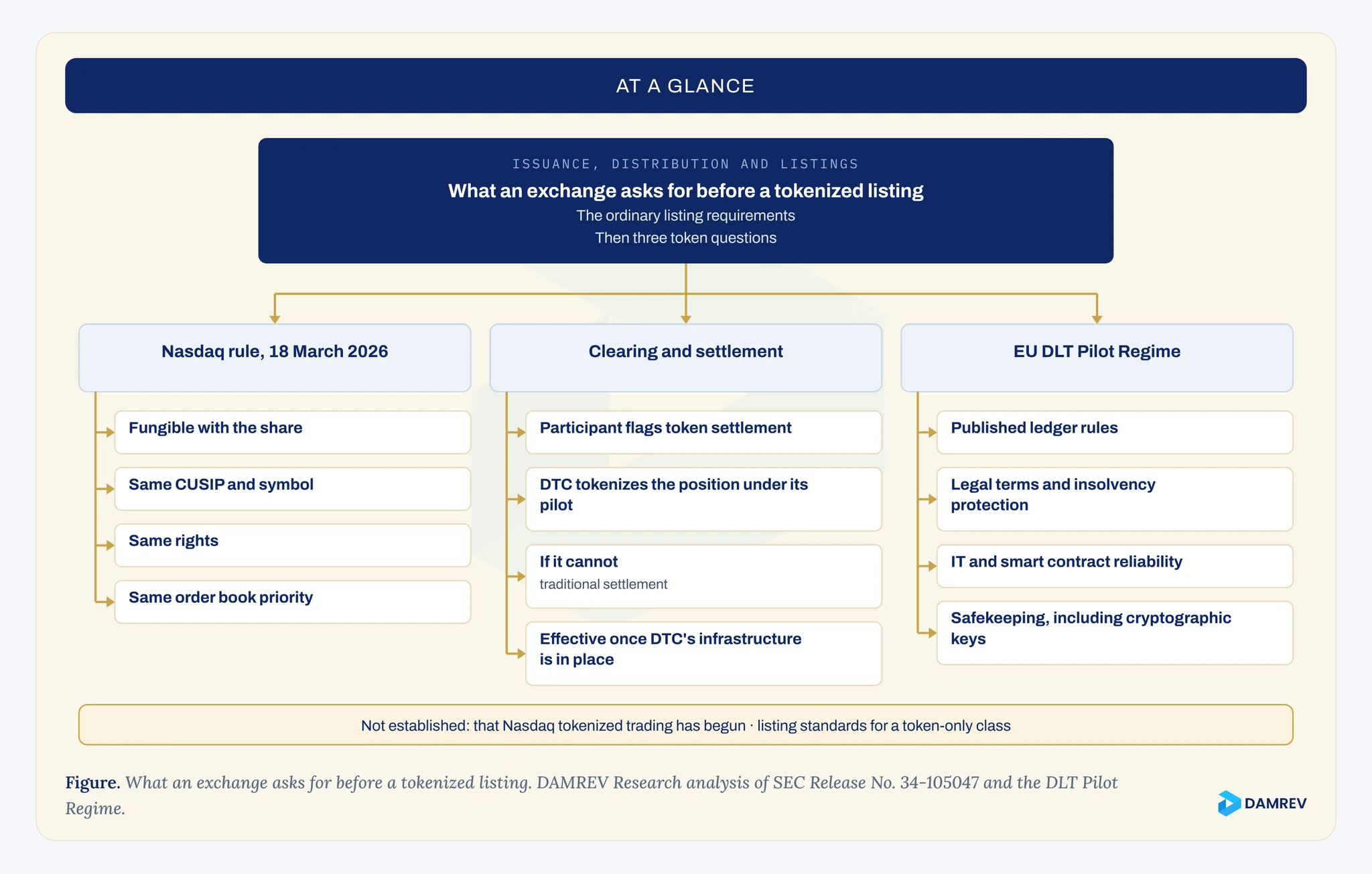
Tokenized listing requirements are the same listing requirements as for any share, and then three questions particular to the token: is it the same security as the conventional share, can it clear and settle through the market's infrastructure, and who keeps the register1, 2, 3.
Nasdaq's approved rule answers the first by requiring the token to be fungible with, and carry the same Committee on Uniform Securities Identification Procedures (CUSIP) number and rights as, the conventional share1.


In this article
01 · The ordinary rules
Does an exchange have separate rules for listing tokenized shares?
In the texts reviewed here, an exchange has no separate rules for listing tokenized shares: the issuer meets the exchange's ordinary listing requirements, and the exchange then sets conditions on the tokenized form. In the US approval of Nasdaq's rule, the eligibility test starts from an existing listing1.
The most useful primary text is the order of the US Securities and Exchange Commission (SEC) of 18 March 2026 approving Nasdaq's rule change to trade securities in tokenized form1. It does not create a listing route for tokens.
A security qualifies only if it is listed on the exchange or traded there under unlisted trading privileges, and is eligible for the tokenization pilot of The Depository Trust Company (DTC)1.
That design tells an issuer what to expect. The exchange does not ask whether a company may list because its shares are tokens. It asks whether a listed company's shares, already meeting every ordinary standard, may also trade and settle in token form. The listing comes first; the token is a form the listed security can take.
So the work an issuer does for an exchange is mostly the familiar work. Registration or a prospectus, financial statements, governance, free float, and the exchange's own standards still decide whether the company lists at all. The token questions sit on top of those.
02 · The same security
Does the token have to be the same security as the listed share?
Under the Nasdaq rule, the token must be the same security as the listed share: fungible with the conventional share, with the same CUSIP number and trading symbol, and with the same rights. The token then trades on the same order book1.
[A] share of a tokenized DTC Eligible Security would be tradable in the Nasdaq Market Center together with, on the same order book as, and with the same execution priority as, its traditional counterpart, but only if the tokenized security is fungible with, shares the same CUSIP number with and trading symbol, and affords its shareholders the same rights and privileges as does a share of an equivalent class of the traditional security.1
The condition does a great deal of work. Because the token and the share are the same security, there is one price, one order book, and one market. As the order records Nasdaq's description, market data feeds "would not differentiate between tokenized and traditional shares"1. A separate tokenized class, or a third party's token, falls outside the rule.
Fungible
The token and the conventional share are interchangeable units of one security1.
One identifier
The same CUSIP number and trading symbol, so the market treats them as one line1.
Same rights
The token must afford "the same rights and privileges" as a share of an equivalent class1.
Same priority
Orders in either form rank together, with the same execution priority1.
This matches the SEC staff's distinction between issuer-sponsored and third-party tokens. The staff say a tokenized security of "substantially similar character" with substantially similar rights may be treated as the same class for certain purposes2. The exchange rule goes further and requires full fungibility before the token may share the book1.
03 · Settlement and the register
How must a tokenized share clear, settle, and be recorded?
A tokenized share clears and settles through the market's existing infrastructure. In the Nasdaq rule, a participant flags its wish to settle in token form and DTC tokenizes the position under its own pilot; if it cannot, the trade settles in traditional form1, 5.
| Party | What the rule or order requires | Source |
|---|---|---|
| The security | Listed on Nasdaq or traded under unlisted trading privileges, and eligible for DTC's tokenization pilot | 1 |
| The trading participant | Selects a tokenization flag on the order, with any information DTC requires, such as a blockchain and a registered wallet address | 1 |
| Nasdaq | Passes the preference to DTC after the trade; does not check eligibility at order entry | 1 |
| DTC | Carries out the preference where it can under its rules and the no-action letter; otherwise settles in traditional form | 1, 5 |
| Timing | The rule takes effect once DTC's infrastructure and post-trade services are in place, with notice to members | 1 |
The fallback is the detail that matters for an issuer. A buyer may ask for a token and receive a conventional position, if it is not an eligible participant, the security is not eligible, or the chosen chain or wallet is not compatible with DTC's pilot1. The token is an option on settlement, not a promise.
The register question runs alongside. The staff describe the issuer, "or its agent", keeping the master securityholder file, on-chain, off-chain, or both2.
For a listed US company that agent is in practice a transfer agent, and in its proposal of September 2026 to modernise the transfer agent rules, the SEC asks for comment on whether the rules should let a transfer agent associate a wallet address and quantity held with off-chain records4. That is a proposal, not a rule.
04 · A DLT venue
What does a DLT venue in Europe ask for?
Under the European pilot regime for distributed ledger technology (DLT) market infrastructures, the DLT Pilot Regime, shares of smaller issuers may be admitted directly, and the venue operator must publish its ledger rules, legal terms, and safeguarding arrangements, including for cryptographic keys3.
The European route reverses the American design. A DLT market infrastructure may admit shares that exist only on the ledger, if the issuer's market capitalisation, or tentative market capitalisation, is below 500 million euro, and within the venue's aggregate cap of 6 billion euro3.
| Requirement | What it covers | Source |
|---|---|---|
| Business plan and legal terms | Rights and liabilities of each party, governing law, dispute resolution, insolvency protection, and forum | 3 |
| Ledger rules | "Rules on the functioning of the distributed ledger technology they use", including access, validating nodes, conflicts, and risk | 3 |
| Public disclosure | How its operations differ from a venue or settlement system that does not use the technology, and which type it uses | 3 |
| Information technology (IT) and cyber | Arrangements proportionate to the business, including the reliability of smart contracts; an audit may be required | 3 |
| Safekeeping | Segregation of client assets, and protection of "the means of access to such assets, including in the form of cryptographic keys" | 3 |
For an issuer, these are the venue's obligations, not its own. They matter because they are what an issuer should read before choosing such a venue: the legal terms decide what happens to holders if the venue fails.

05 · What it does not establish
What does this not establish?
As of 7 October 2026, the Nasdaq approval order and the DLT Pilot Regime read here do not establish that any exchange is trading tokenized shares today or set listing standards for a token-only class. South African venues are treated in their own article1, 3.
| Question | Position | Source |
|---|---|---|
| Whether Nasdaq trading in tokenized form has begun | The rule takes effect once DTC's infrastructure is in place; we have not confirmed from a primary source that it has | 1 |
| A separate tokenized class on a US exchange | Not covered by the Nasdaq rule, which requires fungibility with the traditional security | 1 |
| Third-party tokens | Outside the rule; covered for venues by the SEC's innovation exemption, not by exchange listing | 1 |
| Transfer agent rules for on-chain records | Proposed, not adopted; comments are due by 3 November 2026 | 4 |
| South Africa | The Johannesburg Stock Exchange (JSE) Main Board, AltX, and the Cape Town Stock Exchange (CTSE) are treated in their own article | None |
The pattern across both systems is the same. The token earns its place by fitting the market's existing guarantees: one security, one register that someone is accountable for, and settlement that a recognised infrastructure completes. Where the token cannot fit, the American rule falls back to the conventional form, and the European regime admits only issuers within its limits1, 3.
The exchange's questions in both systems are about the register, the agent, and settlement, and only then about the ledger.
Common questions
What else do people ask?
Short answers to the questions people ask most about this topic.
Are there separate listing standards for tokenized shares on Nasdaq?
The approval order describes none. A security must be listed on the exchange, or traded under unlisted trading privileges, and be eligible for DTC's tokenization pilot1.
What happens if a buyer asks for a token but DTC cannot deliver one?
Under the approved rule, DTC settles the executed order in traditional, non-tokenized form1.
Can a company list a separate tokenized class of shares under the Nasdaq rule?
Not under that rule. It covers tokens that are fungible with, and share the CUSIP number of, an equivalent class of the traditional security1.
Does a DLT venue in Europe hold the keys to investors' tokens?
It may. Where it holds clients' funds, collateral, or DLT financial instruments, the DLT Pilot Regime requires it to safeguard them and "the means of access to such assets, including in the form of cryptographic keys"3.
Where should you go next?
The pages below pick up where this one ends. Start with the one closest to where your asset or programme stands today.
- Tokenized Stocks Are Not One Product: Issuer Shares, Security Entitlements, & Synthetic Exposure ComparedA tokenized stock can be the company's own share, a custodian's security entitlement, or synthetic exposure, each with a different issuer and rights.
- Tokenized Securities Investor Eligibility: Who May Buy in the US, the EU, South Africa, Mauritius, & JerseyTokenizing a security does not change who may buy it. The test comes from the issuer's offering route, in the place where the investor is.
- Secondary Liquidity: What a Listing Does & Does Not PromiseA listing promises a venue and its rules, not a buyer or a price. Securities issued natively on a ledger have shown low secondary liquidity.
- Tokenized IPOWhat a tokenized initial public offering is, what stays the same as a conventional listing, and how DAMREV prepares and operates the instrument.
References
- 1.US Securities and Exchange Commission, Order Approving a Proposed Rule Change, as Modified by Amendment No. 2, to Enable the Trading of Securities on the Exchange in Tokenized Form, Release No. 34-105047, File No. SR-NASDAQ-2025-072, 18 March 2026. https://www.sec.gov/files/rules/sro/nasdaq/2026/34-105047.pdf
- 2.SEC Divisions of Corporation Finance, Investment Management, and Trading and Markets, "Statement on Tokenized Securities", 28 January 2026. https://www.sec.gov/newsroom/speeches-statements/corp-fin-statement-tokenized-securities-012826
- 3.Regulation (EU) 2022/858 on a pilot regime for market infrastructures based on distributed ledger technology, Articles 3 and 7. https://eur-lex.europa.eu/legal-content/EN/TXT/HTML/?uri=CELEX:32022R0858
- 4.US Securities and Exchange Commission, Transfer Agent Rules, proposed rule, Release No. 34-106246, File No. S7-2026-30, 1 September 2026. https://www.sec.gov/rules-regulations/2026/09/s7-2026-30
- 5.SEC Division of Trading and Markets, no-action letter to The Depository Trust Company, 11 December 2025. https://www.sec.gov/files/tm/no-action/dtc-nal-121125.pdf
This article is analysis of public sources, not legal advice. Last updated:




