


Article · Law, Regulation & Policy
The UAE's Three Layers: Federal Rules, VARA, & ADGM
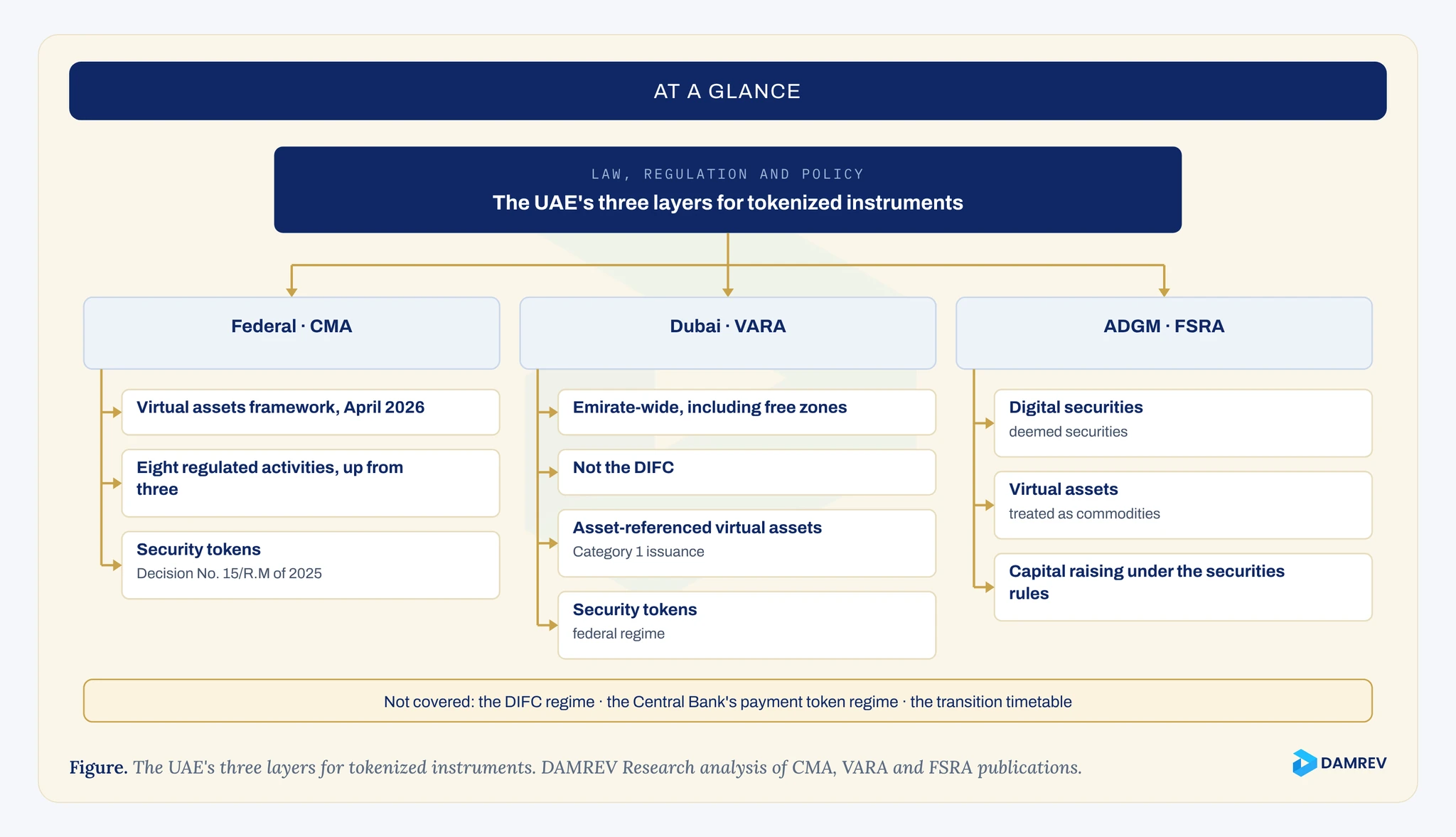
UAE virtual asset regulation depends on where the business operates and what the token is. Onshore, the federal Capital Markets Authority regulates virtual asset activities, which its April 2026 framework expanded from three to eight1, 2.
Dubai's Virtual Assets Regulatory Authority (VARA) regulates virtual assets across the emirate, including its free zones but not the Dubai International Financial Centre (DIFC)5. In Abu Dhabi Global Market, the Financial Services Regulatory Authority (FSRA) treats a token with the features of a security as a security7.


01 · The map
Which UAE regulator reaches a tokenized instrument?
Which UAE regulator reaches a tokenized instrument depends on two things: where the business operates, and whether the token is a security. Onshore and federal, Dubai mainland, and Abu Dhabi Global Market each have their own regime, and security tokens are kept apart in each1, 4, 5, 7.
The United Arab Emirates regulates virtual assets in layers. A federal regime covers the country onshore. Dubai has its own regulator for virtual assets, the Virtual Assets Regulatory Authority (VARA). And the two financial free zones, Abu Dhabi Global Market (ADGM) and the Dubai International Financial Centre, have their own regulators and rulebooks2, 7.
This article covers the first three; the Dubai International Financial Centre is a fourth regime and is outside its scope.
| Layer | Regulator | Virtual assets | Security tokens | Source |
|---|---|---|---|---|
| Federal, onshore | Capital Markets Authority | Virtual assets framework of April 2026, eight regulated activities | Decision No. 15/R.M of 2025 on security tokens and commodity token contracts | 1, 2, 4 |
| Dubai, including its free zones, except the DIFC | VARA | VARA regulations and rulebooks, including asset-referenced virtual assets | Not VARA's; treated as securities under the federal regime | 5, 6 |
| Abu Dhabi Global Market | Financial Services Regulatory Authority | A separate framework, treating virtual assets as commodities | Digital securities, deemed securities under the Financial Services and Markets Regulations (FSMR) | 7 |
The first question for any programme is therefore not the technology but the instrument. A tokenized share, bond, sukuk, or fund unit follows securities law in each layer. A token that references an asset without being a security can fall into a virtual asset regime instead, and which one depends on the business's location4, 6, 7.
02 · The federal layer
What moved at federal level in April 2026?
The UAE's federal regime was replaced. The Capital Markets Authority issued a new virtual assets framework, announced on 13 April 2026, with five modules and eight regulated activities in place of the previous three1, 9.
According to one law firm's summary, the Capital Markets Authority (CMA) took over the federal securities regulator's functions under Federal Decree-Law No. 33 of 2025, and its Decision No. 4/R.M of 2026 sets the framework it announced on 13 April 20262, 9.
One law firm's summary is direct: the decision "does not amend the previous SCA regime, it replaces it in full"2. The CMA's chief executive, Waleed Al Awadhi, said regulation "must evolve at the same pace" as the markets it governs9. The five modules cover general requirements, conduct of business, alternative trading systems, anti-money laundering, and prudential standards9.
Dealing
Dealing in virtual assets as principal, and dealing as agent, licensed as two separate activities1.
Custody
Providing custody, and arranging custody, again as two activities1.
Markets
Operating a multilateral trading facility, under a dedicated module for alternative trading systems1.
Advice and management
Providing investment advice, managing portfolios, and arranging investment deals1.
The alternative trading system module matters most for tokenized securities. It regulates trading venues for "virtual assets and tokenised securities", which brings the two kinds of instrument under one set of venue rules while keeping their classification apart3.
Security tokens themselves were already covered. As summarised by one law firm, the federal regulator's Decision No. 15/R.M of 2025 sets the rules for security tokens and commodity token contracts onshore, applying the same requirements as for traditional instruments and requiring trading and settlement on licensed markets or facilities4.
03 · Dubai and VARA
How does Dubai's VARA fit?
VARA regulates virtual asset activity across Dubai, including its free zones but not the DIFC. That covers tokens that reference real-world assets, but not tokens that are securities, which follow the federal regime5, 6.
The federal framework does not apply in the financial free zones, ADGM and the DIFC, and law firms read it as leaving Dubai virtual asset businesses to VARA2. Dubai's Law No. 4 of 2022, which established VARA, applies throughout the emirate, including its special development zones and free zones, but not the DIFC10.
Within its perimeter VARA runs its own rulebooks. Its Virtual Asset Issuance Rulebook, effective 19 June 2025, sets the rules for issuing virtual assets in or from Dubai, with separate annexes for fiat-referenced and asset-referenced virtual assets5.
The asset-referenced category is where Dubai most often meets real-world asset tokenization. A token on a property, a commodity, or a revenue stream that is not a security can be an asset-referenced virtual asset under VARA.
Once the token carries the rights of a share, a bond, a sukuk, or a fund unit, it is a security, and the federal security token rules apply instead4, 6.
The boundary is drawn by the instrument's rights, not its label. An issuer that calls a fractional property interest a utility token does not move it out of securities law if its rights are those of a fund unit.
04 · ADGM
How does ADGM treat a tokenized security?
ADGM treats a tokenized security as a security: the FSRA deems a token with the features of a security to be a "Digital Security" and regulates it, and every activity around it, under its Financial Services and Markets Regulations7.
If a digital/virtual token being offered is assessed to exhibit the (economic and legal) features and characteristics of a Security, the FSRA will deem the digital/virtual token (being a 'Digital Security') as a Security pursuant to Section 58(2)(b) of FSMR.7
The FSRA describes its approach as technology-neutral7. A digital security is offered, traded, cleared, and held under the rules that apply to any security in ADGM. Virtual assets that are not securities sit in a separate framework, where the FSRA treats them as commodities7.
The guidance lists the activities that need a licence or recognition: operating a recognised investment exchange or a multilateral trading facility, acting as a recognised clearing house, providing custody, including through a digital settlement facility, and intermediary activities such as dealing, advising, and managing7.
| Question | Digital securities | Virtual assets | Source |
|---|---|---|---|
| Legal character | Deemed securities under the FSMR | Treated as commodities, not specified investments | 7 |
| Scope of regulation | All financial services activities in relation to them | Activities in accepted virtual assets only | 7 |
| Capital raising | Permitted under the securities rules | Not provided for under the market rules | 7 |
For a structured finance programme, ADGM's split is the cleanest of the three. The question is answered once, at the start: is this token a security? If it is, the full securities rulebook applies, including the market infrastructure licences that let a venue admit and settle it7.

05 · What it does not establish
What does the three-layer map not establish?
As of 7 October 2026, the three-layer map read here does not cover the Dubai International Financial Centre or the Central Bank's payment token regime. Nor does it settle the transition to the April 2026 federal framework, or classify every hybrid token2, 8.
The fourth regime
The Dubai International Financial Centre has its own regulator and rules, which this article does not cover.
Payment tokens
Dirham payment tokens fall under the Central Bank's Payment Token Services Regulation, a separate regime8.
Transition
Commentators refer to transitional arrangements for the April 2026 framework without stating a timetable we could verify2.
Hybrid tokens
A token with some features of a security and some of an asset-referenced virtual asset needs classification case by case, and no regulator publishes a single test for every case.
The primary texts are also uneven in what is public. The CMA's announcement and VARA's rulebooks are published in full, but several operative decisions are most easily read through law firm summaries, and this article cites those where the text itself was not available to us1, 2, 4, 6.
What the map establishes is the order of questions. Where does the business operate? Is the token a security? Only then does the choice between federal, VARA, and ADGM rules become clear.
Common questions
What else do people ask?
Short answers to the questions people ask most about this topic.
What changed in UAE virtual asset regulation in April 2026?
The Capital Markets Authority issued a new virtual assets framework, announced on 13 April 2026, with five modules and eight regulated activities in place of three. It replaced the previous federal regime in full1, 2.
Does VARA regulate tokenized securities?
VARA regulates virtual assets in Dubai, including asset-referenced virtual assets. A token that carries the rights of a share, a bond, a sukuk, or a fund unit is a security token under the federal regime, as commentators read the allocation4, 6.
Are digital securities in ADGM treated differently from ordinary securities?
No. The FSRA deems a token with the features of a security to be a security under the Financial Services and Markets Regulations, and regulates the activities around it as it would for any security7.
Who regulates dirham payment tokens?
The Central Bank of the UAE, under its Payment Token Services Regulation. That regime is outside the scope of this article8.
Where should you go next?
The pages below pick up where this one ends. Start with the one closest to where your asset or programme stands today.
- Does Tokenizing a Security Change Whether It Is a Security?In the United States, the European Union, Guernsey, and Jersey, tokenizing a security does not change whether it is one, only which one is held.
- Security Tokens in Mauritius: The Securities Act, Not the VAITOS ActIn Mauritius a security token is a security under the Securities Act 2005, and the virtual asset law of 2021 excludes it.
- Screening & OnboardingHow investors are verified by a licensed provider before holding anything and checked again at every transfer, with anti-money laundering, sanctions, and travel-rule obligations met.
- JurisdictionsThe rules for tokenized finance in the twelve jurisdictions where the group works, mapped to where each group entity sits, claiming no permission.
References
- 1.Capital Market Authority, United Arab Emirates, "The CMA Issues the Virtual Assets Framework", press release, 13 April 2026, as distributed by Zawya. https://www.zawya.com/en/press-release/companies-news/the-cma-issues-the-virtual-assets-framework-jv85egoi
- 2.Clyde & Co, "The UAE Capital Markets Authority replaces the federal VASP framework", April 2026. https://www.clydeco.com/en/insights/2026/april/the-uae-capital-markets-authority-replaces-the-fed
- 3.Lexis Middle East, "UAE: CMA issues comprehensive virtual-assets regulatory framework", 17 April 2026. https://www.lexis.ae/2026/04/17/uae-cma-issues-comprehensive-virtual-assets-regulatory-framework/
- 4.Securities and Commodities Authority, Decision No. 15/R.M of 2025 concerning the regulation of security tokens and commodity token contracts, as summarised by Hadef & Partners. https://hadefpartners.com/news-insights/insights/sca-resolution-no-15-chairman-of-2025-concerning-the-regulation-as-to-security-tokens-and-commodity-token-contracts/
- 5.Virtual Assets Regulatory Authority, Dubai, Virtual Asset Issuance Rulebook, version V.20250519, effective 19 June 2025. https://rulebooks.vara.ae/rulebook/virtual-asset-issuance-rulebook
- 6.Kayrouz & Associates, "Asset-referenced virtual assets: VARA issuance requirements in Dubai", 2026. https://www.kayrouzandassociates.com/insights/vara-arva-issuance-requirements-dubai-2026
- 7.Financial Services Regulatory Authority, Abu Dhabi Global Market, Guidance on Regulation of Digital Securities Activities in ADGM, VER02.240220, 24 February 2020. https://assets.adgm.com/download/assets/guidance-on-regulation-of-digital-securities-activities-in-adgm.pdf/f57b23cc3a0a11ef857b6e984d6ae48f?la=en&hash=EDCDD88518578D9E914BC2A27879755F
- 8.Central Bank of the UAE, Payment Token Services Regulation, CBUAE Rulebook. https://rulebook.centralbank.ae/node/5732
- 9.The National, "UAE's CMA issues new framework to regulate virtual assets activities", 13 April 2026. https://www.thenationalnews.com/business/markets/2026/04/13/uaes-cma-issues-new-framework-to-regulate-virtual-assets-activities/
- 10.UAE Government portal, "Regulation of digital properties", on Dubai Law No. 4 of 2022 concerning the regulation of virtual assets in the emirate of Dubai. https://u.ae/en/about-the-uae/digital-uae/regulatory-framework/regulation-of-digital-properties
This article is analysis of public sources, not legal advice. Last updated:




