


Article · Issuance, Distribution & Listings
Listing in South Africa: The JSE Main Board, AltX, & the CTSE
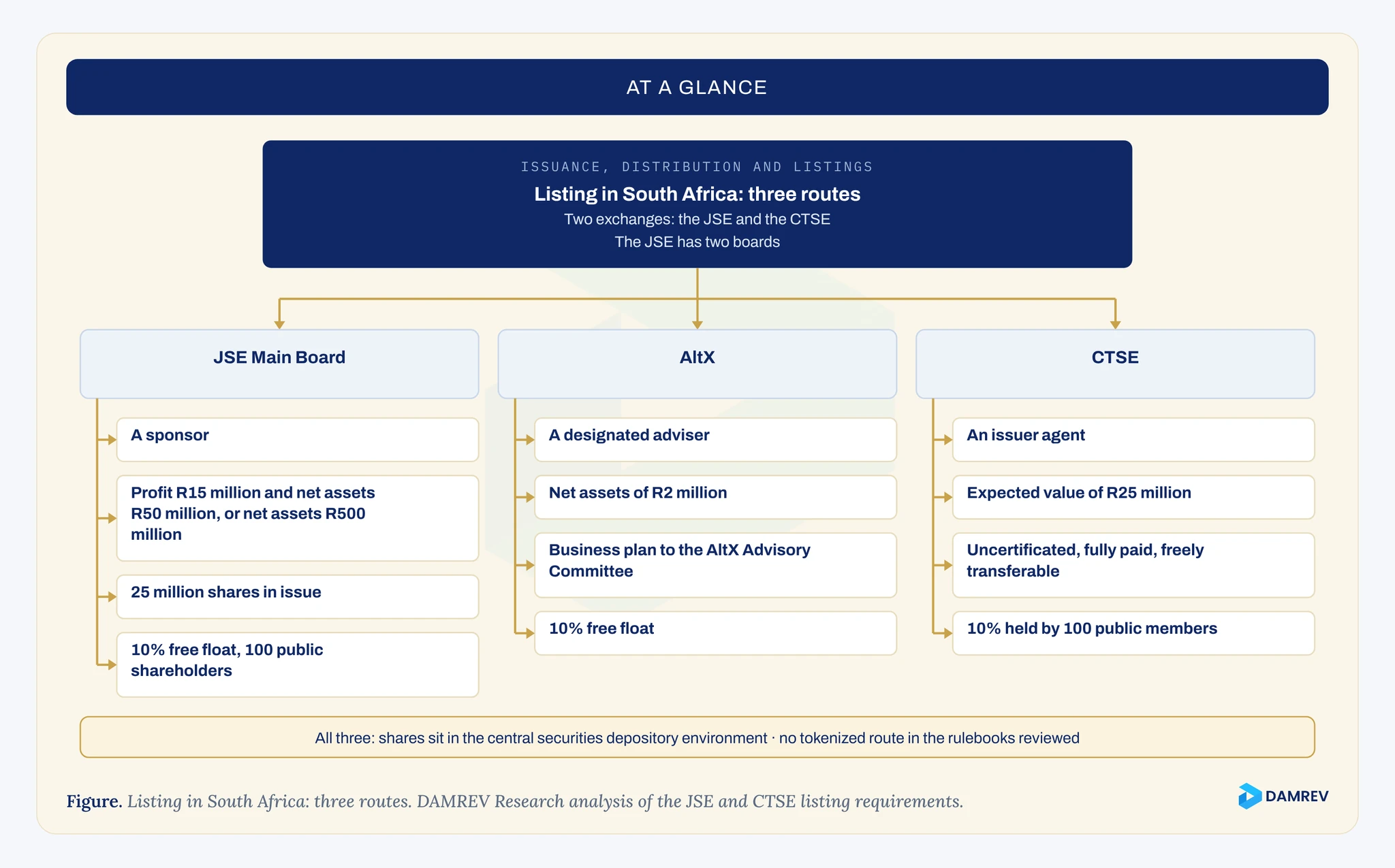
South Africa has two equity exchanges an issuer is most likely to consider, the Johannesburg Stock Exchange (JSE) and the Cape Town Stock Exchange (CTSE), and the JSE has two boards: the Main Board and AltX1, 3. Each sets its own size, track record, and free float tests.
All three require listed shares to sit in the uncertificated, central securities depository environment, which is the first thing a tokenized share would have to fit1, 3.


In this article
01 · Three routes
Where can a company list its shares in South Africa?
A company can list its shares in South Africa on the JSE, on its Main Board or on AltX, or on the Cape Town Stock Exchange. AltX is a board of the JSE, not a third exchange, so the choice is between two exchanges and, at the JSE, two boards1, 3.
The distinction is worth making because it is often blurred. The JSE's own Listings Requirements set out the Main Board criteria in paragraph 2.4 and the AltX criteria in paragraph 2.6 of the same rulebook1.
AltX is, in the JSE's words, a parallel market for small and medium-sized companies4. The CTSE is a separate exchange with its own Listing Requirements3.
| Route | Operator | Adviser the issuer appoints | Main size test | Free float | Source |
|---|---|---|---|---|---|
| JSE Main Board | JSE Limited | A sponsor | Audited profit before tax, taking account of the headline earnings adjustment, of at least R15 million in the latest year with net assets of at least R50 million, or net assets of at least R500 million | 10% of each class held by the public, and at least 100 public shareholders | 1 |
| AltX | JSE Limited | A designated adviser | Net assets of at least R2 million | 10% of each class held by the public | 1 |
| CTSE | Cape Town Stock Exchange | An issuer agent | Expected market value of at least R25 million for the securities to be listed, with discretion to admit less | At least 10% of the class held by at least 100 members of the public | 3 |
The rand figures are thresholds, not costs. They decide whether a company may apply, not what a listing would take to achieve.
The JSE's rulebook changed in January 2026. The JSE says its simplified Listings Requirements came into force for new applicants on 13 January 2026 and for existing issuers on 16 February 20262. Older guides to listing on the JSE may describe criteria that no longer apply.
02 · The JSE Main Board
What does the JSE Main Board ask of an applicant?
The JSE Main Board asks an applicant for a sponsor, an audited financial history, a profit and net asset test or a larger net asset test, control of its main assets, at least 25 million issued equity shares, and a public free float1.
Paragraph 2.4 of the simplified requirements sets the Main Board tests1. An applicant must have three years of audited financial statements, subject to exemptions.
It must then pass one of two size tests: audited profit of at least R15 million "before tax taking account of the headline earnings adjustment on a pre-tax basis" in the most recent financial year, with net assets of at least R50 million, or net assets of at least R500 million on their own1.
A sponsor
Every applicant for a JSE listing must appoint a sponsor1.
Control of its assets
Control, or a reasonable spread of direct interests, in the majority of its assets, with control of the majority of its assets for 12 months1.
Shares in issue
A minimum of 25 million issued equity shares1.
Free float
Ten percent of each class of equity securities held by public shareholders, representing at least 100 shareholders1.
Since September 2024 the Main Board has also been split into two segments, and the JSE reports that 31 Main Board companies have moved to its General Segment, which carries lighter continuing obligations for eligible issuers outside the FTSE/JSE All Share Index2. That affects life after listing more than entry.
03 · AltX
What does AltX ask of an applicant?
AltX asks less in size and more in advice: it requires net assets of at least R2 million and a public free float, but the applicant must appoint a designated adviser and present a business plan to the AltX Advisory Committee1, 4.
Paragraph 2.6 lowers the entry tests. An AltX applicant needs audited financial statements for the preceding financial year, or a profit forecast; net assets of at least R2 million; control or a reasonable spread of interests in the majority of its assets; and a free float of ten percent of each class in public hands1.
Paragraph 2.7 adds the step that most distinguishes the board: the directors and the designated adviser "must present a business plan to the ALT X Advisory Committee prior to being granted a listing"1.
The JSE also requires the executive and non-executive directors of AltX companies to attend a directors' induction programme4. The board trades a lower size threshold for more guidance and scrutiny of the business itself.
04 · The CTSE
What does the CTSE ask of an applicant?
The CTSE asks an applicant for an issuer agent, a contract with the registry, and securities that are uncertificated, freely transferable unless a restriction is approved, fully paid, worth at least R25 million, and at least ten percent in public hands3.
The CTSE's requirements set conditions on the securities themselves. To be listed, securities must "be uncertificated", conform to the law of the applicant's place of incorporation, and rank equally with other securities of the same class3.
They must be freely transferable, unless the CTSE and the registry approve a restriction that applies equally to the whole class and is "objectively determinable without ambiguity"3.
| Condition | What the requirement says | Source |
|---|---|---|
| Form | Securities must be uncertificated | 3 |
| Transferability | Freely transferable, unless the CTSE and the registry approve an objective restriction applying to the whole class | 3 |
| Payment | Fully paid up before admission, unless statute requires otherwise | 3 |
| Size | Expected aggregate market value of at least R25 million, unless the CTSE is satisfied there will be an adequate market | 3 |
| Whole class | An application must cover all securities of the class issued or to be issued | 3 |
The transferability condition is the one a tokenized issuer would meet first. A token that enforces eligibility at transfer is a restriction, and the CTSE's text requires such a restriction to be approved and to be objective3.
05 · The register
What do the exchanges ask about the register?
Both exchanges require listed shares to sit in the dematerialised, central securities depository environment. The JSE requires approval by the depository and compliance with its rules; the CTSE requires uncertificated securities and refers to Strate as the licensed depository1, 3.
The JSE's paragraph 2.47 states the register requirement plainly. Every applicant must maintain a transfer secretary in the certificated environment and, in the dematerialised environment, must:
with respect to the dematerialised environment, be approved by the central securities depositary and comply with the central securities depository rules.1
The CTSE defines Strate as the company "licensed as a central securities depository under the FMA", the Financial Markets Act3. Neither rulebook mentions a distributed ledger, a token, or a blockchain1, 3.
That silence is the main finding for a tokenized issuer. A South African listing today assumes a register kept through the central securities depository. A tokenized share would have to work inside that structure, or a rule change would be needed to admit another one.
The JSE also requires approval from the Financial Surveillance Department of the South African Reserve Bank where required1.

06 · What it does not establish
What does this not establish?
As of 7 October 2026, the JSE and CTSE rulebooks read here do not establish whether any company qualifies, how a tokenized register would be approved, or whether the CTSE has a later version of its requirements than the one it publishes. This article compares entry tests only1, 3.
| Question | Position | Source |
|---|---|---|
| Whether an issuer qualifies | Depends on its facts and the exchange's own assessment | 1, 3 |
| A tokenized route to listing | None found in the rulebooks reviewed | 1, 3 |
| The offer of shares before listing | Governed by the Companies Act; section 96 sets what is not an offer to the public | 5 |
| The CTSE's current rulebook | The version reviewed is version 02, effective 2 October 2017, as published on its website | 3 |
| Continuing obligations, costs, and process | Outside this article | None |
The comparison here is of entry tests, and entry tests are the easy part. What separates the routes in practice is the continuing obligations, the adviser's role, and the market each board reaches.
For a tokenized issuer the order of questions is fixed. Can the company meet a board's entry tests? Can its shares fit the depository's rules? Only then does the ledger come in.
Common questions
What else do people ask?
Short answers to the questions people ask most about this topic.
Is AltX a separate exchange?
No. AltX is a board of the JSE, with its own entry criteria in the JSE Listings Requirements and a designated adviser in place of a sponsor1, 4.
Which JSE rules apply to a new applicant now?
The simplified Listings Requirements, which the JSE says came into force for new applicants on 13 January 2026 and for existing issuers on 16 February 20262.
Can a tokenized share be listed on a South African exchange?
No rulebook reviewed here provides a tokenized route. Each requires listed shares to be uncertificated and handled in the central securities depository environment, so a tokenized share would have to fit that structure1, 3.
Does a listing need South African Reserve Bank approval?
The JSE requires applicants to obtain approval from the Financial Surveillance Department of the South African Reserve Bank where required1.
Where should you go next?
The pages below pick up where this one ends. Start with the one closest to where your asset or programme stands today.
- What an Exchange Asks for Before a Tokenized ListingAn exchange applies its ordinary listing rules, then asks whether the token is the same security, how it settles, and who keeps the register.
- South Africa's Draft Crypto Exchange Control Regime, Read as a WholeSouth Africa proposes to bring cross-border crypto asset transactions into exchange control through two drafts of April and August 2026. Neither is in force.
- Tokenized Securities Investor Eligibility: Who May Buy in the US, the EU, South Africa, Mauritius, & JerseyTokenizing a security does not change who may buy it. The test comes from the issuer's offering route, in the place where the investor is.
- Tokenized IPOWhat a tokenized initial public offering is, what stays the same as a conventional listing, and how DAMREV prepares and operates the instrument.
References
- 1.JSE Limited, JSE Listings Requirements (simplified), 12 December 2025, Section 2. https://www.jse.co.za/sites/default/files/media/documents/jse-listings-requirements-simplified/JSE_Listings_Requirements_Simplified_Final_@_12_December_2025_Final.pdf
- 2.JSE Limited, "FSCA greenlights JSE Simplification Project", 20 January 2026. https://www.jse.co.za/news/news/fsca-greenlights-jse-simplification-project
- 3.Cape Town Stock Exchange, CTSE Listing Requirements, version 02, effective 2 October 2017, as published on its website and read on 7 October 2026. https://www.ctexchange.co.za/resources/equity/CTSE_Listing_Requirements.pdf
- 4.JSE Limited, "AltX", read 7 October 2026. https://www.jse.co.za/raise-capital/equities-market/altx
- 5.Companies Act 71 of 2008 (South Africa), section 96, read with regulation 45 of the Companies Regulations, 2011. https://www.acts.co.za/companies-act-2008/96_offers_that_are_not_offers_to_public
This article is analysis of public sources, not legal advice. Last updated: