


Article · Structures, Title & Asset Classes
Perfecting a Security Interest in Digital Assets: Pledging a Tokenized Asset
Perfecting a security interest in digital assets such as tokens follows the rules for whatever the token legally is, not a rule for tokens as such1, 2, 3.
Under the US Uniform Commercial Code, a tokenized security is investment property perfected by control or filing, and a token that qualifies as a controllable electronic record can be perfected by control, which gives priority over a lender that only filed2, 4, 5.


01 · The answer
How is a security interest in a tokenized asset perfected?
Perfecting a security interest in a token follows the rules for whatever the token legally is. In the United States, a tokenized security is investment property; a token that is a controllable electronic record has its own control rules; other tokens are general intangibles. Each has its own method2, 3, 4.
A lender asked to accept a token as collateral needs two things: a security interest that attaches to it, and perfection, which makes the interest effective against the borrower's other creditors and any trustee in bankruptcy1, 5.
The 2022 amendments to the Uniform Commercial Code (UCC) added rules aimed at digital assets, but they did not create one rule for all tokens. They sort tokens by what they are.
| What the token is | UCC category | How the interest is perfected |
|---|---|---|
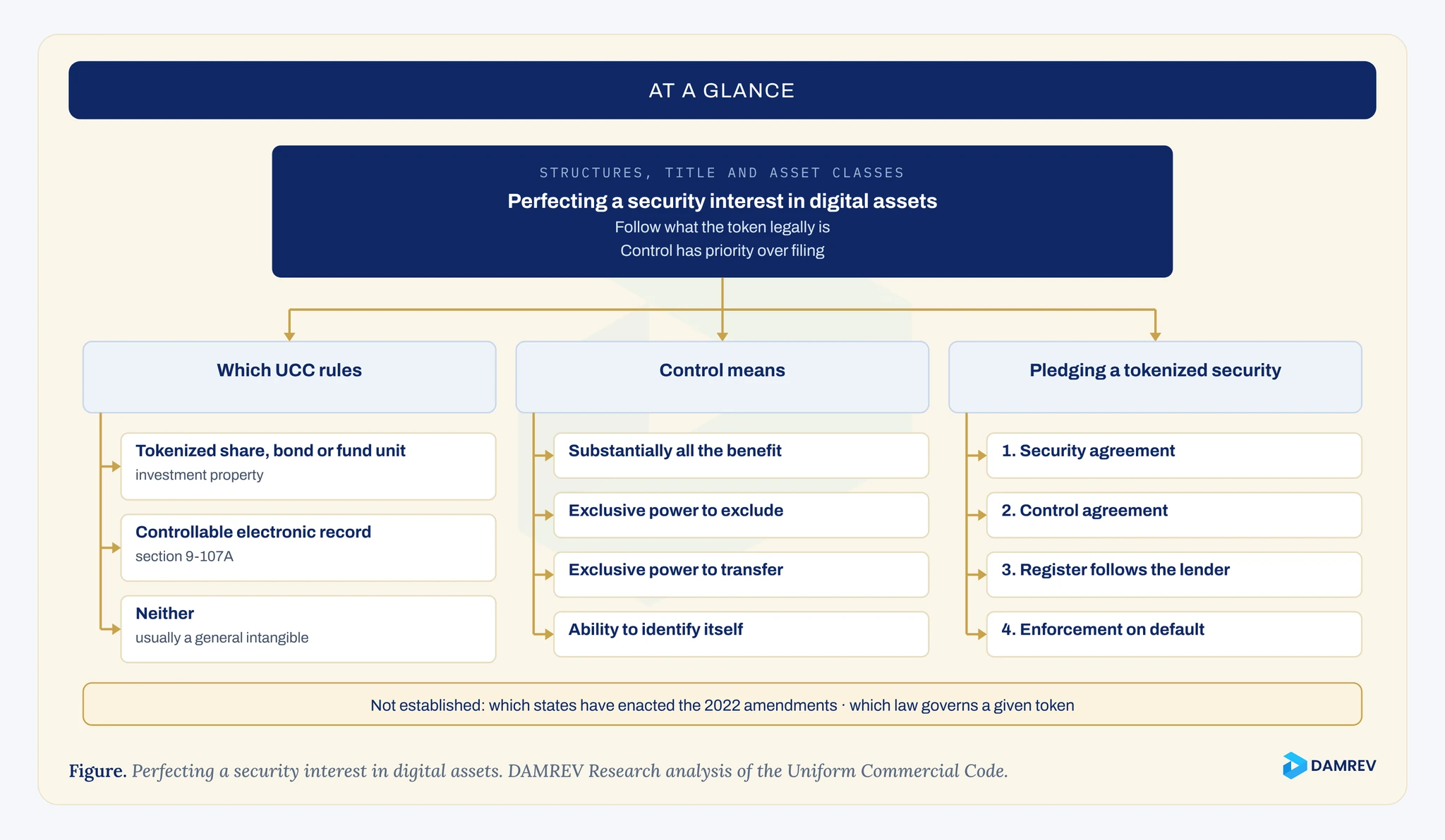
| A tokenized share, bond, or fund unit | Investment property, where it is a security or security entitlement under Article 8. An LLC or partnership interest is not an Article 8 security unless it is dealt in or traded on securities exchanges or markets, its terms expressly provide that it is one, or it is an investment company security3, 6 | By control under section 8-106, or by filing3, 4 |
| A token that is a controllable electronic record | Controllable electronic record | By control under section 9-107A (applying section 12-105), or by filing; control has priority2, 4 |
| A token that is neither | Usually a general intangible | By filing a financing statement5 |
The table matters more than any single rule. The definition of a controllable electronic record excludes "electronic money, investment property, or a transferable record"2.
A tokenized security that is investment property therefore falls outside Article 12, however it is held, while a token that is not an Article 8 security can be a controllable electronic record. A lender that applies the wrong regime may think it has control when it has nothing the law recognises.
02 · Attachment
What makes a security interest attach to a token?
A security interest attaches to a token through the same three things as any other collateral: value given, rights of the borrower in the token, and a signed security agreement or, for some collateral, control. The token does not change these conditions1.
Attachment is the moment the lender's interest exists against the borrower.
Under section 9-203, it requires that value has been given, that the debtor has rights in the collateral or the power to transfer them, and that the debtor has signed a security agreement describing the collateral, or that the lender has control of collateral of a kind that can be controlled1.
The second condition is the one a token tests. The borrower must have rights in what the token represents. If the token is a record of a fund unit, the borrower's rights are in the unit.
If the token is a contract claim against an issuer, the borrower's rights are in that claim. The lender takes no more than the borrower has, whatever the token appears to show.
An unperfected interest is fragile. It is subordinate to a person that becomes a lien creditor before it is perfected5, and a bankruptcy trustee takes that position from the start of a case.
03 · Control
What does control of a token mean?
Control of a controllable electronic record means the exclusive powers to enjoy its benefit, to prevent others from doing so, and to transfer those powers, with the ability to identify oneself as holding them. Control of a tokenized security means an issuer's or intermediary's agreement to follow the lender's instructions2, 3.
Article 12 defines a controllable electronic record by reference to control.
a record stored in an electronic medium that can be subjected to control under Section 12-1052
Control is then defined by four conditions, which the record, an associated record, or the system in which it is recorded must give to the person claiming it2.
Substantially all the benefit
The power to avail itself of substantially all the benefit from the electronic record2.
Exclusive power to exclude
The exclusive power to prevent others from availing themselves of substantially all that benefit2.
Exclusive power to transfer
The exclusive power to transfer control of the record to another person or cause another to obtain control2.
Identification
The ability to readily identify itself as the person having those powers, for example by name, identifying number, or cryptographic key2.
Control has a priority advantage that filing does not. A security interest in a controllable electronic record held by a lender with control has priority over a conflicting interest held by a lender without control4. New York's enactment of the 2022 amendments, Chapter 579 of the Laws of 2025, took effect on 3 June 20267, 8.
Under its transition rules, priorities established before that date are decided by the old Article 9 until the adjustment date, one year after the effective date. On the adjustment date, those earlier priorities in Article 12 property and electronic money cease to apply to the extent the amended rules change them9, 10.
For a tokenized security, Article 8 governs instead. A purchaser has control of an uncertificated security where the issuer "has agreed that it will comply with instructions" from the purchaser without further consent by the registered owner, and of a security entitlement where the intermediary agrees to follow its entitlement orders3.
04 · The register
What must the register show?
The register must show enough for the lender to prove control and to act on default. For a tokenized security, that is usually the issuer's or intermediary's agreement and a register that will follow the lender's instructions; for a controllable electronic record, the system must give the lender exclusive powers2, 3.
The register is where a pledge becomes real. A wallet holding a token is not a pledge unless the lender has the powers the law requires.
A note on an issuer's register is not control unless the issuer has agreed to act on the lender's instructions3. Each depends on how the register works, and the lender must be able to show it.
Pledging a tokenized security as collateral

- What must the register show?
- Step 1: The security agreement: The borrower signs a security agreement describing the tokenized security as collateral. ([1])
- Step 2: The control agreement: The issuer, or the securities intermediary, agrees to comply with the lender's instructions without further consent of the borrower. ([3])
- Step 3: The register reflects it: The register, whether on a ledger or off it, is set so that transfers of the pledged holding follow the lender's instructions.
- Step 4: Enforcement on default: On default, the lender instructs the issuer or intermediary to transfer the holding, under the security agreement and the law.
A register that lets the borrower move the token without the lender's consent, or that the issuer can reverse without telling the lender, may defeat the control the lender thinks it has. The documents and the register's rules have to say who can do what, and the lender should be able to verify both.

05 · What it does not establish
What does this reading not establish?
As of 7 October 2026, the Delaware enactment and the uniform text of the Uniform Commercial Code read here do not establish which states have enacted the 2022 amendments, which law governs perfection for a given token, or whether any arrangement gives control. The article reads the Delaware text and the uniform text and sets out the questions1, 2, 4.
| Question | Position | Source |
|---|---|---|
| Which states have enacted the 2022 amendments | Not established here. The Delaware text is read; New York's enactment is read from the session law and its effective date from commentary | 2, 7, 8 |
| Which law governs perfection for a given token | Not established. The UCC has its own choice of law rules, which turn on the type of collateral | 2, 4 |
| Whether a given wallet or register arrangement gives control | Not established. That turns on the arrangement's terms and technology | 2, 3 |
| Treatment outside the United States | Not established. Other legal systems treat security over digital assets under their own law | |
| Some UCC text read from the uniform version | The uniform text of sections 8-106, 9-203, and 9-317 is read; state enactments may differ | 1, 3, 5 |
The uniform text read for sections 8-106, 9-203, and 9-317 may differ in detail from what a given state has enacted, and some states' versions predate the 2022 amendments1, 3, 5. Delaware's Article 12 and its amended Article 9 are read directly2, 4.
What the texts establish is that a token is pledged according to what it is. The lender's first question is legal classification, its second is control, and only its third is the technology.
Common questions
What else do people ask?
Short answers to the questions people ask most about this topic.
Is a tokenized security a controllable electronic record?
No. The definition of a controllable electronic record excludes investment property, so a token that is a security stays under the investment property rules of Articles 8 and 92.
Is filing a financing statement enough?
It perfects the interest in many cases, but a lender with control of a controllable electronic record has priority over one without control, even if the filing came first4.
Can a lender have control of a token held by an issuer's register rather than a wallet?
For an uncertificated security, a purchaser has control where the issuer agrees to comply with its instructions without further consent of the registered owner3. Whether a given register arrangement does that depends on its terms.
Do these rules apply everywhere in the United States?
Only where a state has enacted the 2022 amendments. The text quoted here is Delaware's enactment; each state's version must be checked.
Where should you go next?
The pages below pick up where this one ends. Start with the one closest to where your asset or programme stands today.
- Bankruptcy Remote SPV Tokenization: What the Vehicle Must Still Do Off-ChainCode cannot make a vehicle bankruptcy remote. A special purpose vehicle gets there off-chain, through a true sale, its documents, and a separate existence.
- Tokenized Fund Structure: The Vehicle, the Units, & the RegisterA tokenized fund is an ordinary fund with its register of units on a ledger. Which record is the official register decides the holder's position.
- Credit, Receivables & Project FinanceHow loan books, receivables, and project cash flows become tokenized debt that applies its own ranking and eligibility rules, while credit risk stays unchanged.
- Proof & ServicingKeeping an instrument working for life: distributions, corporate actions, transfers, and reporting follow the encoded terms, and every event is evidenced.
References
- 1.Uniform Commercial Code, section 9-203, "Attachment and enforceability of security interest". https://www.law.cornell.edu/ucc/9/9-203
- 2.Delaware Code, Title 6, Subtitle I, Article 12, "Controllable Electronic Records", sections 12-102 and 12-105 (84 Del. Laws, c. 174). https://delcode.delaware.gov/title6/c012/index.html
- 3.Uniform Commercial Code, section 8-106, "Control". https://www.law.cornell.edu/ucc/8/8-106
- 4.Delaware Code, Title 6, Subtitle I, Article 9, Part 3, sections 9-314 and 9-326A. https://delcode.delaware.gov/title6/c009/sc03/index.html
- 5.Uniform Commercial Code, section 9-317, "Interests that take priority over or take free of security interest or agricultural lien". https://www.law.cornell.edu/ucc/9/9-317
- 6.Uniform Commercial Code, section 8-103, rules for determining whether certain obligations and interests are securities or financial assets. https://www.law.cornell.edu/ucc/8/8-103
- 7.Troutman Pepper Locke, "New York's UCC amendments are live: what secured lenders need to know about digital asset collateral", 20 July 2026. https://www.troutman.com/insights/new-yorks-ucc-amendments-are-live-what-secured-lenders-need-to-know-about-digital-asset-collateral/
- 8.New York State Senate, Senate Bill S1840A (2025), amending the Uniform Commercial Code to provide for emerging technologies, signed 5 December 2025 as Chapter 579 of the Laws of 2025. https://www.nysenate.gov/legislation/bills/2025/S1840/amendment/A
- 9.New York Uniform Commercial Code, section 12-A-102, definitions of "adjustment date" and "effective date". https://www.nysenate.gov/legislation/laws/UCC/12-A-102
- 10.New York Uniform Commercial Code, section 12-A-305, priority. https://www.nysenate.gov/legislation/laws/UCC/12-A-305
This article is analysis of public sources, not legal advice. Last updated:




