


Article · Structures, Title & Asset Classes
Tokenized Fund Structure: The Vehicle, the Units, & the Register
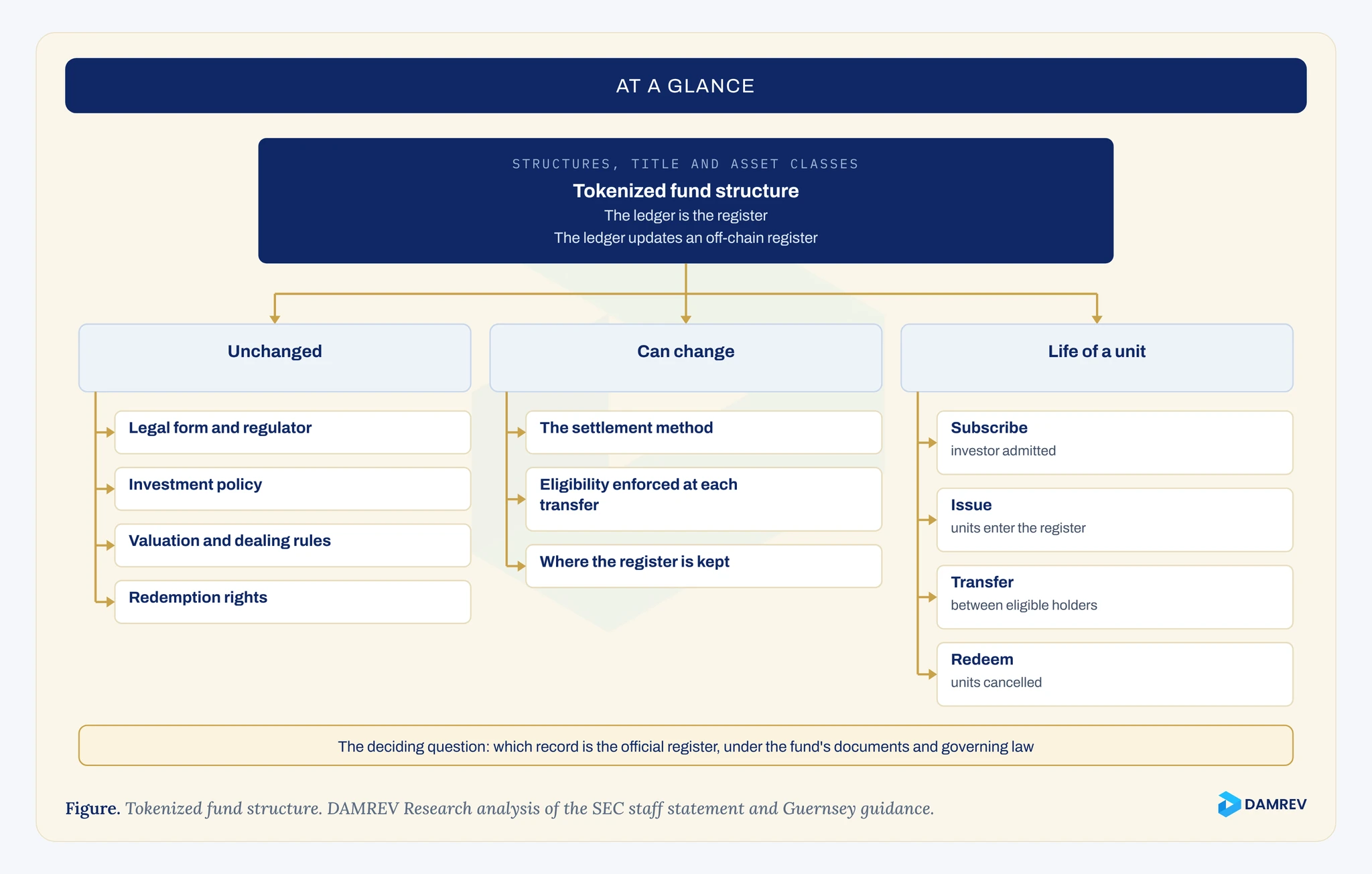
In a tokenized fund structure, the fund is an ordinary fund whose register of units, or a record of it, is kept on a ledger. The vehicle, the units' rights, and the rules for dealing stay in the fund's constitution and offering documents, and the law that governs the fund does not change with the format1, 2.
The question that decides the holder's position is which record is the official register: the ledger, or an off-chain file the ledger mirrors1, 3, 4.

01 · The answer
What is a tokenized fund?
A tokenized fund is a fund whose units are recorded, or represented, as tokens on a distributed ledger, and it keeps its legal form, its regulator, and its documents. In a tokenized fund structure, only the way holdings are recorded and transferred changes1, 2.
The phrase suggests a new product. The primary texts treat it as an old one in a new format.
In January 2026 the staff of three divisions of the US Securities and Exchange Commission (SEC) said that the format in which a security is issued, or whether its holders are recorded on-chain or off-chain, "does not affect application of the federal securities laws"1.
Guernsey's guidance of July 2026 applies the same principle to funds, under its own law2.
A tokenized fund therefore has three parts that must be read separately. The vehicle is the legal person or arrangement that owns the portfolio. The units are the rights an investor holds against the vehicle. The register is the record of who holds which units.
Tokenization changes the third part, may change how the second is transferred, and leaves the first where it was.
02 · The vehicle
What stays in the fund's constitutional documents?
The fund's constitutional documents keep nearly everything that decides an investor's rights: the legal form, the investment policy, valuation and dealing, redemption, eligibility, and the governing law. A token records the holding; it does not restate those terms1, 2.
The documents that create and govern the fund are the same documents a conventional fund has: a trust deed, articles, or partnership agreement, and a prospectus or offering memorandum.
The token contract can enforce some of their rules, such as who may hold a unit, but it takes those rules from the documents. Where the two differ, the documents set out which governs.
| Element | Where it is set | Does tokenization change it? |
|---|---|---|
| Legal form and regulator | Constitution and the regime the fund is registered or authorised under | No1, 2 |
| Investment policy and limits | Constitution and offering document | No |
| Valuation and dealing | Offering document, under the fund's rules | The settlement method may change; the rules do not |
| Redemption rights | Constitution and offering document | No |
| Who may hold units | Offering document and the law of the place of distribution | Can be enforced at each transfer by the token contract |
| The register | Company or trust law, and the fund's documents | Yes: it may be kept on, or mirrored from, a ledger1, 2, 3 |
Guernsey's guidance makes the regulatory side explicit. A tokenized Guernsey fund is still administered by its licensed designated administrator, which "remains responsible for administering the fund" even where a ledger supports the record-keeping2. The administrator, not the code, answers to the regulator.
03 · The register
Which record is the official register?
The official register is whichever record the fund's documents and the governing law make official. The SEC staff describe two models: the ledger integrated into the master securityholder file, or an off-chain file that the ledger is used to update1.
This is the question that decides what a token holder owns. If the ledger is the register, a transfer of the token is a transfer of the unit. If an off-chain file is the register, the token is evidence of a holding, and the holder's rights follow the off-chain record if the two ever disagree.
The ledger is the register
The issuer or its agent "integrates DLT into the systems that it uses to record owners of the security", so a token transfer produces a transfer on the master securityholder file1.
The ledger updates the register
Where the token is not integrated, "the offchain database records constitute the master securityholder file", and the on-chain records are used to update them1.
No parallel register, if it can be printed
In Guernsey, where records are natively issued and kept on a blockchain, a parallel off-chain register is not required, provided the register can be reproduced in hard copy2.
A US money market fund registered under the Investment Company Act shows the first model in its own words. Its prospectus of 1 August 2026 names Stellar as the fund's primary public blockchain, with other networks available for some accounts3.
The Fund's transfer agent maintains the official record of share ownership via a proprietary blockchain-integrated system3
The sentence is precise about who holds the record. It is the transfer agent's record, kept on a system the transfer agent controls, which uses public networks.
An earlier prospectus said fund and shareholder records are "under the full and complete control of the Fund's transfer agent"4, and the current one says the transfer agent "has the ability to correct errors and unauthorized transactions in, and limit the transferability of, Fund shares"3. The ledger records the holdings; the transfer agent decides them.
04 · The units
What does a token holder own in a tokenized fund?
A token holder owns a unit or share in the fund, with the rights the constitution gives it, where the issuer or its agent puts the token on the register. A token issued by someone else may be a different security: an entitlement to a unit held in custody, or synthetic exposure1.
The distinction matters for funds because a third party can wrap fund units in a token of its own. The SEC staff statement separates tokens issued by or for the issuer from tokens issued by third parties1.
A third party may issue a crypto asset "representing the underlying security", such as a security entitlement to units held in custody, or one "representing its own security that provides synthetic exposure"1. A holder of either owns a claim on the third party, not a unit in the fund.
An issuer-integrated tokenized fund: from subscription to redemption
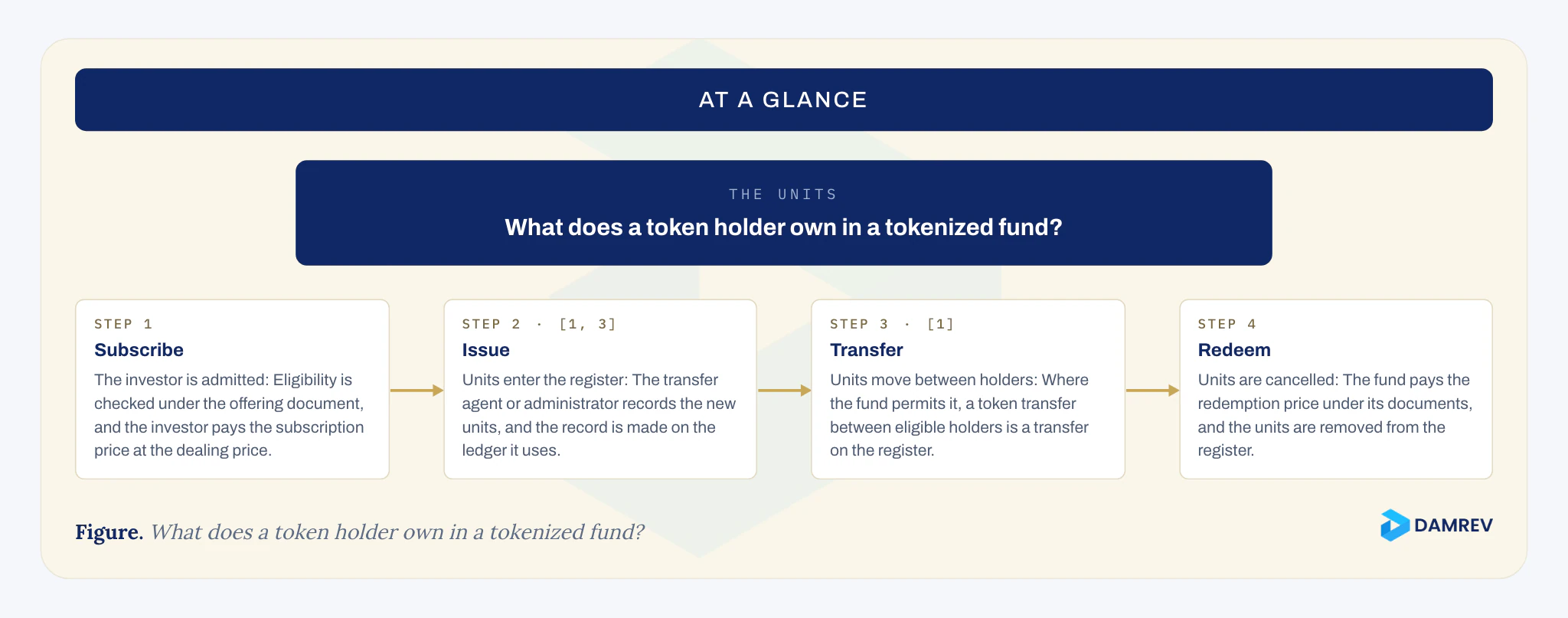
- What does a token holder own in a tokenized fund?
- Subscribe: The investor is admitted: Eligibility is checked under the offering document, and the investor pays the subscription price at the dealing price. (Step 1)
- Issue: Units enter the register: The transfer agent or administrator records the new units, and the record is made on the ledger it uses. (Step 2, [1, 3])
- Transfer: Units move between holders: Where the fund permits it, a token transfer between eligible holders is a transfer on the register. (Step 3, [1])
- Redeem: Units are cancelled: The fund pays the redemption price under its documents, and the units are removed from the register. (Step 4)
Every step except the record itself happens under the documents. The investor's money, the price, the eligibility check, and the redemption payment are all governed by the fund's terms and the law of the fund, as they would be without a token.

05 · What it does not establish
What does this reading not establish?
As of 7 October 2026, the SEC staff statement, the Guernsey guidance, and the fund prospectuses read here do not establish which record is official for any other fund, how a court would resolve a conflict between a ledger and an off-chain file, or how any jurisdiction other than the United States and Guernsey treats a tokenized unit1, 2.
| Question | Position | Source |
|---|---|---|
| The official register of any other fund | Not established. Each fund's documents and governing law decide it | 1, 2 |
| A conflict between the ledger and an off-chain record | Not established. We found no court decision on a tokenized fund register in either jurisdiction read | 1, 2 |
| The status of the SEC staff statement | A staff statement. It is not a rule and grants no relief | 1 |
| Treatment of tokenized units elsewhere | Not established. Each jurisdiction's fund and securities law must be read; Jersey, for example, requires custody and annual independent verification of the underlying assets for tokenized real-world assets | 5 |
| How any token in the market is structured | Not established. The fund example is read from its own filings and is not a view on that fund | 3, 4 |
The staff statement is a statement of staff views, not a rule of the Commission1. It describes the models; it does not decide which one a fund must use. The fund prospectus is the issuer's own description of its arrangements, and it governs only that fund3.
What the texts do establish is where to look. A reader who wants to know what a tokenized fund is should read its constitution for the vehicle and the units, and its offering document for the register. The token is the last place the answer will be found.
Common questions
What else do people ask?
Short answers on tokenized funds: whether a tokenized fund is a different kind of fund, whether its unit is a virtual asset, who keeps its register, and what happens if the blockchain stops working.
Is a tokenized fund a different kind of fund?
No. It is a fund of whatever legal form it already has, regulated under whatever regime already applies to it. The SEC staff say the format of a security, and whether its holders are recorded on-chain or off-chain, does not affect how the federal securities laws apply1.
Is a tokenized fund unit a virtual asset?
In Guernsey, not when the token is issued solely as a digital representation of an investor's interest in a registered or authorised fund2. Other jurisdictions answer the question under their own definitions.
Who keeps the register of a tokenized fund?
The person the fund's documents and regulator make responsible: in the US example read here, the fund's transfer agent; in Guernsey, the licensed designated administrator remains responsible for administering the fund2, 3.
What happens if the blockchain stops working?
That depends on the fund's documents. The prospectus of 3 January 2025 said transactions cannot be recorded on-chain during a network delay, and that the fund could choose to use a different approved network if a delay lasts4.
Where should you go next?
The pages below pick up where this one ends. Start with the one closest to where your asset or programme stands today.
- Feeder Funds On-Chain: Eligibility Enforced at Every TransferA tokenized feeder fund tests eligibility at every transfer, because its rules test holders at each acquisition. Investor status is still verified off-chain.
- Tokenized Fund Offering Memorandum Disclosure: What the Document Must Still SayA tokenized fund's offering memorandum must still say everything fund rules require. A crypto-asset white paper does not replace it.
- Funds & Investment VehiclesHow a fund, feeder, or closed-ended vehicle becomes a tokenized instrument carrying its own rules, with the manager, administrator, and custodian unchanged.
- Guernsey's Tokenization Guidance of 24 July 2026Guernsey's guidance of 24 July 2026 lets a fund or issuer record and transfer its investments as tokens, under the regimes already applying to it.
References
- 1.SEC Divisions of Corporation Finance, Investment Management, and Trading and Markets, "Statement on Tokenized Securities", 28 January 2026. https://www.sec.gov/newsroom/speeches-statements/corp-fin-statement-tokenized-securities-012826
- 2.Guernsey Financial Services Commission, Guidance Note on the Tokenisation of Investments and Other Assets in the Bailiwick of Guernsey, July 2026. https://www.gfsc.gg/sites/default/files/media/helix-file/Guidance%20-%20Tokenisation%20of%20Investments%20%28July%202026%29.pdf
- 3.Franklin Templeton Trust, Form N-1A post-effective amendment (485BPOS), Franklin OnChain U.S. Government Money Fund, prospectus dated 1 August 2026. https://www.sec.gov/Archives/edgar/data/0001786958/000165558926000970/c485bpos.htm
- 4.Franklin Templeton Trust, Form N-1A post-effective amendment (485BPOS), Franklin OnChain U.S. Government Money Fund, prospectus dated 3 January 2025. https://www.sec.gov/Archives/edgar/data/1786958/000174177325000031/c485bpos.htm
- 5.Jersey Financial Services Commission, "Tokenisation of real-world assets (RWAs)", issued 28 August 2024, last revised 13 July 2026. https://www.jerseyfsc.org/industry/guidance-and-policy/tokenisation-of-real-world-assets-rwas/
This article is analysis of public sources, not legal advice. Last updated:




