


Article · Structures, Title & Asset Classes
Tokenized Fund Offering Memorandum Disclosure: What the Document Must Still Say
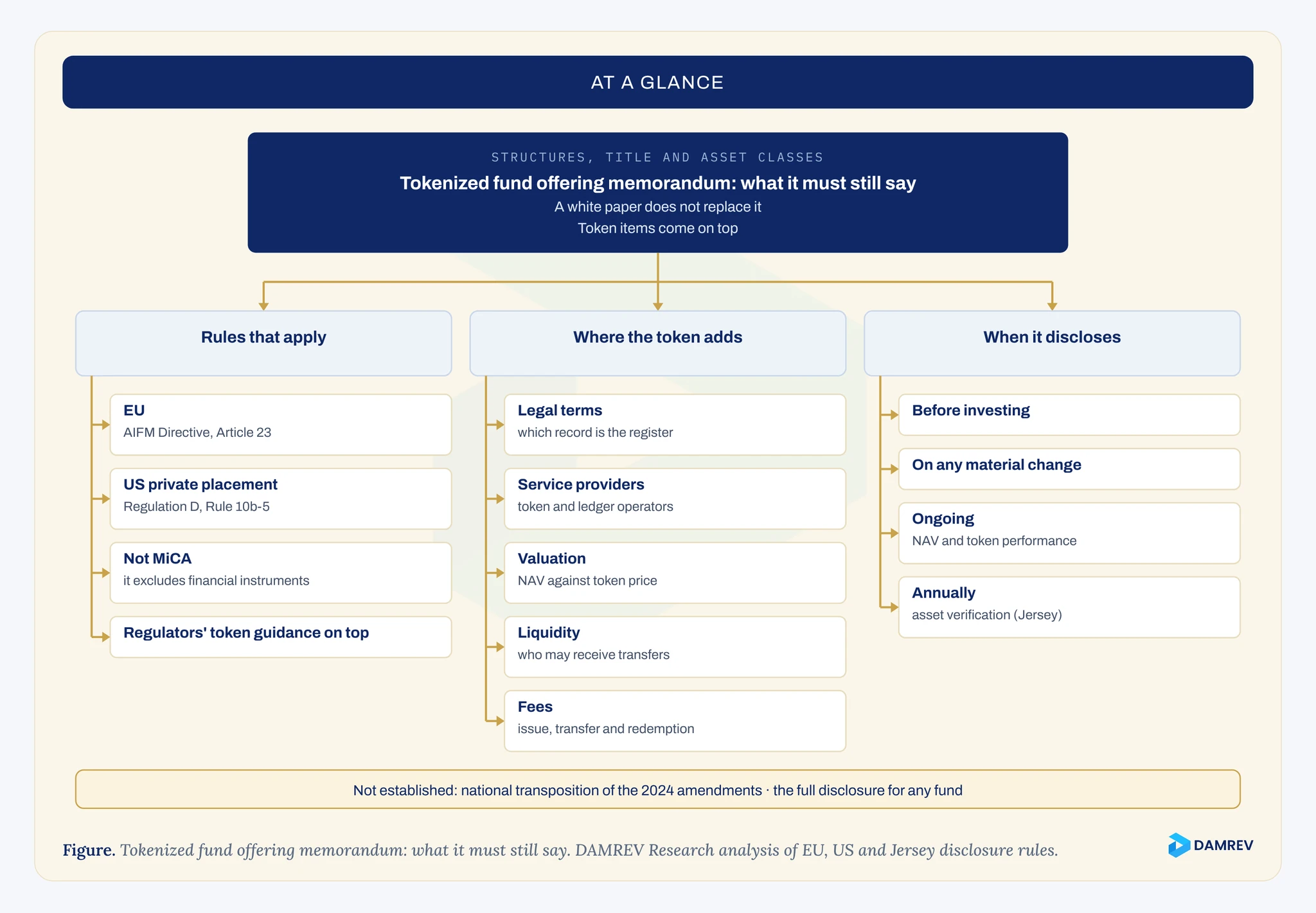
Tokenized fund offering memorandum disclosure must still cover everything the fund rules require of any fund: strategy, legal terms, service providers, valuation, liquidity, fees, and the rest1, 2.
A crypto-asset white paper does not replace it, because the crypto-asset regulation of the European Union (EU) excludes financial instruments, and where a regulator adds token-specific items, such as how the token's rights and price may differ from the underlying, they come on top3, 4.


01 · The answer
Is a white paper an offering memorandum?
No. For tokenized fund offering memorandum disclosure, the document must meet the fund and securities rules that apply to the fund. A crypto-asset white paper meets a different regime, which in the EU does not apply to financial instruments at all1, 3.
Many token projects publish a white paper: a document describing the technology, the token, and the project's aims. For a crypto-asset in the EU, a white paper has a legal role under the Markets in Crypto-Assets Regulation (MiCA). For a tokenized fund, it has none.
MiCA does not apply to crypto-assets that qualify as financial instruments, and a unit in a fund is one3. The fund's investors are protected by the disclosure rules for funds, and those rules do not change because the units are tokens1, 5.
The question for any tokenized fund is therefore not what a white paper should say, but what the offering document must still say. The answer comes in two layers. The first is everything any fund of that kind must disclose. The second is whatever the regulator adds because the units are tokens.
02 · The rules
Which rules set what a tokenized fund must disclose?
What a tokenized fund must disclose is set by the rules that apply to the fund and its offer: for an EU alternative investment fund, Article 23 of the Alternative Investment Fund Managers (AIFM) Directive; for a US private offering, Rule 502(b) and the anti-fraud rules; and any regulator's token guidance on top1, 2, 4.
The three texts read here differ in approach. The EU lists the items. The US private placement rules require set information only in some offers, and leave the rest to the anti-fraud rules. Jersey adds items specific to tokenized assets.
EU: a list of items
Managers of alternative investment funds must make listed information available to investors "before they invest", and any material change to it1.
US private placements: anti-fraud first
Rule 502(b) requires specified information for non-accredited purchasers in a US private offering, and none in a US private offering limited to accredited investors; Rule 10b-5 applies in every case2, 6.
Not MiCA
The EU's crypto-asset regulation, with its white paper regime, does not apply to crypto-assets that qualify as financial instruments3.
Token guidance on top
Jersey's guidance on tokenized real-world assets sets disclosure and reporting expectations specific to tokens, in addition to the issuer's other obligations4.
The US position needs care. A private fund offered only to accredited investors has no list of required contents under Rule 502(b), but the rule itself notes that issuers should consider providing the information to accredited investors as well, given the anti-fraud provisions2.
In practice the anti-fraud rule sets the standard: no untrue statement of material fact, and no omission that makes what is said misleading6.
03 · The items
What must the offering document contain, item by item?
For an EU alternative investment fund, the offering document must contain a list of items from strategy and legal terms to valuation, liquidity, fees, and performance, extended in 2024. Tokenization changes the content of some items, such as the register and transfers, but removes none1, 7.
The right column is our reading of where the token enters, not itself a requirement except where a reference shows one.
| Item | What the rule requires | Where the token adds to it |
|---|---|---|
| (a) Strategy and objectives | The investment strategy, objectives, assets, techniques, risks, and leverage, now including the fund's name and "the maximum level of leverage which the AIFM is entitled to employ"1, 7 | Any risks arising from the ledger used for the register |
| (c) Legal implications | "the main legal implications of the contractual relationship", including jurisdiction and governing law1 | Which record is the official register, and which governs if the ledger and other records differ |
| (d) Service providers | The identity of the manager, depositary, auditor, and other providers1 | Any provider that operates the token, the ledger connection, or the register |
| (g) Valuation | The valuation procedure and pricing methodology1 | How the net asset value relates to any price at which tokens trade4 |
| (h) Liquidity and redemption | Liquidity risk management, redemption rights, and, since 2024, the liquidity management tools selected1, 7 | Whether tokens may be transferred between holders, and to whom |
| (i) and (ia) Fees | All fees, charges, and expenses borne by investors and their maximum amounts, and, since 2024, a list of those borne by the manager1, 7 | Any fees for issuing, transferring, or redeeming tokens |
| (l) Issue and sale | The procedure and conditions for issue and sale of units1 | The eligibility checks applied before a token is issued or transferred |
| (m) and (n) Net asset value (NAV) and performance | The latest net asset value and, where available, historical performance1 | Performance of the token against the net asset value, where tokens trade4 |
The other items apply unchanged: (b) the procedure for changing strategy, (e) how the manager covers professional liability risks, (f) any delegation of management or safe-keeping functions, (j) fair treatment of investors, (k) the latest annual report, (o) the prime broker, and (p) how and when periodic information on liquidity and leverage is disclosed1.
The 2024 amendments also added periodic items under Article 23(4)(e) and (f), including the fees borne by investors each year and any special purpose vehicle used for the fund's investments7.
04 · The token
What must a tokenized fund say about the token itself?
A tokenized fund must say about the token itself, where the regulator asks, how the token's rights and price may differ from the underlying, how the assets are held and verified, and when verification results are published. Jersey's guidance sets these out for tokenized real-world assets4.
Jersey's guidance names token-specific disclosure in terms. It says risk warnings may include "the token's price difference compared to the price of the underlying asset", and expects issuers to report publicly the "performance of the token against NAV"4. Its starting point is a plain statement of the gap a holder needs to understand.
If the rights of the token differ to the rights of holding the underlying asset, this should be clearly disclosed.4
The guidance places the remaining items around custody and verification. Underlying assets are to be held by a professional custodian, ring-fenced, and "independently verified by an appropriately qualified third party annually", with results published "within three months of the end of the issuer's financial year end"4.
When a tokenized fund discloses, under the rules read here
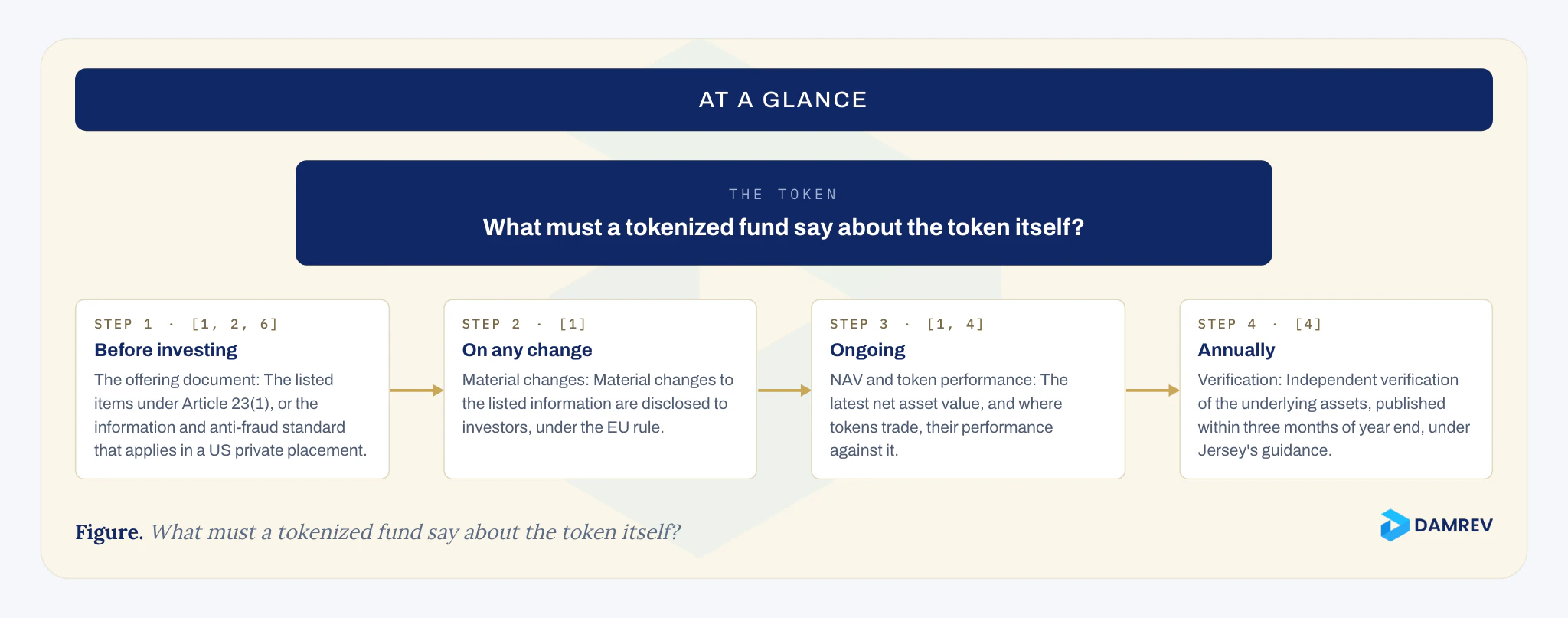
- What must a tokenized fund say about the token itself?
- Before investing: The offering document: The listed items under Article 23(1), or the information and anti-fraud standard that applies in a US private placement. (Step 1, [1, 2, 6])
- On any change: Material changes: Material changes to the listed information are disclosed to investors, under the EU rule. (Step 2, [1])
- Ongoing: NAV and token performance: The latest net asset value, and where tokens trade, their performance against it. (Step 3, [1, 4])
- Annually: Verification: Independent verification of the underlying assets, published within three months of year end, under Jersey's guidance. (Step 4, [4])
None of these items is a technical description of the ledger; each asks what investors own, who holds the assets, how the price relates to the value, and who checks.

05 · What it does not establish
What does this reading not establish?
As of 7 October 2026, the EU, US, and Jersey texts read here do not establish the full disclosure required of any fund, how each Member State has transposed the 2024 amendments, or the rules of any jurisdiction not read here. The article compares the items of the texts read and stops there1, 2, 4, 7.
| Question | Position | Source |
|---|---|---|
| National transposition of the 2024 amendments | Not established. Directive (EU) 2024/927 amends Article 23 at EU level; under its Article 3(1), transposition measures were due by 16 April 2026, with Articles 1(12) and 2(7) applying from 16 April 2027; each Member State's implementing law was not read | 7 |
| Disclosure for undertakings for collective investment in transferable securities (UCITS) or US registered funds | Not read. They have their own, longer disclosure regimes | |
| Other jurisdictions' token disclosure rules | Not established. Cayman, Guernsey, and others have their own texts; only Jersey's guidance is read for token items | 4 |
| The full disclosure for any fund | Not established. That depends on the fund, its investors, and every rule that applies to its offer | 1, 2 |
| Tax disclosure | Outside the scope of this article. Take advice from your own tax adviser |
The base EU text is read from the consolidated version published by the EU, and the 2024 amending directive is read alongside it1, 7. The Jersey guidance is guidance, not law, and applies to issuers within its scope4.
What the comparison shows is that the token adds questions and removes none. A tokenized fund's offering document is a fund offering document first. The white paper, if there is one, is at most an appendix.
Common questions
What else do people ask?
Short answers to the questions people ask most about this topic.
Does a tokenized fund need a MiCA white paper?
Not where its units are financial instruments, because the Markets in Crypto-Assets Regulation does not apply to crypto-assets that qualify as financial instruments. The fund's disclosure then comes from the fund and securities rules3.
Must a US private fund sold only to accredited investors provide a set disclosure document?
Rule 502(b) does not require specified information where sales are made only to accredited investors, but the anti-fraud rules still apply, and the rule's own note suggests considering providing the information to them2.
What does a tokenized fund disclose that a conventional one does not?
Whatever its regulator adds. Jersey's guidance, for example, asks issuers to disclose clearly where the token's rights differ from those of holding the underlying asset, says risk warnings may include the price difference, and expects independent verification of the assets to be published4.
Can an issuer use one document for both purposes?
A single document can carry both the fund disclosure and the token disclosure, provided it meets every rule that applies. The label on the document does not decide which rules apply.
Where should you go next?
The pages below pick up where this one ends. Start with the one closest to where your asset or programme stands today.
- Tokenized Fund Structure: The Vehicle, the Units, & the RegisterA tokenized fund is an ordinary fund with its register of units on a ledger. Which record is the official register decides the holder's position.
- Feeder Funds On-Chain: Eligibility Enforced at Every TransferA tokenized feeder fund tests eligibility at every transfer, because its rules test holders at each acquisition. Investor status is still verified off-chain.
- Funds & Investment VehiclesHow a fund, feeder, or closed-ended vehicle becomes a tokenized instrument carrying its own rules, with the manager, administrator, and custodian unchanged.
- Jersey: When a Tokenized Asset Is a Virtual Asset, & When It Is NotIn Jersey a token representing a share, bond, commodity, or fund unit is a tokenized real-world asset, not a virtual asset issuance.
References
- 1.Directive 2011/61/EU on Alternative Investment Fund Managers, Article 23, consolidated text. https://eur-lex.europa.eu/legal-content/EN/TXT/?uri=CELEX:02011L0061-20240415
- 2.Code of Federal Regulations, Title 17, section 230.502 (Rule 502). https://www.law.cornell.edu/cfr/text/17/230.502
- 3.Regulation (EU) 2023/1114 on markets in crypto-assets, Article 2(4). https://eur-lex.europa.eu/eli/reg/2023/1114/oj/eng
- 4.Jersey Financial Services Commission, "Tokenisation of real-world assets (RWAs)", issued 28 August 2024, last revised 13 July 2026. https://www.jerseyfsc.org/industry/guidance-and-policy/tokenisation-of-real-world-assets-rwas/
- 5.SEC Divisions of Corporation Finance, Investment Management, and Trading and Markets, "Statement on Tokenized Securities", 28 January 2026. https://www.sec.gov/newsroom/speeches-statements/corp-fin-statement-tokenized-securities-012826
- 6.Code of Federal Regulations, Title 17, section 240.10b-5 (Rule 10b-5). https://www.law.cornell.edu/cfr/text/17/240.10b-5
- 7.Directive (EU) 2024/927 of 13 March 2024 amending Directives 2011/61/EU and 2009/65/EC, Article 1, point (11), amending Article 23 of Directive 2011/61/EU. https://eur-lex.europa.eu/legal-content/EN/TXT/HTML/?uri=CELEX:32024L0927
This article is analysis of public sources, not legal advice. Last updated:




