


Article · Structures, Title & Asset Classes
Feeder Funds On-Chain: Eligibility Enforced at Every Transfer
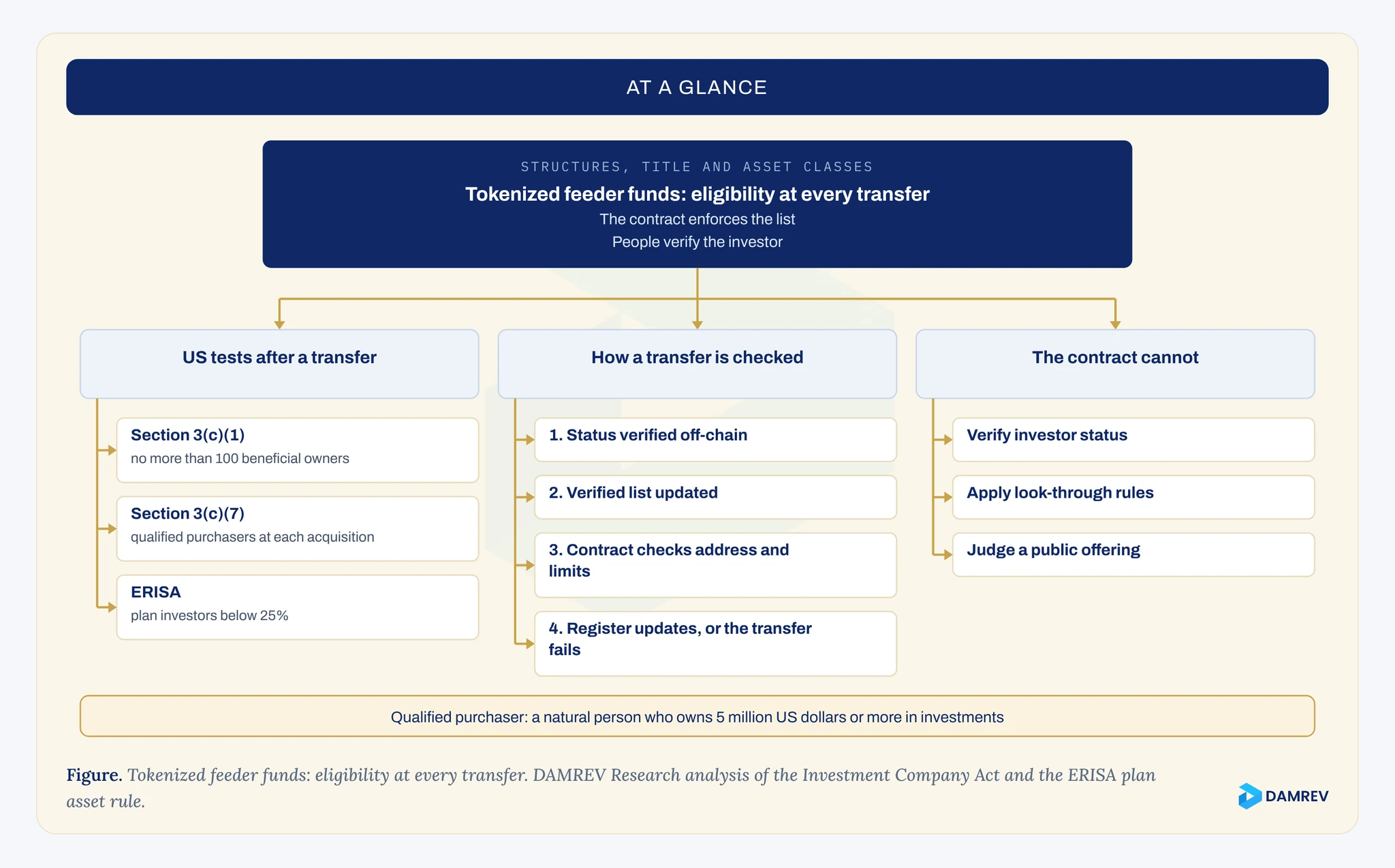
A tokenized feeder fund must check eligibility at every transfer because the rules that keep it outside full fund regulation test its holders at each acquisition1, 2, 3. A token contract can stop an ineligible transfer from being recorded, but the investor's status is verified off-chain, and the counts and look-through rules still need people to apply them1, 4.


01 · The answer
Why must a tokenized feeder fund check eligibility at every transfer?
A tokenized feeder fund must check eligibility at every transfer because the rules a private feeder relies on test its holders continuously, or at each acquisition. One ineligible transfer can put the fund outside its exemption, whatever the subscription checks found1, 3.
A conventional private fund controls who holds its units through the transfer agent or administrator, which refuses to register a transfer to an ineligible investor.
A tokenized feeder moves the record of holdings onto a ledger, where a transfer can be made between two addresses without anyone asking first. Unless the fund keeps the gate, eligibility is checked once, at subscription, and never again.
That is not enough under the US rules read here. Each of the three tests below is about who holds the units after a transfer, not only about who subscribed.
| Test | What it requires | When it applies |
|---|---|---|
| Section 3(c)(1), Investment Company Act | Securities beneficially owned by not more than 100 persons, and no public offering | Continuously, so a transfer that adds a holder counts, except that under SEC Rule 3c-6 a security held by the transferor's estate, by a person who received it as a gift or bequest or under a legal separation or divorce, or by a company set up exclusively for the benefit of, or owned exclusively by, the transferor and those persons, is treated as still held by the transferor1, 5 |
| Section 3(c)(7), Investment Company Act | Securities owned exclusively by persons who were qualified purchasers when they acquired them, and no public offering | At each acquisition, including by transfer, except gifts, bequests, and involuntary transfers from a qualified purchaser1 |
| Plan asset rule under the Employee Retirement Income Security Act (ERISA) | Benefit plan investors hold less than 25 percent of the value of any class of equity | Immediately after the most recent acquisition of any equity interest3 |
Each test can be failed by a single transfer. A fund that fails one of them may have to register as an investment company, or may find that its assets are treated as the assets of the pension plans invested in it. Neither is a consequence any feeder is set up to bear.
02 · The feeder
What is a feeder fund, and why tokenize one?
A feeder fund is a fund that invests its investors' money in another fund, the master. Feeders exist to admit a particular class of investor, so their eligibility rules are their reason for being, and tokenizing the units must keep them1.
Managers use feeders to bring investors with different legal, regulatory, or tax positions into one portfolio. One feeder may admit US taxable investors, another US tax-exempt investors, another non-US investors. Each feeder's investor base is the point of the feeder.
That is why the question for a tokenized feeder is not whether its units can move on a ledger, but whether they can move only to the people the feeder exists to admit.
Tokenization does not change the legal analysis. The staff of the US Securities and Exchange Commission (SEC) say the format of a security, and whether its holders are recorded on-chain or off-chain, "does not affect application of the federal securities laws"4. A feeder that relies on section 3(c)(7) before tokenization relies on it afterwards, on the same terms.
03 · The tests
What do the tests require, and when?
Section 3(c)(1) caps the number of beneficial owners; section 3(c)(7) requires each holder to be a qualified purchaser when acquiring; the ERISA rule caps plan investors at below 25 percent after each acquisition1, 2, 3.
The qualified purchaser test has its timing written into the statute itself. A fund relying on section 3(c)(7) must be one whose securities are owned exclusively by qualified purchasers, measured at the moment each holder acquired them1.
the outstanding securities of which are owned exclusively by persons who, at the time of acquisition of such securities, are qualified purchasers1
Qualified purchaser is a defined term. It includes a natural person "who owns not less than $5,000,000 in investments, as defined by the Commission", and a person acting for its own account or for other qualified purchasers who "owns and invests on a discretionary basis, not less than $25,000,000 in investments"2. Neither threshold can be read from a wallet.
- The most beneficial owners a fund may have under section 3(c)(1), with a higher limit for qualifying venture capital funds1
- 100
- The investments a natural person must own to be a qualified purchaser under section 2(a)(51)(A)(i)2
- US$5 million
- The share of any class of equity held by benefit plan investors at which participation becomes significant under the ERISA rule3
- 25%
The ERISA rule is the clearest about timing. Benefit plan participation is "significant" where "25 percent or more of the value of any class of equity interests in the entity is held by benefit plan investors", and the test is applied "immediately after the most recent acquisition of any equity interest in the entity"3.
A transfer from a taxable investor to a pension plan can cross the line on its own.
04 · The contract
What can the token contract enforce?
The token contract can refuse to record a transfer to an address that is not on the fund's list of verified investors, or one that would breach a numeric limit it can see. It cannot verify status, apply look-through rules, or judge a public offering1, 2.
The useful design separates two jobs. Verification happens off-chain: the fund or its agent checks an investor's status and records the result. Enforcement happens on-chain: the token contract consults that record before a transfer is written to the ledger. The contract enforces a decision made elsewhere.
How a tokenized feeder enforces eligibility on a transfer

- What can the token contract enforce?
- Step 1: Verification off-chain: The fund's administrator or transfer agent checks the buyer's status, such as qualified purchaser or benefit plan investor, under the fund's procedures.
- Step 2: The list is updated: The verified address and its status are recorded where the token contract can read them.
- Step 3: The contract checks: Before recording the transfer, the contract checks the buyer's address and any limit it can compute, such as holder count or plan investor share.
- Step 4: The register updates: If the checks pass, the transfer is recorded; if not, it fails and the seller keeps the units.
Some things stay off-chain whatever the contract does. Counting beneficial owners under section 3(c)(1) can require looking through an investing entity to its own holders, which a contract cannot see1.
Whether the fund is making a public offering depends on how it markets its units, not on who holds them1. And an investor's status can change after verification, so the list needs to be kept current.
Guernsey's guidance makes the same allocation for its funds: the licensed designated administrator "remains responsible for administering the fund" where a ledger supports the record6. The administrator is the person accountable.

05 · What it does not establish
What does this reading not establish?
As of 7 October 2026, the Investment Company Act provisions, the ERISA plan asset regulation, and the guidance read here do not establish which exemption any fund relies on, how non-US feeders are tested, or that any contract design satisfies the rules. The reading sets out the tests and the division of work, not a compliance opinion1, 3.
| Question | Position | Source |
|---|---|---|
| Which exemption a given feeder relies on | Not established. That is set by its documents and its counsel | 1 |
| How look-through counting applies to a given investor | Not established. Section 3(c)(1) has its own attribution rules, which need case-by-case analysis | 1 |
| Feeders outside the United States | Not established. Each jurisdiction's fund rules apply; Guernsey's guidance is read here only for the administrator's role | 6 |
| Whether a contract design is compliant | Not established. A contract enforces the list it is given; the list and the procedures behind it decide whether the rules are met | 4 |
| Tax treatment of different feeders | Outside the scope of this article. Take advice from your own tax adviser |
The texts read here are statutes and a regulation, and they apply on their own terms1, 2, 3. They do not mention ledgers or tokens. The SEC staff statement confirms that tokenization does not change how they apply, and it is a staff statement, not a rule4.
What the texts establish is the timing. Each test looks at who holds the units after a change of hands. A tokenized feeder keeps its exemption only if its ledger keeps the same gate its transfer agent kept, and the people who verify investors keep the gate's list correct.
Common questions
What else do people ask?
Short answers to the questions people ask most about this topic.
Does a transfer by gift or inheritance need a qualified purchaser?
No. Under section 3(c)(7)(A), securities received from a qualified purchaser as a gift or bequest, or through divorce, death, or another involuntary event, are deemed owned by a qualified purchaser1.
Why is checking eligibility at subscription not enough?
Because a transfer is an acquisition by the new holder. A fund relying on section 3(c)(7) must be owned exclusively by persons who were qualified purchasers at the time they acquired their units, and the ERISA 25 percent test is applied immediately after each acquisition1, 3.
Can a token contract decide whether an investor is a qualified purchaser?
No. It can check whether an address appears on a list of verified investors. The verification of the investor's status happens off-chain, under the fund's own procedures.
Does tokenizing a feeder fund change the exemption it relies on?
No. The staff of the US Securities and Exchange Commission (SEC) say the format of a security does not affect how the federal securities laws apply4.
Where should you go next?
The pages below pick up where this one ends. Start with the one closest to where your asset or programme stands today.
- Tokenized Fund Structure: The Vehicle, the Units, & the RegisterA tokenized fund is an ordinary fund with its register of units on a ledger. Which record is the official register decides the holder's position.
- Tokenized Fund Offering Memorandum Disclosure: What the Document Must Still SayA tokenized fund's offering memorandum must still say everything fund rules require. A crypto-asset white paper does not replace it.
- A Guide to Tokenizing a Feeder FundHow a feeder fund's interests become tokens that admit only eligible investors, keep an exact register, and pay distributions, in five stages.
- Funds & Investment VehiclesHow a fund, feeder, or closed-ended vehicle becomes a tokenized instrument carrying its own rules, with the manager, administrator, and custodian unchanged.
References
- 1.Investment Company Act of 1940, section 3(c)(1) and 3(c)(7), United States Code, Title 15, section 80a-3. https://www.law.cornell.edu/uscode/text/15/80a-3
- 2.Investment Company Act of 1940, section 2(a)(51), "Qualified purchaser", United States Code, Title 15, section 80a-2. https://www.govinfo.gov/content/pkg/USCODE-2023-title15/html/USCODE-2023-title15-chap2D-subchapI-sec80a-2.htm
- 3.Code of Federal Regulations, Title 29, section 2510.3-101, "Definition of 'plan assets': plan investments". https://www.law.cornell.edu/cfr/text/29/2510.3-101
- 4.SEC Divisions of Corporation Finance, Investment Management, and Trading and Markets, "Statement on Tokenized Securities", 28 January 2026. https://www.sec.gov/newsroom/speeches-statements/corp-fin-statement-tokenized-securities-012826
- 5.17 CFR 270.3c-6, transfers of interests in certain private investment companies. https://www.law.cornell.edu/cfr/text/17/270.3c-6
- 6.Guernsey Financial Services Commission, Guidance Note on the Tokenisation of Investments and Other Assets in the Bailiwick of Guernsey, July 2026. https://www.gfsc.gg/sites/default/files/media/helix-file/Guidance%20-%20Tokenisation%20of%20Investments%20%28July%202026%29.pdf
This article is analysis of public sources, not legal advice. Last updated:




