


Article · Markets & Data
How RWA Market Data Is Measured: The Trackers' Methods Compared
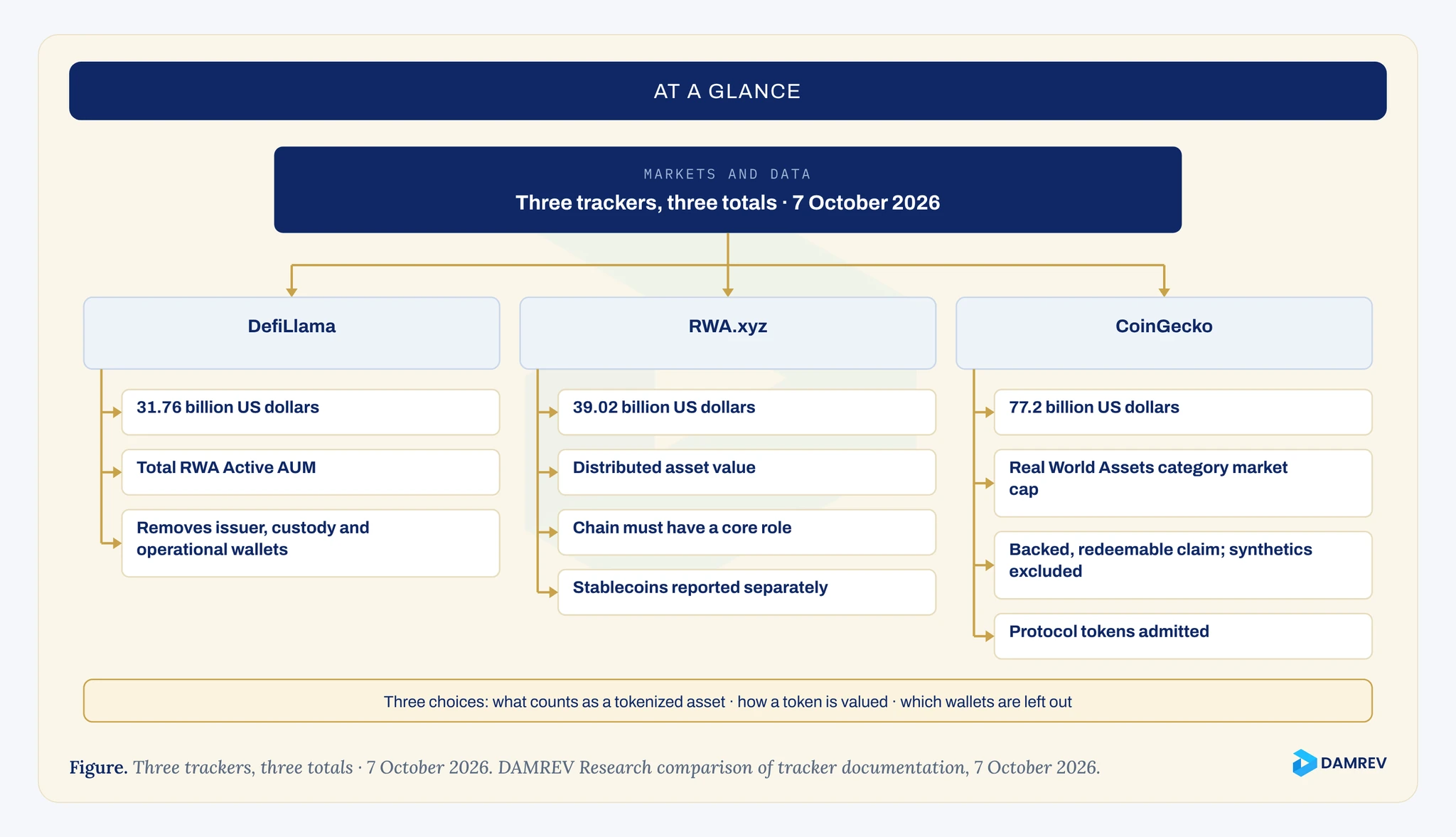
Each tracker makes three choices of its own: what counts as a tokenized asset, how a token is valued, and which wallets are left out1, 2, 3, 4, 5, 6. Those choices explain why, within 35 minutes on 7 October 2026, published totals ran from 31.76 billion to 77.2 billion US dollars7, 8, 9.


In this article
01 · Three totals
Why do the trackers publish different totals?
The trackers publish different totals because they measure different things: within 35 minutes on 7 October 2026, three public trackers showed 31.76 billion, 39.02 billion, and 77.2 billion US dollars for what each calls tokenized or real-world assets (RWA)7, 8, 9.
Every figure in this category comes from somewhere, and most come from a small number of public trackers. Readers tend to treat their totals as competing estimates of one number. They are better read as answers to different questions.
This article compares how five trackers decide what to count, how they value it, and how they count holders, using each tracker's own documentation. It does not say which is best.
- DefiLlama, Total RWA Active AUM (assets under management), in US dollars, at 18:56 UTC on 7 October 20268
- 31.76 billion
- RWA.xyz, distributed asset value, in US dollars, at about 18:23 UTC7
- 39.02 billion
- CoinGecko, Real World Assets category market cap, in US dollars, at 18:56 UTC9
- 77.2 billion
The differences are not errors. The DefiLlama figure removes tokens held in issuer wallets, custody omnibus accounts, and internal operational flows; the RWA.xyz figure counts transferable tokens and excludes stablecoins; the CoinGecko figure is a market category that includes the tokens of protocols serving the sector4, 7, 9.
Each is a defensible measure of something. None is a measure of the others.
02 · What is listed
What does each tracker list?
Each tracker applies its own test of what to list: one lists an asset only if the chain has a core role in issuance, transfer, and settlement; another requires a backed, redeemable claim and excludes synthetics, but admits protocol tokens2, 6.
Inclusion is the first and largest source of difference, because it decides which tokens exist for the tracker at all.
| Tracker | What is listed | How a token is valued | Stablecoins | Source |
|---|---|---|---|---|
| RWA.xyz | Assets where the chain has "a core role" in issuance, transfer, and settlement; no announced but undeployed assets; distributed and represented reported apart | Market value is total supply times price; for funds, total asset value under management; circulating asset value is circulating supply times net asset value (NAV) | Reported separately | 1, 2, 10 |
| DefiLlama | RWA assets on its dashboard, grouped by platform and chain | Onchain AUM, excluding burned tokens; Active AUM after removing issuer wallets, custody omnibus accounts, and internal operational flows | Not stated in the documentation read | 4, 8, 11 |
| CoinGecko | Tokens that represent an actual asset, backed by it and redeemable or with a verifiable claim; synthetics excluded; protocol tokens admitted if the project is functional | Market cap, method not stated on the methodology page | Not stated on the methodology page | 6 |
| Allium | Rates, equities, credit, currencies, commodities, private funds, and real estate | Price times circulating supply | Not stated on the page read | 5 |
| Dune (curated dataset) | A curated token registry; access is restricted | Curated RWA prices applied to balances | Not stated on the page read | 3 |
Two inclusion choices move totals most. The first is whether records kept on an issuer's own system count. One tracker separates them as represented value, which on 7 October 2026 was 373.69 billion US dollars against 39.02 billion distributed7, 10.
The second is whether tokens of the protocols that serve tokenized assets belong in the total. A category that admits them adds a market price for a business to the value of the assets it services6. Neither choice is visible in a headline figure.
Coverage of ledgers is a quieter third choice. A tracker can count only the chains it reads. One provider's documentation names Ethereum, Solana, Aptos, Sui, and Stellar among others, without a complete list5. Another's dashboard offers a filter of more than a dozen named chains, with the rest grouped as "Others"8.
An asset issued on a ledger a tracker does not read is absent from its total, however large it is, and a permissioned ledger that publishes no data is absent from all of them.
03 · How value is set
How is a token valued?
Trackers value a token by price or by net asset value, on total or circulating supply, and the four combinations can give different numbers for the same token on the same day1, 5.
A tokenized fund unit has a net asset value set by its administrator. It may also have a market price, if it trades.
The two diverge when the token trades at a premium or discount, and the documentation of one tracker says so in terms: total asset value "may differ from market value if the token trades at a premium or discount to NAV"1.
Supply is the second choice. Total supply counts every token minted. Circulating supply removes tokens held in addresses the tracker treats as outside the market. One tracker defines it as "Total supply minus tokens held in non-circulating addresses (e.g., treasury wallets, burn addresses, locked contracts)"1. Another values tokens at price times circulating supply, without stating which addresses it removes5.
For most tokenized funds the difference between price and NAV is small, and the choice of supply matters more. For thinly traded tokens, a single trade can set a price far from NAV, and a tracker that uses price will report a different value from one that uses NAV.
This article makes no comment on any token's price; the point is that a tracker's choice of input changes its total.
04 · Which wallets count
Which wallets are counted?
Trackers do not count the same wallets: they remove different sets of issuer, bridge, treasury, and distributor wallets from both value and holder counts, and one publishes a separate measure of value in active use1, 3, 4.
The third choice is which addresses are treated as the market. One dataset marks as non-circulating the tokens held in a tokenized-stock issuer's system wallets, bridge lockboxes, issuer inventory, and custodian distributor omnibus accounts, while exchange, lending, and unidentified wallets stay in3. Another publishes an adjusted holder count that "excludes known infrastructure addresses (bridges, smart contracts, treasury wallets)"1.
DefiLlama goes furthest. Its methodology defines an Active market cap that excludes "issuer wallets, custody omnibus accounts, and internal operational flows", and tests each wallet by asking whether compromising it would let a third party extract meaningful value11.
Its research report of April 2026 describes the same measure as removing team, treasury, and other internal addresses and mint and burn loops4. The methodology describes it in one line.
The portion of Onchain Marketcap that is taking real market risk in user or protocol hands.11
That definition explains much of the gap between its Active AUM of 31.76 billion US dollars and its Onchain AUM of 34.8 billion on 7 October 20268. It may also explain part of the gap with RWA.xyz's distributed figure, which removes non-circulating addresses on its own list; neither tracker publishes a reconciliation with the other1, 7.
Holder counts follow the same logic. The trackers whose holder definitions we read all count an address with any non-zero balance as a holder, and differ on which addresses they then remove1, 3, 5.

05 · What it does not establish
What does this comparison not establish?
As of 7 October 2026, the tracker documentation and dashboards read here do not establish which tracker is right, which is best, or the true size of the market. This comparison sets out stated methods, from public documentation, on one day1, 2, 3, 4, 5, 6.
Not a ranking
Each tracker answers a different question well. The comparison is of method, and this article draws no conclusion on quality.
Not a full audit
Some methods are documented only in part, and one dataset is restricted. Where a page did not say, the table says so rather than guessing3, 4, 6.
Not stable
Trackers change their rules. One reclassified its totals in November 2025, and any tracker may do so again without the assets changing10.
Nor does it establish that the trackers are independent of each other. Analysts, asset managers, and press reports often draw on the same one or two sources, so agreement between published figures can reflect a shared source rather than separate confirmation.
What the comparison does establish is a checklist. Before a figure from any tracker is quoted or compared, four things should be known: what is listed, how value is set, which wallets are removed, and whether stablecoins and issuers' own records are in or out. A total that cannot answer those four is a number without a measure.
The Quarterly Reading states its method, Method v1.0, in full.
Common questions
What else do people ask?
Short answers to the questions people ask most about this topic.
Which tracker of tokenized assets is most accurate?
This article does not rank them. Each measures something different, and the right figure depends on the question being asked: transferable tokens, tokens in active use, or a market category that includes protocol tokens1, 4, 6.
Why is one total almost twice another?
In part because one tracker's category admits the tokens of protocols that serve tokenized assets, valued at market prices, alongside asset-backed tokens6, 9. No tracker publishes a reconciliation with another.
Do trackers count tokens held by the issuer?
It depends on the measure. Some publish both a total and a figure that removes tokens held in issuer, treasury, or bridge wallets, and the difference can be material1, 3, 4.
Can I compare figures from different trackers?
Only after checking that they count the same assets, value them the same way, and exclude the same wallets. Otherwise the comparison measures the methods, not the market.
Where should you go next?
The pages below pick up where this one ends. Start with the one closest to where your asset or programme stands today.
- Why Tokenization Forecasts DisagreeSix widely cited tokenization forecasts run from about 2 trillion to 30.1 trillion US dollars, mostly because they count different things to different years.
- The Quarterly Reading, Q3 2026On 7 October 2026 tokenized assets other than stablecoins carried 39.02 billion US dollars of distributed value across 5.16 million holder addresses.
- Is Private Credit the Largest Tokenized Asset Class? It Depends What You CountOn 7 October 2026 tokenized private credit held 8.04 billion US dollars of distributed value, against 15.00 billion for Treasury funds.
- Proof & ServicingKeeping an instrument working for life: distributions, corporate actions, transfers, and reporting follow the encoded terms, and every event is evidenced.
References
- 1.RWA.xyz documentation, "Metrics", read 7 October 2026. https://docs.rwa.xyz/methodology/metrics
- 2.RWA.xyz documentation, "Coverage", read 7 October 2026. https://docs.rwa.xyz/methodology/coverage
- 3.Dune, curated RWA data catalog, "balances_enriched", read 7 October 2026. https://docs.dune.com/data-catalog/curated/rwa/holders-supply/balances-enriched
- 4.DefiLlama Research, "The State of RWAfi: Q1 2026", 23 April 2026. https://defillama.com/research/report/the-state-of-rwafi-q1-2026-report
- 5.Allium documentation, "RWA metrics", read 7 October 2026. https://docs.allium.so/historical-data/rwa/metrics
- 6.CoinGecko, "RWA classification methodology", read 7 October 2026. https://www.coingecko.com/en/api/rwa-classification-methodology
- 7.RWA.xyz, Global Market Overview dashboard, read 7 October 2026 at about 18:23 UTC. https://app.rwa.xyz/
- 8.DefiLlama, RWA dashboard, read 7 October 2026 at 18:56 UTC. https://defillama.com/rwa
- 9.CoinGecko, Real World Assets (RWA) category page, read 7 October 2026 at 18:56 UTC. https://www.coingecko.com/en/categories/real-world-assets-rwa
- 10.RWA.xyz (Bryan Choe), "A New Framework for Tokenized Assets: Distributed & Represented", 21 November 2025. https://app.rwa.xyz/blog/a-new-framework-for-tokenized-assets-distributed-and-represented
- 11.DefiLlama documentation, "Methodology & Metrics" for real-world assets, read 7 October 2026. https://docs.llama.fi/real-world-assets/real-world-assets/methodology-and-metrics
This article is analysis of public sources, not legal advice. Last updated: