


Article · Markets & Data
Tokenization in South Africa: What Can Be Measured Today
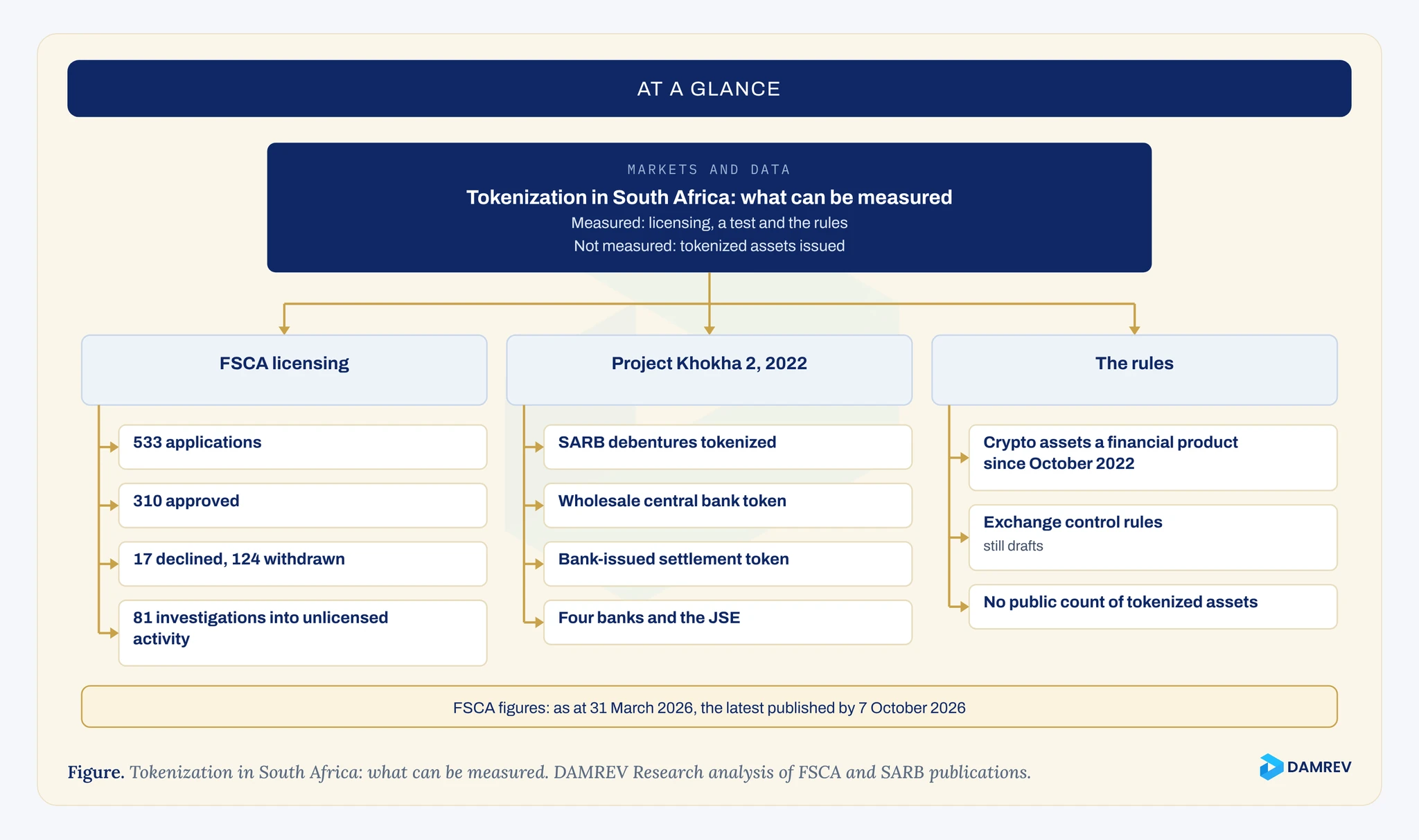
Public data on tokenization in South Africa measures licensing, an experiment, and rules, but not the assets themselves: the Financial Sector Conduct Authority (FSCA) had approved 310 crypto asset service provider licences by 31 March 2026, the South African Reserve Bank (SARB) tested tokenized debentures in 2022, and the main exchange control rules for crypto assets are still drafts1, 2, 3.
No public source we found counts tokenized assets issued in South Africa4.


In this article
01 · What can be measured
What can be measured about tokenization in South Africa?
Public data can measure three things about tokenization in South Africa: how many crypto asset service providers the FSCA has licensed, what the SARB tested when it tokenized its own debentures, and which rules are in force or in draft. The tokenized assets themselves are not counted by any public source we found1, 2, 3, 4.
Readers in South Africa ask how large tokenization is in their own market, and most published answers are global figures with a South African label attached. This article does the narrower thing: it sets out what public data can measure about tokenization in South Africa on 7 October 2026, and where the measurement stops.
The answer is uneven. South Africa has a detailed public record of who may provide crypto asset services, a published account of one central bank experiment in tokenized securities, and a regulatory pipeline whose status can be stated precisely.
It has no official statistic that we found for tokenized securities, funds, or property issued locally, and the leading public tracker does not show any asset as domiciled in South Africa on the pages we could read4.
That distinction shapes everything that follows. The most frequently cited South African figure, the number of licensed crypto asset service providers, measures the service industry around crypto assets. It does not measure tokenized assets, and it should not be read as if it did.
02 · Licensing
What does the licensing record show?
By 31 March 2026 the FSCA had received 533 applications from crypto asset service providers and approved 310, while 17 had been declined and 124 withdrawn. These were the latest figures we found published by 7 October 20261.
The FSCA's release of 15 April 2026 is the most recent public account of the licensing programme we found. It gives the number of applications and their outcomes as at 31 March 2026, and reports on enforcement against unlicensed providers1. Its previous release, of 15 December 2025, gave 300 approvals from 512 applications as at 12 December 20258.
- Crypto asset service provider licences approved by the FSCA, from 533 applications, as at 31 March 20261
- 310
- Applications voluntarily withdrawn, against 17 declined1
- 124
- Investigations opened into potential unlicensed activity, of which 51 were still under investigation1
- 81
By subtraction, 82 applications were still being assessed at that date. The FSCA did not state the figure1. In the three and a half months between its two releases, approvals rose by ten1, 8.
The record is now about six months old, which is itself a finding: the most cited South African measure is updated by occasional release, not on a schedule.
The figure also differs in kind from the global measures in this category. The trackers count tokens and their value; the FSCA counts firms and their licences1, 4. A rise in licensed providers can happen without a single tokenized asset being issued in South Africa, and the reverse is also possible.
The record says nothing about what the licensed providers do with tokenized assets. A licence covers services in relation to crypto assets as a class of financial product1. Whether any licensed provider handles tokenized securities, how much, or for whom, is not in the public record we read.
03 · The experiment
What has South Africa tested?
South Africa has tested tokenized SARB debentures in a proof of concept: Project Khokha 2, reported in April 2022, issued, cleared, and settled them on a distributed ledger with four banks and the Johannesburg Stock Exchange (JSE), using a wholesale central bank token and a bank-issued settlement token2, 7.
The central bank's experiment is the clearest public account of a tokenized security in South Africa. It is also an experiment, and the SARB says so.
What was tokenized
SARB debentures, a debt security the central bank issues, were issued, cleared, and settled on a distributed ledger2.
How it settled
Primary purchases settled in a wholesale central bank digital currency; secondary trades between participants in a settlement token issued by commercial banks2.
Who took part
The SARB with the Intergovernmental Fintech Working Group, and Absa, FirstRand, the JSE, Nedbank, and Standard Bank as industry participants2.
The report found that a single shared platform for a tokenized security could perform functions that separately licensed market infrastructures perform today, and that the legal, regulatory, and policy implications needed careful consideration first2, 7. It described the project as exploratory and said it did not imply a policy shift2.
What the experiment measured was feasibility, not a market. It was a proof of concept among the SARB and its participants, and the record we read reports no live issuance to investors that followed it2, 7. It remains the reference point because nothing comparable has been published since.
04 · The rules
Which rules apply, and in what state?
Of the five rules that bear on tokenization in South Africa, two are in force, one is guidance, and two are drafts. The FSCA's financial product declaration and the 1961 exchange control regulations apply today; the joint payments communication is guidance; the crypto exchange control regulations and manual are in consultation3, 5, 6, 9, 10.
The rules can be measured more precisely than the market, because each has a status and a date. Our South Africa Rule Tracker records them; the table records their position on 7 October 2026.
| Rule | Status | Date | Source |
|---|---|---|---|
| FSCA declaration of crypto assets as a financial product | In force | 19 October 2022 | 9 |
| Exchange Control Regulations, 1961 | In force | 1 December 1961 | 10 |
| SARB and FSCA Joint Communication on crypto assets for domestic payment purposes | Guidance | 28 May 2026 | 6 |
| Draft Capital Flow Management Regulations, 2026 | Consultation, closed 30 June 2026 | Not set | 3 |
| Draft Crypto Assets Manual | Consultation, closed 30 September 2026 | Not set | 5 |
The payments position is the one most often misread. The SARB and the FSCA state that "A crypto asset does not have legal tender status", and that crypto assets are not money under the National Payment System Act, while noting that stablecoins offer redemption at face value6.
That is guidance on payments. It says nothing about whether a security may be recorded or transferred as a token, which is a different question governed by different law.
The table shows a framework built mainly around crypto assets as a product and as a cross-border flow. None of the five instruments is written specifically for tokenized securities.
How the law that governs securities applies to a tokenized share or bond is a separate question, which these instruments do not address; our article on the draft exchange control regime reads the two drafts together.

05 · What it does not establish
What does this record not establish?
As of 7 October 2026, the public sources read here do not establish the size of tokenized assets in South Africa, the activity of licensed providers in tokenized securities, or any figure for the group's own programmes. This record sets out what public sources measure, and where they stop1, 4.
| Question | What the sources show | What they do not show |
|---|---|---|
| Tokenized assets issued locally | None found on the tracker pages we read4 | Whether any exist off public ledgers, or on pages the free view does not show |
| Licensed providers | 310 approved as at 31 March 20261 | What they do with tokenized securities |
| Tokenized securities | A 2022 central bank proof of concept2 | Live issuance to investors |
| Rules | Status and dates of five instruments3, 5, 6 | When the drafts will be finalised |
The absence of a tracker entry is not proof of absence. The free view of the leading tracker shows only the first page of each table, and an asset issued on a permissioned ledger that publishes no data would not appear in any public tracker4.
What can be said is narrower: on 7 October 2026, no public source we found counts tokenized assets issued in South Africa.
The group's Africa programme publishes on its own site, afrivest.org, and this article draws no figures from it. For a measured view of the global market, The Quarterly Reading sets out what one tracker showed on 7 October 2026.
Common questions
What else do people ask?
Short answers to the questions people ask most about this topic.
How large is the tokenized asset market in South Africa?
No public source we found measures it. On 7 October 2026 we found no asset shown as domiciled in South Africa on the public pages of the leading tracker, though its free view cannot confirm that none exists4.
How many crypto asset service providers are licensed in South Africa?
The FSCA had approved 310 licences from 533 applications by 31 March 2026, the latest figure we found published by 7 October 20261.
Has South Africa tokenized a security?
In a test. The SARB's Project Khokha 2, reported in April 2022, issued, cleared, and settled tokenized SARB debentures in a proof of concept with Absa, FirstRand, Nedbank, Standard Bank, and the JSE2.
Where should you go next?
The pages below pick up where this one ends. Start with the one closest to where your asset or programme stands today.
- South Africa's Draft Crypto Exchange Control Regime, Read as a WholeSouth Africa proposes to bring cross-border crypto asset transactions into exchange control through two drafts of April and August 2026. Neither is in force.
- How RWA Market Data Is Measured: The Trackers' Methods ComparedTrackers differ on what counts, how tokens are valued, and which wallets are left out, so totals ran from 31.76 to 77.2 billion US dollars.
- The Quarterly Reading, Q3 2026On 7 October 2026 tokenized assets other than stablecoins carried 39.02 billion US dollars of distributed value across 5.16 million holder addresses.
- AfriVestAfriVest, the Africa programme of the DAMREV group, which sits beneath DAMREV, publishes on its own site, afrivest.org.
References
- 1.Financial Sector Conduct Authority, press release, "Update on licensing and supervision of crypto asset service providers", 15 April 2026, figures as at 31 March 2026 (copy of the release; not found on fsca.co.za). https://www.masthead.co.za/wp-content/uploads/2026/05/FSCA_Press_Release_-_Update_on_licensing_and_supervision_of_CASPs.pdf
- 2.South African Reserve Bank, media release on the Project Khokha 2 report, 6 April 2022. https://www.resbank.co.za/content/dam/sarb/publications/media-releases/2022/project-khokha-2/Project%20Khokha%202%20Report%20media%20release%206%20April%202022.pdf
- 3.South African Reserve Bank, media release on the Draft Capital Flow Management Regulations, 2026. https://www.resbank.co.za/en/home/publications/publication-detail-pages/media-releases/2026/capital-flow-comment
- 4.RWA.xyz, asset screener and asset class pages, read 7 October 2026 at 19:44 UTC. https://app.rwa.xyz/asset-screener
- 5.South African Reserve Bank, media release on the Draft Crypto Assets Manual, 2026. https://www.resbank.co.za/en/home/publications/publication-detail-pages/media-releases/2026/crypto-assets
- 6.South African Reserve Bank and Financial Sector Conduct Authority, Joint Communication on crypto assets for domestic payment purposes, dated 28 May 2026 in its file name; the document itself is undated. https://www.resbank.co.za/content/dam/sarb/what-we-do/payments-and-settlements/regulation-oversight-and-supervision/designation-notices/280526%20Joint%20Communication_Crypto%20assets%20for%20domestic%20payment%20purposes.pdf
- 7.South African Reserve Bank, Project Khokha 2 Summary Report, 6 April 2022. https://www.resbank.co.za/content/dam/sarb/publications/media-releases/2022/project-khokha-2/Project%20Khokha%202%20Summary%20Report%206%20April%202022.pdf
- 8.Financial Sector Conduct Authority, press release, "Update on licensing and supervision of crypto asset service providers", 15 December 2025, figures as at 12 December 2025 (copy of the release; not found on fsca.co.za). https://jutacomplinews.co.za/media/filestore/2026/01/FSCA_Press_Release-Update_on_licensing_and_supervision_of_crypto_asset_service_providers_._2.pdf
- 9.Financial Sector Conduct Authority, Declaration of a crypto asset as a financial product under the Financial Advisory and Intermediary Services Act, General Notice 1350 of 2022, Government Gazette No. 47334, 19 October 2022. https://www.gov.za/sites/default/files/gcis_document/202210/47334gen1350.pdf
- 10.Exchange Control Regulations, 1961, Government Notice R.1111 of 1 December 1961, made under the Currency and Exchanges Act 9 of 1933, as amended up to Government Notice R.445 of 8 June 2012, published by the South African Reserve Bank. https://www.resbank.co.za/content/dam/sarb/what-we-do/financial-surveillance/financial-surveillance-documents/Exchange%20Control%20Regulations,%201961.pdf
This article is analysis of public sources, not legal advice. Last updated: