


Article · Markets & Data
Who Holds Tokenized Assets: Holder Counts, Concentration, & What a Wallet Count Hides
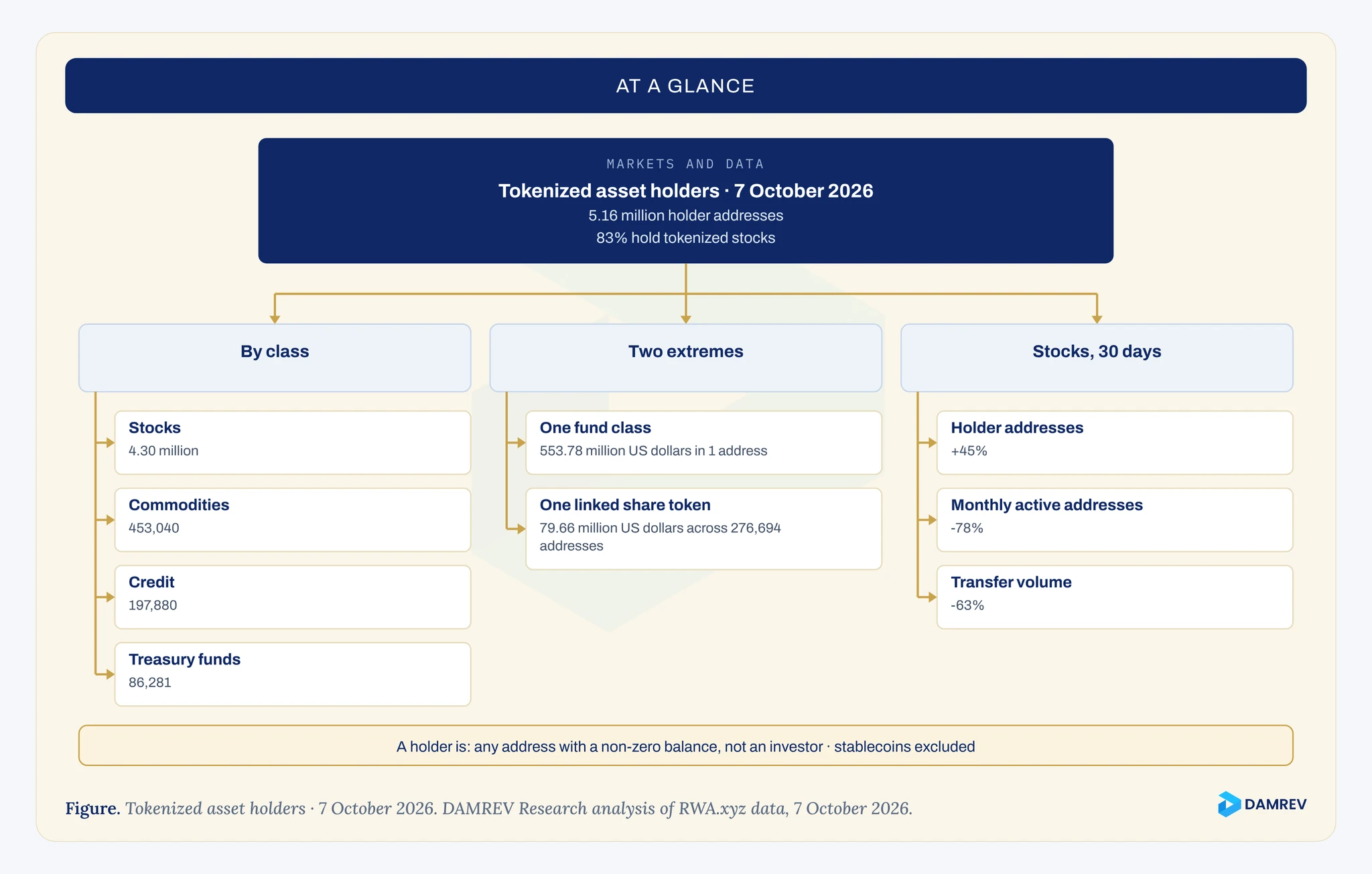
Tokenized asset holders numbered 5.16 million addresses on 7 October 2026 on RWA.xyz, stablecoins excluded, and 83 percent of them held tokenized stocks1, 2. A holder is an address with any non-zero balance, so the count says how widely tokens are spread, not how many investors there are or how much each holds3.


In this article
01 · The count
How many holders do tokenized assets have?
Tokenized assets had about 5.16 million holder addresses on 7 October 2026, stablecoins excluded. Tokenized stocks account for 4.30 million of them, and every other class for under a million together1, 2.
Holder counts appear in almost every account of the tokenized market, usually as evidence that adoption is broadening. The leading tracker reported 5,159,235 holder addresses at about 18:23 UTC on 7 October 2026, up 40.20 percent in 30 days1. Read against the classes, the figure is dominated by one of them.
- Holder addresses across tokenized assets, stablecoins excluded, on 7 October 20261
- 5.16 million
- Holder addresses for tokenized US Treasury funds, the class with the largest distributed value5
- 86,281
The contrast between value and holders runs through the whole market. Tokenized US Treasury funds held 15.00 billion US dollars of distributed value with 86,281 addresses5. Tokenized stocks held 3.23 billion with 4.30 million2. Commodities had 453,040 addresses, credit 197,8806, 7. The classes that hold the most value have the fewest addresses, and the reverse.
Stablecoins sit on another scale altogether. The same tracker counted 295.15 million stablecoin holder addresses on the same day, about 57 times the count for every other tokenized asset combined1. Tokens used as money have spread far more widely than tokens that represent an investment, and the two figures are reported separately for that reason.
02 · What a holder is
What does a holder count count?
A holder count counts addresses, not investors: an address counts as a holder if it holds any amount of a token above zero, however small, on the ledgers the tracker reads3.
The tracker defines the measure precisely, and the definition explains most of what follows.
The number of unique addresses holding a non-zero balance of the token, counted directly from on-chain state.3
Three consequences flow from it. An address holding one cent of a token counts the same as one holding a billion dollars. One investor using five wallets counts five times. And a custodian or transfer agent holding for thousands of clients at one address counts once3.
The tracker also publishes an adjusted count that "excludes known infrastructure addresses (bridges, smart contracts, treasury wallets)" to come closer to end users3. Which count a given dashboard figure uses is not stated beside the figure. Neither count can see through an exchange's or custodian's wallet to the clients behind it.
The class figures add up to the overall total within rounding1, 2, 5, 6, 7. That suggests the total sums each class's count, so an address holding tokens in two classes may count twice. The methodology does not say whether addresses are deduplicated across assets, and this reading leaves that question open3.
03 · Concentration
How concentrated are holdings?
Holdings of tokenized assets sit at opposite extremes, depending on the asset: some tokens hold hundreds of millions of US dollars across a handful of addresses; others spread tens of millions across hundreds of thousands, at a few hundred dollars each4.
Dividing an asset's total value by its holder addresses gives an average balance per address. An average hides how holdings are spread within the asset, which the free view does not show, but it separates two very different kinds of product.
| Asset type, as shown | Total value, millions of US dollars | Holder addresses | Average per address, US dollars |
|---|---|---|---|
| Money market fund class for non-US investors | 553.78 | 1 | 553,780,000 |
| Treasury liquidity fund for US qualified purchasers | 2,249.04 | 106 | 21,200,000 |
| Issuer-native share token of a US listed company | 328.66 | 77 | 4,270,000 |
| Yield product for non-US investors | 2,305.68 | 18,556 | 124,000 |
| Third-party token linked to a listed S&P 500 fund | 53.97 | 77,106 | 700 |
| Third-party token linked to one company's shares | 79.66 | 276,694 | 288 |
| Third-party token linked to a listed Nasdaq-100 fund | 67.42 | 326,957 | 206 |
The top of the table is institutional. Funds sold to qualified purchasers or professional investors have few holders by design, and a token issued by a company over its own shares can sit with a few dozen addresses4.
The bottom is retail in shape: small balances, very many addresses. The tracker describes its stocks class as including shares "issued natively onchain or represented synthetically"2, and the tokens with the largest counts here are issued by third parties, not by the companies whose shares they track4.
An average can mislead in either direction. An asset with 77 addresses may have one address holding nearly all of it, such as an issuer's own wallet or a custodian's omnibus account, and many holding very little.
The tracker's adjusted count removes known treasury wallets and contracts for this reason, but the free view does not show the distribution of balances3.
Most of the 5.16 million addresses therefore sit in the products that hold the least value per address. A headline count adds a fund's 106 addresses to a share-tracking token's 326,957 as if each address meant the same thing.
04 · The 30-day jump
What lies behind the 30-day jump?
The 30-day jump in tokenized asset holders reflects more addresses, not more activity: in the 30 days to 7 October 2026, tokenized stock holder addresses rose 45 percent while the class's monthly active addresses fell 78 percent2.
The overall holder count rose 40.20 percent in 30 days1. Almost all of the rise came from two classes: stocks, up 45.00 percent to 4.30 million, and commodities, up 39.03 percent to 453,0402, 6. Over the same 30 days, credit holder addresses rose 0.84 percent7; the Treasury fund dashboard showed a seven-day change of 0.61 percent5.
Holders up, activity down
Tokenized stocks showed 751,734 monthly active addresses, 78.28 percent fewer than 30 days earlier, while holder addresses rose by 45 percent2.
Volume down too
Monthly transfer volume in tokenized stocks was 11.28 billion US dollars, 63.37 percent lower than 30 days earlier2.
A count that only grows
An address keeps counting as a holder for as long as it holds any balance, whether or not it is ever used again3.
Taken together, these figures fit a pattern in which tokens reached many new addresses in small amounts while trading slowed. They do not show how that happened. Distribution through an exchange or wallet promotion, a token split across addresses, or genuine new buyers would each raise the count, and the dashboards do not distinguish them2, 3.

05 · What it does not establish
What does the holder count not establish?
As of 7 October 2026, the RWA.xyz dashboards and methodology read here do not establish how many investors hold tokenized assets, who they are, or how holdings are distributed within any asset. The holder count counts addresses with a balance, on one tracker's ledgers, on one day3.
| Question | What the count shows | What it does not show |
|---|---|---|
| Number of investors | Addresses with a non-zero balance3 | People or institutions; one may use many addresses, and one custodian may hold for many |
| Size of holdings | Total value per asset4 | How value is spread across addresses within an asset |
| Investor type | Eligibility shown on some asset pages4 | Whether a given address belongs to a retail or institutional holder |
| Growth | 30-day change in addresses1, 2 | Whether new addresses are new buyers, transfers, or distributions |
| Overlap | Counts per class1 | Whether an address in two classes is counted once or twice |
The count means more for some products than for others. Where every address must pass eligibility checks before it can receive a token, as in the restricted funds above, an address is close to an identified investor, though a custodian may still hold for several behind one address.
Where a token moves freely between wallets, an address may be anyone, including an exchange holding for thousands of customers3, 4.
These limits do not make the count useless. Across a class, it shows how widely a token has been spread, and set against value it separates institutional products from retail-shaped ones. What it cannot do is serve as a measure of adoption by investors, which is how it is most often quoted.
Common questions
What else do people ask?
Short answers on holder counts: how many people hold tokenized assets, why tokenized stocks have so many holders, whether one investor can appear as several, and whether a rising count means more investors.
How many people hold tokenized assets?
No public source counts people. The tracker counts addresses with a non-zero balance: 5,159,235 on 7 October 2026, stablecoins excluded1, 3.
Why do tokenized stocks have so many holders?
Some tokens linked to listed shares and funds are spread across hundreds of thousands of addresses with small average balances. One such token showed 326,957 addresses and about 206 US dollars per address4.
Can one investor appear as several holders?
Yes. A holder count counts addresses, and one investor can use several. A custodian can also hold for many investors at one address, which pulls the count the other way3.
Does a rising holder count mean more investors?
Not necessarily. In the 30 days to 7 October 2026, holder addresses for tokenized stocks rose 45 percent while monthly active addresses fell 78 percent2.
Where should you go next?
The pages below pick up where this one ends. Start with the one closest to where your asset or programme stands today.
- Tokenized Money Market Funds: Who Holds Them, & What They Are Used ForOn 7 October 2026 nine of the ten largest tokenized money market products held 10.63 billion US dollars across 2,375 addresses.
- The Quarterly Reading, Q3 2026On 7 October 2026 tokenized assets other than stablecoins carried 39.02 billion US dollars of distributed value across 5.16 million holder addresses.
- Tokenized Stocks Are Not One Product: Issuer Shares, Security Entitlements, & Synthetic Exposure ComparedA tokenized stock can be the company's own share, a custodian's security entitlement, or synthetic exposure, each with a different issuer and rights.
- Screening & OnboardingHow investors are verified by a licensed provider before holding anything and checked again at every transfer, with anti-money laundering, sanctions, and travel-rule obligations met.
References
- 1.RWA.xyz, Global Market Overview dashboard, read 7 October 2026 at about 18:23 UTC. https://app.rwa.xyz/
- 2.RWA.xyz, Tokenized Stocks dashboard, read 7 October 2026 at 18:52 UTC. https://app.rwa.xyz/stocks
- 3.RWA.xyz documentation, "Metrics", read 7 October 2026. https://docs.rwa.xyz/methodology/metrics
- 4.RWA.xyz, asset pages for tokenized stocks and funds, read 7 October 2026 at 18:36 and 18:53 UTC. Each asset and its figures are listed in the raw pull kept with this article. Example page shown. https://app.rwa.xyz/assets/QQQB
- 5.RWA.xyz, Tokenized U.S. Treasury Funds dashboard, read 7 October 2026 at 18:24 UTC. https://app.rwa.xyz/treasuries
- 6.RWA.xyz, Tokenized Commodities dashboard, read 7 October 2026 at 18:24 UTC. https://app.rwa.xyz/commodities
- 7.RWA.xyz, Tokenized Credit dashboard, read 7 October 2026 at 18:24 UTC. https://app.rwa.xyz/credit
This article is analysis of public sources, not legal advice. Last updated:




