


Article · Markets & Data
Tokenized Money Market Funds: Who Holds Them, & What They Are Used For
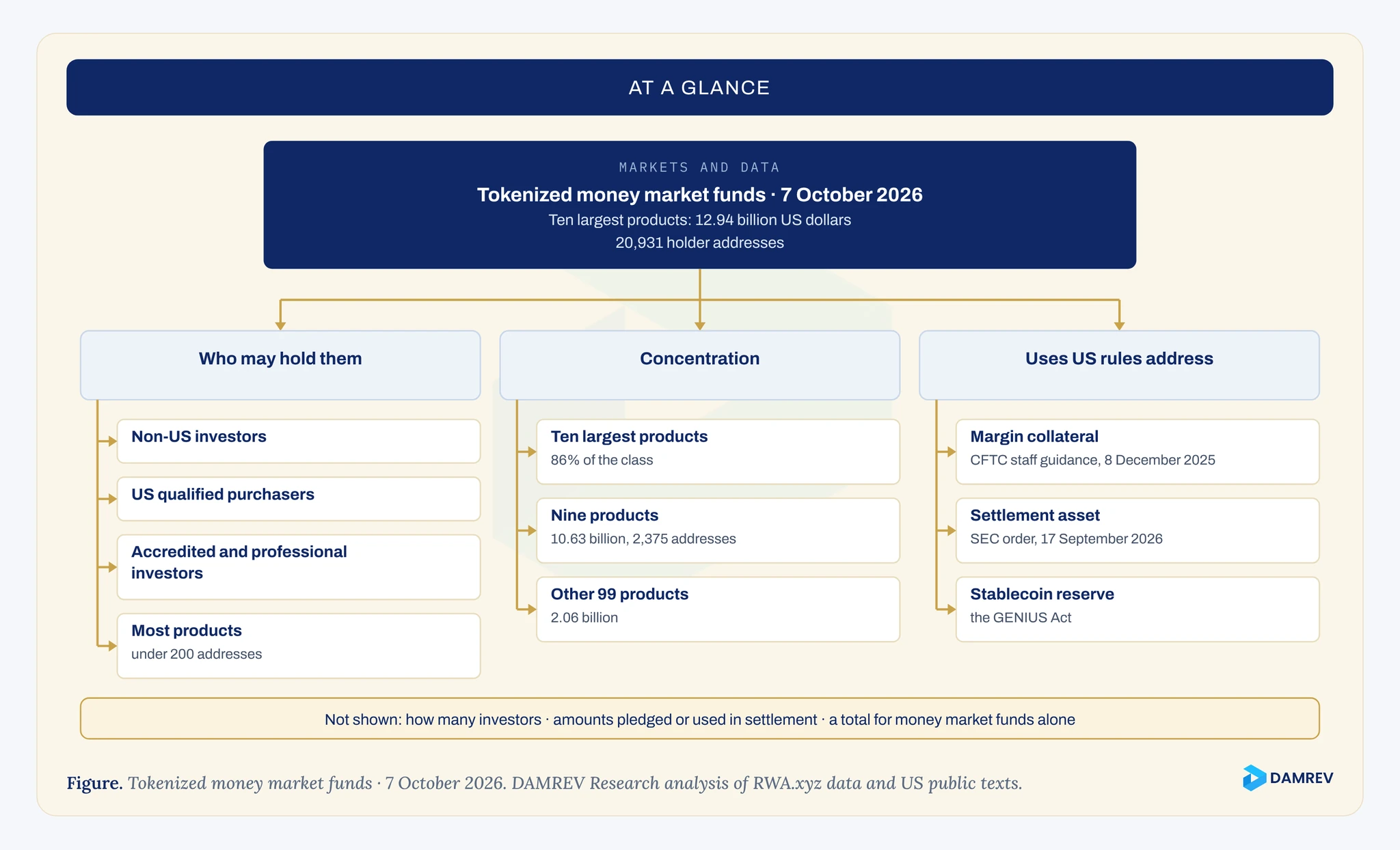
Very few holders hold most of the value of tokenized money market funds: on 7 October 2026 the ten largest tokenized Treasury and money market products carried 12.94 billion US dollars across 20,931 addresses, and nine of them held 10.63 billion across 2,3751, 2.
These funds are used as cash, and US rules now address three further uses: margin collateral, a settlement asset on tokenized venues, and stablecoin reserves3, 4, 5.


In this article
01 · What is counted
What is a tokenized money market fund, and what does the data count?
A tokenized money market fund is a money market fund whose shares are recorded and transferred as tokens, and no tracker counts these funds on their own. The nearest published class, tokenized US Treasury funds, held 15.00 billion US dollars of distributed value on 7 October 20261.
The fund is the same legal vehicle it would be without the token. What changes is the register: the holding of a share is recorded on a ledger, and in most cases the share can move from one approved wallet to another.
The fund's rules on who may invest, how it values its assets, and when it redeems are set by its documents and its regulator, not by the token.
Measuring these funds is harder than defining them. The leading tracker does not publish a money market fund class. It publishes a class of tokenized US Treasury funds, which it describes as covering Treasury bills, notes, bonds, and Treasury-focused money market funds1.
On 7 October 2026 that class held 15.00 billion US dollars of distributed value in 109 assets, with 86,281 holder addresses1.
Not every product in the class calls itself a money market fund. Among the ten largest, three have "money market" in their names, and others are described as liquidity funds, short-duration government securities funds, or yield products2. This article uses the class as the closest measure available and says where that matters.
02 · Who holds them
Who holds tokenized money market funds?
Tokenized money market funds are held mostly by a small number of eligible investors: the ten largest products are open only to restricted groups such as qualified purchasers, accredited or professional investors, or non-US investors, and most have fewer than 200 holder addresses2.
The tracker publishes, for each product, its total value, its holder addresses, and the class of investor it may be sold to. We read the asset pages of the ten largest products by total value at 18:36 UTC on 7 October 2026.
We describe them by eligibility, not by name, because the article concerns the shape of the market and not any one provider2.
| Rank by value | Investors it may be sold to, as shown | Total value, millions of US dollars | Holder addresses |
|---|---|---|---|
| 1 | Non-US investors | 2,400 | 35 |
| 2 | Non-US investors | 2,310 | 18,556 |
| 3 | US qualified purchasers | 2,250 | 106 |
| 4 | Not shown | 1,710 | 47 |
| 5 | US investors | 1,230 | 916 |
| 6 | Not shown | 761 | 1,128 |
| 7 | Professional investors and US qualified institutional buyers | 755 | 8 |
| 8 | US qualified purchasers and accredited investors | 624 | 104 |
| 9 | Non-US investors | 554 | 1 |
| 10 | Non-US professional investors | 345 | 30 |
The pattern is clear even without names. Four of the ten have fewer than 40 holder addresses. One has a single address. The only product with a five-figure count is open to non-US investors and is not described as a money market fund2.
A fund that admits only qualified purchasers is built for institutions and large family offices, and its holder count reflects that.
All ten are counted as distributed, which can look like a contradiction. The tracker treats a token as distributed when it can move to wallets outside the issuing platform, including wallets subject to whitelist or eligibility controls7.
A fund can therefore be closed to the public and still be distributed on this measure: its shares move on a public ledger, but only between wallets that the fund or its transfer agent has approved. Distributed describes how the share moves. It says nothing about who may buy it.
03 · Concentration
How concentrated is the holding?
Holding of tokenized Treasury and money market products is highly concentrated: the ten largest products hold 86 percent of the class's value. Leaving out the one product with a large retail-style count, nine products hold 10.63 billion US dollars across 2,375 addresses1, 2.
- Share of the class's 15.00 billion US dollars of distributed value held in its ten largest products2, 1
- 86%
- Holder addresses across nine of the ten largest products, which together hold 10.63 billion US dollars2
- 2,375
The arithmetic gives an average of about 4.5 million US dollars per address across those nine products. An average hides a great deal, and the tracker's free view does not show how value is spread across addresses within a product.
It does show that most of the class's holders sit in small products, and most of its value sits with a few thousand addresses1, 2.
This concentration is what the eligibility rules would predict. Funds sold only to qualified purchasers, qualified institutional buyers, or professional investors have few holders by design. A tokenized share does not widen eligibility. It changes how the holding is recorded and moved, not who may hold it.
04 · What they are used for
What are tokenized money market funds used for?
Tokenized money market funds are used as cash that can move on a ledger, and in three further roles that US rules now address: margin collateral in derivatives markets, a settlement asset on tokenized securities venues, and a reserve asset for payment stablecoins3, 4, 5.
The basic use is the one a money market fund always had: holding cash in a fund rather than a deposit. What the token adds is that the share can move between approved wallets at any hour, which makes it usable in places where a conventional fund share is hard to deliver. Three US texts now speak to those places.
Collateral for futures and swaps
Commodity Futures Trading Commission (CFTC) staff guidance of 8 December 2025 applies to tokenized assets including money market fund shares. It sets out eligibility, legal enforceability, segregation and custody, haircuts, and operational risk, and creates no new rule3, 6.
A settlement asset on tokenized venues
The Securities and Exchange Commission's (SEC) exemptive order of 17 September 2026 lets a tokenized National Market System (NMS) stock be paired with a tokenized money market fund on a tokenized securities venue4.
A stablecoin reserve
The GENIUS Act lists registered government money market funds invested solely in the other listed reserves, and allows the listed reserves, other than repurchase and reverse repurchase agreements, in tokenized form where they comply with applicable law5.
The collateral guidance is careful about the token itself. It asks whether a tokenized asset gives rights "the same or functionally equivalent" to the conventional asset, and whether it can bear an equivalent haircut once settlement and operational risks are counted3.
However, different tokenization methods may provide different rights to token-holders or different levels of protection.3
That sentence explains why the use of a tokenized fund share as collateral is decided case by case. The fund may be identical; the token's legal link to the share, how it is held, and what happens if the ledger fails may not be3.

05 · What it does not establish
What does this reading not establish?
As of 7 October 2026, the RWA.xyz figures and US texts read here do not establish how many investors hold tokenized money market funds, how much is actually pledged or used in settlement, or whether any product qualifies for any of the three roles. This article records holdings and the texts that permit uses1, 3, 5.
| Question | What the sources show | What they do not show |
|---|---|---|
| Number of investors | Holder addresses per product2 | People or institutions behind each address |
| Use as collateral | The CFTC staff framework for assessing it3 | How much is pledged, with whom, or at what haircut |
| Use on a tokenized venue | That the SEC order permits the pairing4 | Whether any venue is operating under the order |
| Use as a stablecoin reserve | The statutory list of eligible reserves5 | Which issuers hold which funds, or when the reserve rules bind |
| Size of the fund market | A class that mixes funds with other Treasury products1 | A total for money market funds alone |
The holder figures count addresses on the ledgers the tracker reads. A transfer agent or custodian can hold for many clients at one address, and some funds keep part of their register off-chain, so the true number of investors may be higher or lower1, 2.
None of the three uses is a finding that any product qualifies. Each text sets conditions, and whether a given fund meets them is a question for the fund, its counterparties, and their advisers. The GENIUS Act's reserve rules also do not yet bind; our article on its dates sets out the dates the Act itself fixes5.
Common questions
What else do people ask?
Short answers to the questions people ask most about this topic.
How large is the tokenized money market fund market?
No tracker publishes that figure on its own. The nearest is RWA.xyz's class of tokenized US Treasury funds, which carried 15.00 billion US dollars of distributed value on 7 October 2026 and mixes money market funds with other Treasury products1.
Can a tokenized money market fund be posted as margin?
CFTC staff guidance of 8 December 2025 covers tokenized money market fund shares as collateral, but it creates no new rule. A firm must still show the asset is eligible, legally enforceable, properly held, and correctly haircut3.
Can a stablecoin issuer hold tokenized money market fund shares as reserves?
The GENIUS Act lists registered government money market funds invested solely in the other listed reserve assets, and allows the listed reserves, other than repurchase and reverse repurchase agreements, in tokenized form if they comply with applicable law5. When the Act takes effect is covered in our article on its dates.
Is a holder count the number of investors?
No. It counts addresses. A custodian or transfer agent can hold for many investors at one address, and one investor can use several1.
Where should you go next?
The pages below pick up where this one ends. Start with the one closest to where your asset or programme stands today.
- Why the First US-Registered Tokenized Money Market Fund Runs on StellarThe first US-registered money market fund with a public blockchain as its official record runs on Stellar: finality at ledger close, and issuer controls.
- The Quarterly Reading, Q3 2026On 7 October 2026 tokenized assets other than stablecoins carried 39.02 billion US dollars of distributed value across 5.16 million holder addresses.
- Who Holds Tokenized Assets: Holder Counts, Concentration, & What a Wallet Count HidesOn 7 October 2026 tokenized assets had 5.16 million holder addresses. An address is not an investor, so the count shows only spread.
- When the GENIUS Act Takes Effect: 18 January 2027 & 18 July 2028The GENIUS Act binds payment stablecoin issuers from 18 January 2027, not the firms that hold or settle in stablecoins. Service providers follow in 2028.
References
- 1.RWA.xyz, Tokenized U.S. Treasury Funds dashboard and assets table, read 7 October 2026 at 18:35 UTC. https://app.rwa.xyz/treasuries
- 2.RWA.xyz, asset pages for the ten largest products in the class by total asset value, read 7 October 2026 at 18:36 UTC. The products and their figures are listed in the raw pull kept with this article. Example page shown. https://app.rwa.xyz/assets/BUIDL
- 3.CFTC Market Participants Division, Division of Market Oversight, and Division of Clearing and Risk, "Tokenized Collateral Guidance", CFTC Letter No. 25-39, 8 December 2025. https://www.cftc.gov/csl/25-39/download
- 4.US Securities and Exchange Commission, Order Granting Temporary Conditional Exemptive Relief (Tokenized Securities Venues), Exchange Act Release No. 34-106402, 17 September 2026. https://www.sec.gov/files/rules/exorders/2026/34-106402.pdf
- 5.Guiding and Establishing National Innovation for U.S. Stablecoins Act (GENIUS Act), Public Law 119-27, Section 4(a)(1)(A), 18 July 2025. https://www.congress.gov/119/plaws/publ27/PLAW-119publ27.htm
- 6.US Commodity Futures Trading Commission, press release 9146-25, "Acting Chairman Pham Announces Launch of Digital Assets Pilot Program for Tokenized Collateral in Derivatives Markets", 8 December 2025. https://www.cftc.gov/PressRoom/PressReleases/9146-25
- 7.RWA.xyz (Bryan Choe), "A New Framework for Tokenized Assets: Distributed & Represented", 21 November 2025. https://app.rwa.xyz/blog/a-new-framework-for-tokenized-assets-distributed-and-represented
This article is analysis of public sources, not legal advice. Last updated:




