


Article · Markets & Data
Tokenized Bonds: What Sovereigns, Agencies, & Banks Have Actually Issued, Measured
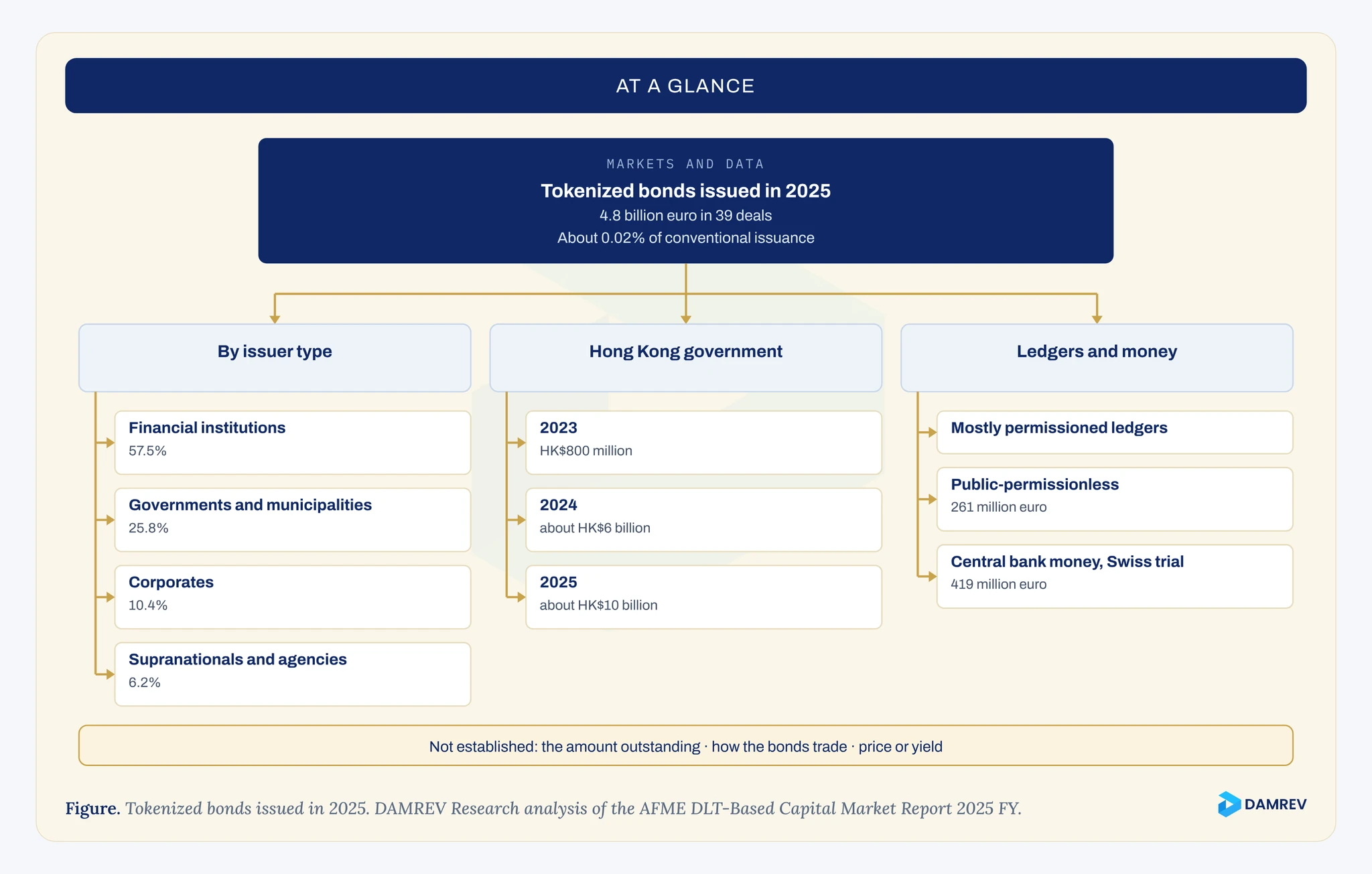
Tokenized bond issuance is small measured against the bond market: 4.8 billion euro of fixed income was issued on distributed ledgers in 2025, in 39 deals, against about 23 trillion euro of conventional fixed income issued each year1. Banks and other financial institutions issued 57.5 percent of it, governments and municipalities 25.8 percent, and supranationals and agencies 6.2 percent1.


In this article
01 · How much
How much has been issued as tokenized bonds?
Issuance of tokenized bonds was 4.8 billion euro in 2025, in 39 deals, up from 3.25 billion in 2024, and about 0.02 percent of the 23 trillion euro of conventional fixed income issued each year1.
The most complete public count of bonds issued on distributed ledgers is kept by the Association for Financial Markets in Europe (AFME).
Its report for 2025, with data to December, counts bonds, bills, commercial paper, covered bonds, and structured notes issued natively on a ledger, and excludes deals whose value was not disclosed1, 3. It is a measure of issuance in a year, not of bonds outstanding.
- Fixed income issued on distributed ledgers worldwide in 2025, in 39 deals1
- 4.8 billion euro
- Change from 2024, when 3.25 billion euro was issued1
- +48%
- Share of the 23 trillion euro of conventional fixed income issued each year, on AFME's comparison1
- About 0.02%
The series is short and uneven. AFME counts 270 million euro in 2021, 882 million in 2022, 860 million in 2023, 3.25 billion in 2024, and 4.81 billion in 20251.
The jump in 2024 owed much to central bank trials: the European Central Bank and the Swiss National Bank ran experiments that year in settling ledger-based securities in central bank money, and bonds were issued to take part in them1, 2.
The central bank's own study confirms how recent the activity is. Its sample of 183 tokenized bonds issued between August 2018 and November 2025 found that 88 percent were issued in the last three years2. On either count, tokenized bonds are an experiment conducted by real issuers, not yet a segment of the bond market.
02 · Who issued
Who issued them?
Tokenized bonds were issued mainly by banks and other financial institutions, then by governments and municipalities. Supranationals and agencies, often described as the natural first issuers, accounted for 6.2 percent in 20251.
The title of this article names sovereigns, agencies, and banks because they are the issuers most often cited in this market. The 2025 count shows how much each actually issued.
Geography moved in 2025. Issuers based in Asia raised 3.8 billion euro, against 893 million euro in Europe, down from 1.7 billion in 20241. Within Europe, Switzerland accounted for 536 million euro and Germany for 300 million1.
The central bank's sample tells a different story, because it counts bonds rather than euro.
In that sample, 91 percent of issuers were corporations, a group that includes public financial institutions such as development banks, and two-thirds of issuers were domiciled in Germany, where an electronic securities law allows bonds to be issued on a register without a paper certificate2.
The sample draws in part on the German supervisor's register of such securities, which on our reading may lift the German share2. Many small German issues raise the count; a few large Asian issues raise the value. Both are accurate, and they answer different questions.
03 · A sovereign series
What has a sovereign actually issued?
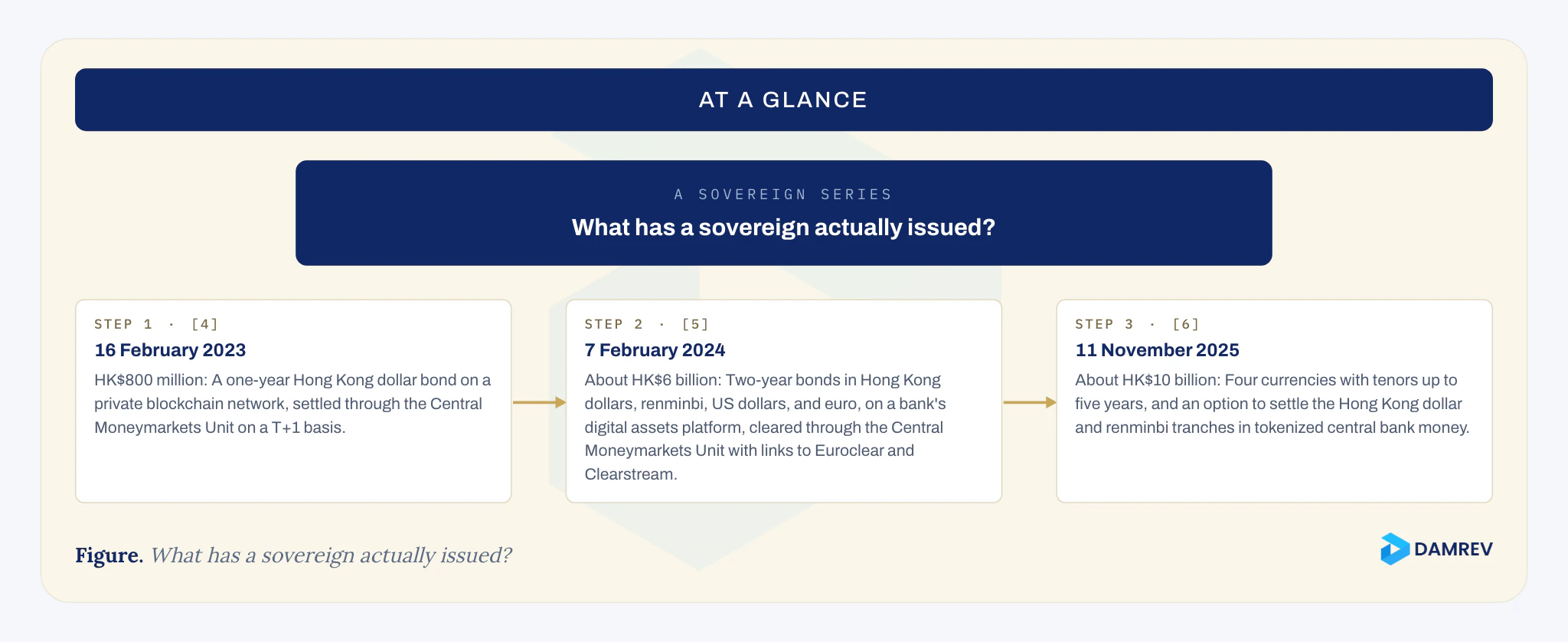
Hong Kong's government has the clearest public record of sovereign tokenized issuance, with three series of tokenized green bonds: HK$800 million in 2023, about HK$6 billion in 2024, and about HK$10 billion in 2025, each settled through the central securities depository4, 5, 6.
A sovereign series shows what tokenized issuance looks like when a government repeats it. Each Hong Kong issue is set out in the government's own release, and the three together show size, currencies, and settlement changing in a short time.
The Hong Kong government's tokenized green bonds, 2023 to 2025, from its own releases
- What has a sovereign actually issued?
- 16 February 2023: HK$800 million: A one-year Hong Kong dollar bond on a private blockchain network, settled through the Central Moneymarkets Unit on a T+1 basis. (Step 1, [4])
- 7 February 2024: About HK$6 billion: Two-year bonds in Hong Kong dollars, renminbi, US dollars, and euro, on a bank's digital assets platform, cleared through the Central Moneymarkets Unit with links to Euroclear and Clearstream. (Step 2, [5])
- 11 November 2025: About HK$10 billion: Four currencies with tenors up to five years, and an option to settle the Hong Kong dollar and renminbi tranches in tokenized central bank money. (Step 3, [6])
Three features stand out. Each issue was larger than the last. Each settled through the existing central securities depository rather than around it4, 5, 6. And the third introduced settlement in tokenized central bank money as an option, not a requirement6. The government built the token onto the existing system rather than replacing it.
Five of the 2024 and 2025 tranches appear in AFME's list of the largest digital green bond issues worldwide, which is one reason governments and municipalities reached a quarter of 2025's total1.
04 · How they were built
On what ledgers, and settled in what money?
Tokenized bonds issued in 2025 were mostly on ledgers that only approved institutions can write to, and mostly settled in money the report does not identify. Public-permissionless ledgers carried 261 million euro of 2025's issuance, and central bank money in a Swiss trial settled 419 million1.
The ledger breakdown in the 2025 report, as published, accounts for about 2.0 billion of the 4.8 billion euro issued. Of that, 1,680 million euro was on public-permissioned ledgers, which anyone may read but only approved parties may write to; 261 million on public-permissionless ledgers; and 69 million on private ledgers1.
The settlement asset is undisclosed for 4,084 million euro, about 85 percent. Of the rest, 419 million euro settled in Swiss wholesale central bank digital currency, 290 million in conventional money, and 19 million in a Japanese bank deposit token1.
These figures describe a market built by and for institutions. A tokenized bond in this sense is usually a security recorded by a regulated platform, settled through or alongside a central securities depository, and held by banks and investors that platform has admitted. That is a different object from the transferable tokens a public tracker counts.
On 7 October 2026, RWA.xyz showed 946.12 million US dollars of tokenized non-US government debt as distributed value outstanding7. That figure measures a stock of transferable tokens, not a year's issuance, and it cannot be compared with the AFME count.

05 · What it does not establish
What does the record not establish?
As of 7 October 2026, the industry count and central bank study read here do not establish how much is outstanding, how the bonds trade, or anything about their price or yield. The industry count covers what was issued, where the value was disclosed, under one association's definition1.
Not an outstanding total
The industry count is issuance per year. Bonds mature, and short-dated ones mature quickly, so the sum of the years overstates what is outstanding1.
Not complete
Deals without a disclosed value are excluded. Of about 51 German deals in one register, 27 were left out for that reason1.
Not about price
This article measures issuance only. It says nothing on the price, yield, or prospects of any bond or issuer.
The record also does not show whether tokenization changed the cost or terms of borrowing. The central bank's study found that tokenized bonds tend to have maturities about six months shorter on average than conventional bonds, and its econometric sample held only 41 tokenized bonds2.
A small sample of early adopters cannot say what a mature market would look like.
What the record does show is scale and direction. In 2025 the world's tokenized bond issuance was about 0.02 percent of conventional issuance, it came mostly from banks, and the governments that took part kept their bonds inside existing settlement systems. That is the measured position as of October 2026.
Common questions
What else do people ask?
Short answers on tokenized bonds: how large the market is, whether governments have issued them, whether they are issued on public blockchains, and why sources give different pictures.
How large is the tokenized bond market?
On issuance, 4.8 billion euro in 2025 and 3.25 billion in 2024, on the count of the Association for Financial Markets in Europe1. No source we found states an outstanding total for every ledger.
Have governments issued tokenized bonds?
Yes, in small amounts. Governments and municipalities issued 25.8 percent of 2025's total, and the Hong Kong government has issued three series since 2023, the largest about HK$10 billion1, 4, 5, 6.
Are tokenized bonds issued on public blockchains?
Mostly not. Of the 2025 issuance whose ledger type was reported, about 84 percent was on public-permissioned ledgers and 13 percent on public-permissionless ones1.
Where should you go next?
The pages below pick up where this one ends. Start with the one closest to where your asset or programme stands today.
- Why Tokenization Forecasts DisagreeSix widely cited tokenization forecasts run from about 2 trillion to 30.1 trillion US dollars, mostly because they count different things to different years.
- How RWA Market Data Is Measured: The Trackers' Methods ComparedTrackers differ on what counts, how tokens are valued, and which wallets are left out, so totals ran from 31.76 to 77.2 billion US dollars.
- Settlement Finality on a Blockchain: Why a Register Cannot Be Probably TrueA register can record a transfer only once it is final. Probabilistic finality never gets there outright, and technical finality is not legal finality.
- Advisory & StructuringSettling the asset, the claim, the vehicle, the ranking, and the control framework with your counsel before any technology.
References
- 1.Association for Financial Markets in Europe (AFME), DLT-Based Capital Market Report 2025 FY, published 24 February 2026, data to December 2025. https://www.afme.eu/media/5npbm5g2/afme-dlt-report-2025-fy.pdf
- 2.European Central Bank, Macroprudential Bulletin 33, "Tokenised bonds: assessing efficiency and liquidity in a nascent market", 13 April 2026. https://www.ecb.europa.eu/press/financial-stability-publications/macroprudential-bulletin/html/ecb.mpbu202604_03.en.html
- 3.AFME, DLT-Based Capital Market Report 2025 FY, publication page. https://www.afme.eu/publications/data-research/dlt-based-capital-market-report-2025-fy/
- 4.HKSAR Government, "HKSAR Government's Inaugural Tokenised Green Bond Offering", 16 February 2023. https://www.info.gov.hk/gia/general/202302/16/P2023021600466.htm
- 5.HKSAR Government, "HKSAR Government's Digital Green Bonds Offering", 7 February 2024. https://www.info.gov.hk/gia/general/202402/07/P2024020700516.htm
- 6.HKSAR Government, "HKSAR Government's Third Digital Green Bonds Offering", 11 November 2025. https://www.info.gov.hk/gia/general/202511/11/P2025111100724.htm
- 7.RWA.xyz, Tokenized Non-U.S. Government Debt dashboard, read 7 October 2026 at 18:24 UTC. https://app.rwa.xyz/government-bonds
This article is analysis of public sources, not legal advice. Last updated:




