


Article · Markets & Data
Tokenized Private Credit in a Downturn: What the Record of Defaults Shows
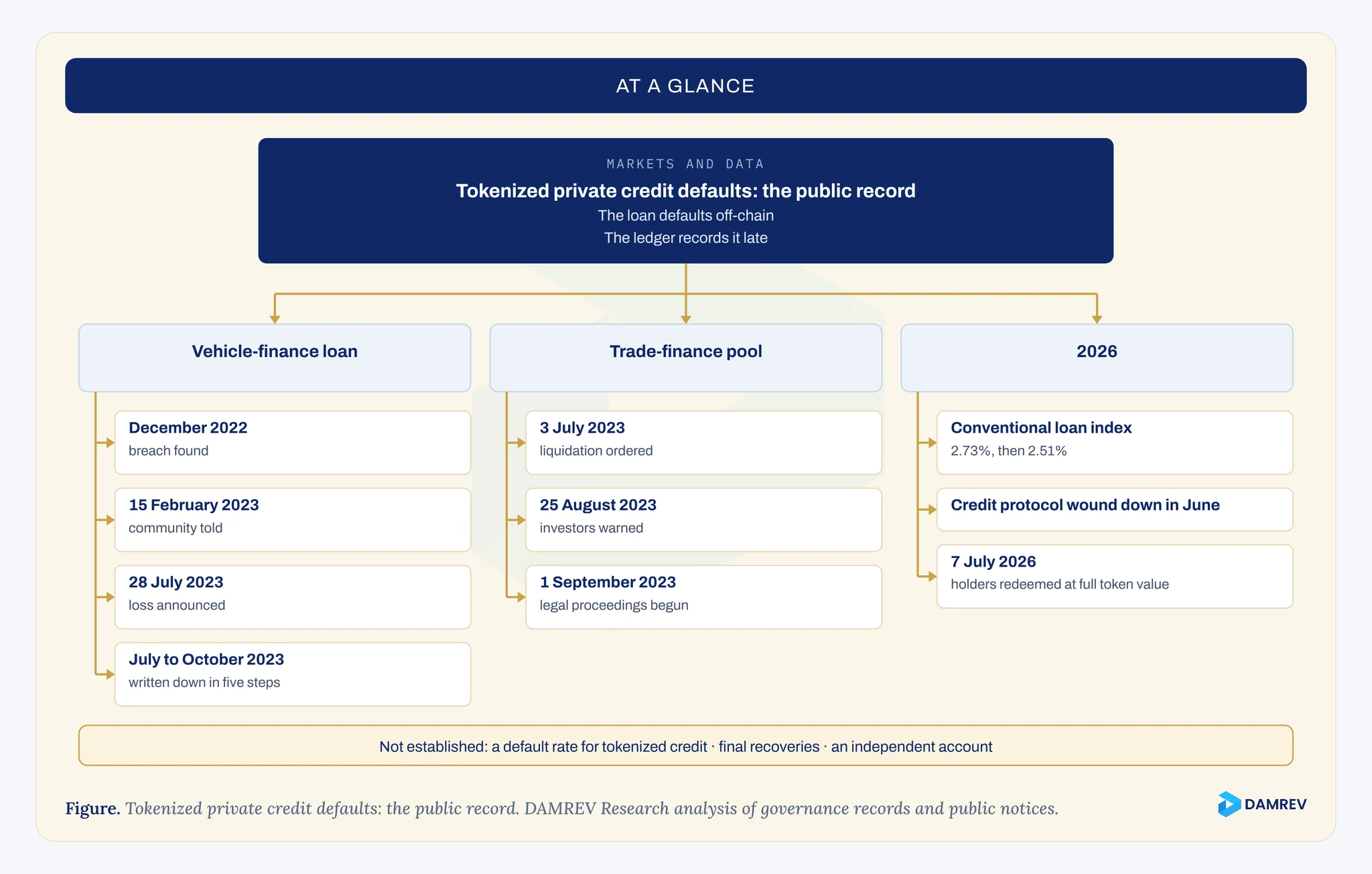
The public record of tokenized private credit defaults shows that a tokenized loan defaults the way any loan does, off-chain, and that the ledger learns of it late: in the cases on record, losses reached token holders through lenders' and originators' notices weeks or months after the event, not through on-chain data1, 2, 3.
What the ledger then did well was apply and display the loss, step by step and in public1, 4.


In this article
01 · The question
Does a tokenized loan default differently?
A tokenized loan does not default differently: the borrower fails to pay off-chain, under a loan agreement and the law that governs it. The token records the consequence once the lender, the originator, or a court has acted1, 3.
Tokenized private credit is often sold on transparency. This article asks what the public record showed when loans in tokenized pools failed, and when it showed it.
The record is short: a few on-chain credit pools, mostly in 2022 and 2023, and one wind-down in 2026. The platforms and borrowers are named in the references.
02 · A vehicle-finance loan, 2023
What happened when a vehicle-finance loan failed in 2023?
In the 2023 vehicle-finance case, the lender found the problem in the borrower's own reports in December 2022, told the community in February 2023, and announced a possible total loss of the 5 million US dollar loan in July. The write-down was then applied in five public steps1, 2.
The borrower was an East African vehicle-finance company that had borrowed 5 million US dollars from an on-chain senior pool. According to the lender's agents, a review of the borrower's reporting in December 2022 found a related-party loan that breached the facility agreement1.
The community was told on 15 February 2023 and asked to appoint an agent to act for it2. No payment had yet been missed.
The record of one tokenized loan default, from discovery to write-down
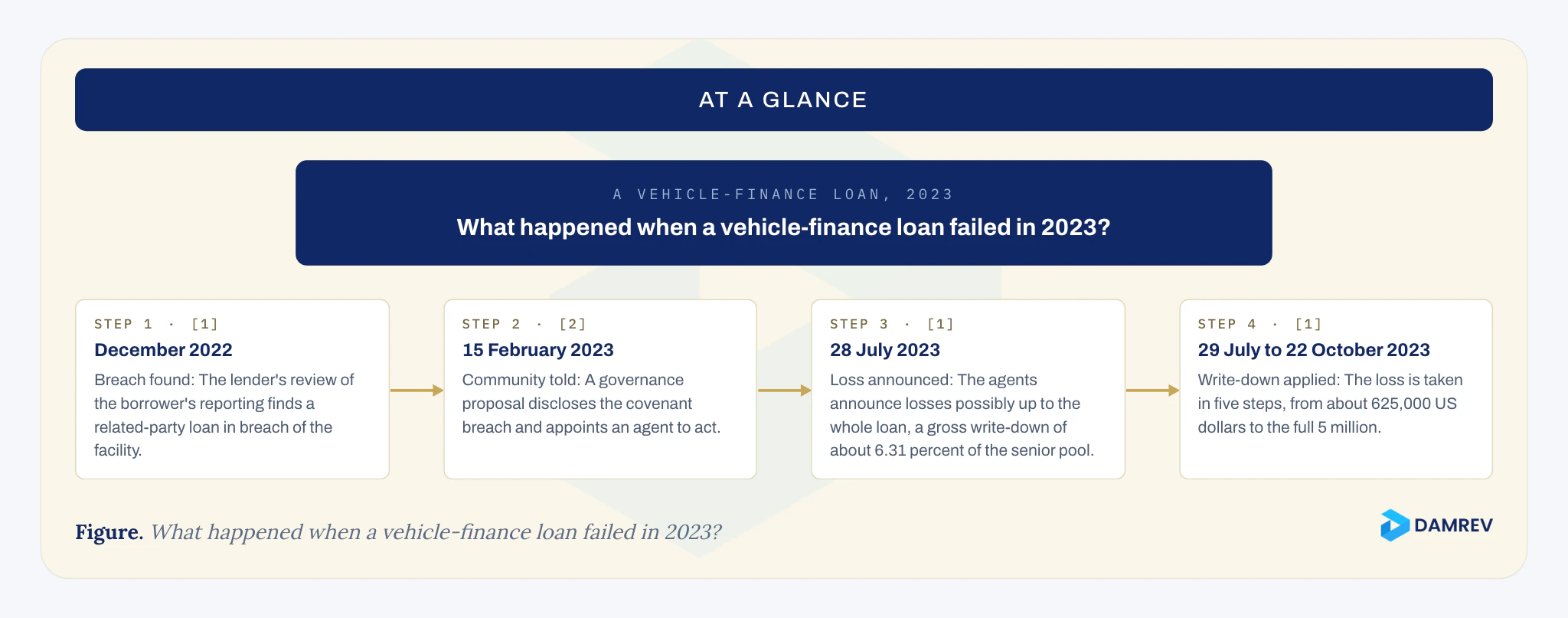
- What happened when a vehicle-finance loan failed in 2023?
- December 2022: Breach found: The lender's review of the borrower's reporting finds a related-party loan in breach of the facility. (Step 1, [1])
- 15 February 2023: Community told: A governance proposal discloses the covenant breach and appoints an agent to act. (Step 2, [2])
- 28 July 2023: Loss announced: The agents announce losses possibly up to the whole loan, a gross write-down of about 6.31 percent of the senior pool. (Step 3, [1])
- 29 July to 22 October 2023: Write-down applied: The loss is taken in five steps, from about 625,000 US dollars to the full 5 million. (Step 4, [1])
Seven months passed between the discovery and the announcement of a loss. Forum readers knew of the breach in February; holders watching only the chain saw nothing until the first write-down on 29 July1, 2.
The ledger did show one thing that no notice did: what the market thought. One analysis, published by RWA.xyz, reports that on 17 September 2023 a Curve pool priced the pool's token at about 0.80 US dollars, against a share price of about 1.15 recorded by the protocol4.
The gap was wider than the announced loss alone would explain, and one analysis put it down to a loss of confidence after the notices4. The chain recorded the reaction, not the cause.
The lender's agent reported on 16 December 2024 that a restructuring had completed in November 2024, with 460,000 US dollars paid on-chain to the senior pool, 250,000 of it in loan recovery and 210,000 in closing fees8.
The same post records a payment of 1 million US dollars made by the community in late 2023 under a governance proposal responding to the default8. Most of the principal was not recovered, and the final figures came almost two years after the breach was found.
03 · A trade-finance pool, 2023
What happened when a trade-finance pool's borrower collapsed?
In the 2023 trade-finance case, a court ordered the borrower's liquidation on 3 July 2023, according to a regulator's notice cited by a forum participant. The originator told pool investors of a significant risk of loss on 25 August, more than seven weeks later3.
The second case is a trade-finance pool whose largest borrowers were an Australian company and its New Zealand affiliate.
On 25 August 2023 the originator posted a notice that the pool had an exposure of 1,792,471 DAI to those borrowers, and that "there is a significant risk of total or partial loss of funds related to the amounts owed to us"3.
| Date | Event | Source |
|---|---|---|
| 31 May 2023 | Liquidation application filed against the borrower, per a regulator's notice cited in the thread | Forum thread3 |
| 3 July 2023 | Court orders the borrower's liquidation, per the same notice | Forum thread3 |
| 25 August 2023 | Originator warns pool investors of a significant risk of total or partial loss | Originator's notice3 |
| 30 August 2023 | The pool's senior lender is scheduled to vote to cut the pool's borrowing limit to zero | Forum thread3 |
| 1 September 2023 | Originator reports that it has begun formal legal proceedings against the borrower | Originator's notice3 |
A forum participant asked why the liquidation had not been disclosed until late August3. The thread records no answer.
Other participants pointed to redemptions from the pool's junior tranche in the weeks before the notice, and asked whether they had been made by the originator. The thread offers this only as a suggestion, and we do not treat it as established3.
Anyone could see that money had left the junior tranche. No one could see from the chain why, or that a court in Australia had already acted.
04 · The 2026 downturn
What has the 2026 downturn shown?
The 2026 downturn has produced little new evidence on tokenized loans: one index of conventional US private credit defaults read 2.73 percent in the first quarter of 2026 and 2.51 percent in the second. The main tokenized event was a credit protocol's wind-down in June 2026, after its older pools had suffered losses5, 7.
One law firm's index of senior secured and unitranche loans read 2.73 percent for the first quarter of 2026 and 2.51 percent for the second, across 716 loans with 195.6 billion US dollars of original principal7. Its methodology is available only to the firm's clients.
- Default rate on one index of US senior secured and unitranche private loans, second quarter of 2026, down from 2.73% in the first7
- 2.51%
- Loans enabled by the wound-down credit protocol since launch, in US dollars, by its own account5
- About 100 million
- Date the protocol reported that all holders of its wound-down product had been redeemed at full token value5
- 7 July 2026
On 12 June 2026 the founders of an on-chain credit protocol proposed moving it into maintenance mode and winding down a product that had given non-US investors exposure to private credit funds5, 6.
The proposal said the protocol had enabled about 100 million US dollars of loans, and that "a number of borrower pools experienced serious performance issues"5. Recoveries from those older pools move to a new US trust. A token holder vote on the proposal was reported by The Block on 23 June 2026 as passing with no votes against6.
The wind-down is a business event, not a default of the product being closed. The protocol's update of 7 July 2026 reports that all of that product's holders were redeemed at the full value of their tokens, plus one additional month of interest, and that this did not apply to the older pools5.

05 · What it does not establish
What does the record not establish?
As of 7 October 2026, the governance records and notices read here do not establish a default rate for tokenized private credit, how the sector performs in a downturn, or what investors in the older pools will recover. The record is a handful of cases, told mostly through the notices of the parties involved1, 3, 5.
No default rate
We found no published series that measures defaults on tokenized loans. The cases here cannot be turned into a rate, and comparing them with a conventional index would mislead7.
No final loss figures
The vehicle-finance case closed in November 2024 with a partial recovery, but recoveries in the trade-finance case and in the older pools of the 2026 wind-down were still being pursued in the sources we read. Claims of loss rates made in forum comments are not verified, and we do not use them3, 5, 8.
No independent account
Most of the record comes from the lenders' agents and originators themselves, on governance forums. A court record or an audited statement would carry more weight1, 3.
What the record supports is modest. A tokenized pool shows its holders the same numbers at the same time and applies a loss in public. It does not see a borrower's books, a covenant breach, or a court order; in the 2023 cases those reached the chain weeks or months later.
Common questions
What else do people ask?
Short answers on defaults: whether a blockchain reduces the risk of default, whether investors could see the defaults coming on-chain, whether the 2026 wind-down caused losses for its product's holders, and whether default rates are published.
Does putting a loan on a blockchain reduce the risk of default?
No. The borrower's ability to pay is unchanged. In the cases on record, the token recorded the loss after the lender or originator had learned of it off-chain1, 3.
Could investors see the defaults coming on-chain?
Not from the ledger itself. In the 2023 cases the warning came from the borrower's own reporting or a court process, and reached investors through forum notices1, 3.
Did the 2026 wind-down cause losses for its product's holders?
The protocol's own update of 7 July 2026 says all holders of the wound-down product were redeemed at the full value of their tokens. Recoveries on the protocol's older loans continue through a trust5.
Are tokenized private credit default rates published?
Not as an index. Conventional US private credit has published indices, such as one at 2.51 percent for the second quarter of 2026, but we found no comparable published series for tokenized loans7.
Where should you go next?
The pages below pick up where this one ends. Start with the one closest to where your asset or programme stands today.
- Is Private Credit the Largest Tokenized Asset Class? It Depends What You CountOn 7 October 2026 tokenized private credit held 8.04 billion US dollars of distributed value, against 15.00 billion for Treasury funds.
- How RWA Market Data Is Measured: The Trackers' Methods ComparedTrackers differ on what counts, how tokens are valued, and which wallets are left out, so totals ran from 31.76 to 77.2 billion US dollars.
- What Makes a Receivables Book TokenizableA receivables book is tokenizable once four things are settled: a true sale to a vehicle, eligibility rules, concentration limits, and competent collection.
- Proof & ServicingKeeping an instrument working for life: distributions, corporate actions, transfers, and reporting follow the encoded terms, and every event is evidenced.
References
- 1.Goldfinch governance forum, "Update on the Tugende Kenya facility", 28 July 2023. https://gov.goldfinch.finance/t/update-on-the-tugende-kenya-facility/1809
- 2.Goldfinch governance forum, GIP-41, "Appoint Warbler Labs to act on behalf of the Goldfinch community in the resolution of Tugende Kenya's covenant breach", 15 February 2023. https://gov.goldfinch.finance/t/gip-41-appoint-warbler-labs-to-act-on-behalf-of-the-goldfinch-community-in-the-resolution-of-tugende-kenya-s-covenant-breach/1566
- 3.Centrifuge governance forum, "ConsolFreight CF4 Pool Update August 2023: Important Notice", from 25 August 2023, with the thread to 1 September 2023. https://gov.centrifuge.io/t/consolfreight-cf4-pool-update-august-2023-important-notice/5674
- 4.RWA.xyz blog (guest post, Nathan Howard), "Case study: Goldfinch distressed debt", 18 September 2023. https://app.rwa.xyz/blog/case-study-goldfinch-distressed-debt
- 5.Goldfinch governance forum, GIP-87, "Maintenance mode of Goldfinch operations and wind-down Goldfinch Prime", 12 June 2026, with the update of 7 July 2026. https://gov.goldfinch.finance/t/gip-87-maintenance-mode-of-goldfinch-operations-and-wind-down-goldfinch-prime/2202
- 6.The Block, report of the token holder vote on GIP-87, 23 June 2026. https://theblock.co/post/405825/goldfinch-set-shutter-prime-community-vote-backs-wind-down-proposal
- 7.Proskauer, "Proskauer's Private Credit Default Index Reveals Rate of 2.51% for Q2 2026", 28 July 2026. https://www.proskauer.com/report/proskauers-private-credit-default-index-reveals-rate-of-251-for-q2-2026
- 8.Goldfinch governance forum, "Update 2: Warbler Labs and Tugende have agreed in principle to a restructuring plan", with the post of 16 December 2024 recording the completed restructuring. https://gov.goldfinch.finance/t/update-2-warbler-labs-and-tugende-have-agreed-in-principle-to-a-restructuring-plan-that-may-result-in-a-material-recovery-for-the-goldfinch-senior-pool/1835
This article is analysis of public sources, not legal advice. Last updated:




