


Article · Structures, Title & Asset Classes
What Makes a Receivables Book Tokenizable
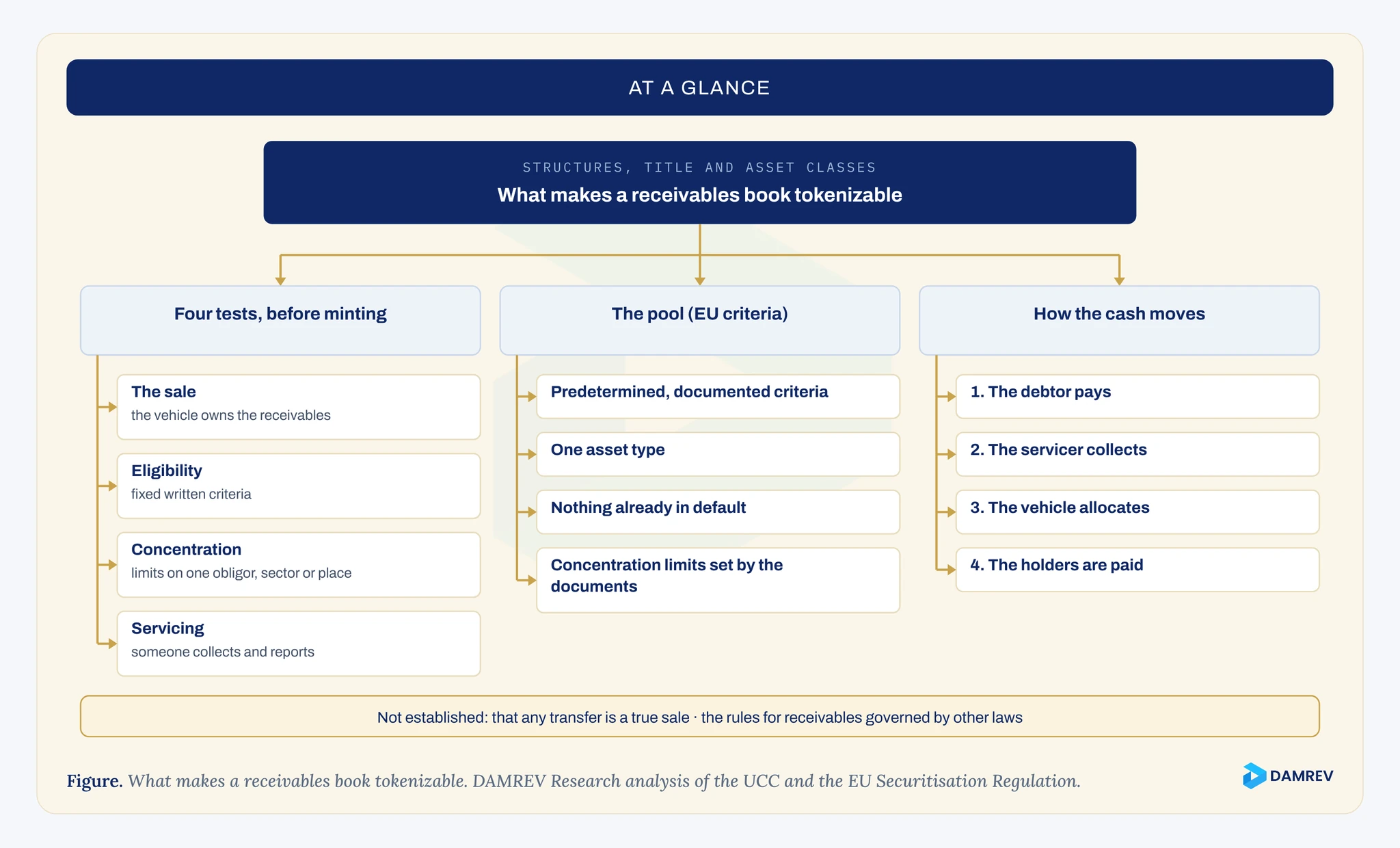
Receivables tokenization works when four things are settled before any token is minted: the receivables have been sold to a vehicle in a way the law recognises, the pool is defined by fixed eligibility rules, its concentrations are limited, and someone competent collects the cash1, 2, 6.
None of the four is created by the token, and each fails or holds under the law that governs the receivables1, 4.


01 · The answer
What makes a receivables book tokenizable?
Receivables tokenization needs four things, all settled before any token is minted: a sale the law recognises, a pool defined by fixed eligibility rules, limits on concentration, and a servicer that collects the cash. The token records the result1, 6, 7.
A receivable is a right to be paid: an invoice, a loan instalment, a lease payment. A book of them is valuable only if three things are true at once. The buyer owns the rights, the rights are of the kind described, and the cash they produce reaches the buyer.
Tokenization offers a new way to record and transfer interests in the book. It offers no new way to make any of those three things true.
| Test | What must be settled | Where it is decided |
|---|---|---|
| The sale | The receivables belong to the vehicle, not the originator | The transfer documents and the law governing the receivables1, 2, 3 |
| Eligibility | Which receivables may enter the pool, by fixed written criteria | The transaction documents7 |
| Concentration | How much of the pool may depend on one obligor, sector, or place | The transaction documents |
| Servicing | Who collects, chases, and reports, and what happens if they fail | The servicing agreement6, 7 |
Each test has a familiar name in securitisation, and tokenized receivables are a form of it.
The vocabulary below is taken from the US Uniform Commercial Code (UCC), which governs the sale of accounts and other payment rights in the United States, and from the Securitisation Regulation of the European Union (EU), which sets out the criteria for a simple, transparent and standardised securitisation1, 7.
02 · The sale
How do receivables leave the originator?
Receivables leave the originator by a sale the governing law recognises, completed with any filing that law requires. Under the UCC, a seller keeps no interest in an account it has sold, but the buyer's interest must be perfected to hold against the seller's creditors1, 3, 4.
US law brings sales of receivables inside the secured transactions regime. Article 9 applies to "a sale of accounts, chattel paper, payment intangibles, or promissory notes", and the UCC's definition of a security interest includes "any interest of a consignor and a buyer of accounts, chattel paper, a payment intangible, or a promissory note"2.
The consequence of a completed sale is stated plainly.
A debtor that has sold an account, chattel paper, payment intangible, or promissory note does not retain a legal or equitable interest in the collateral sold.1
Perfection is the step that protects the sale against third parties. A sale of payment intangibles or promissory notes is perfected when it attaches, as is a small assignment of accounts that does not transfer "a significant part of the assignor's outstanding accounts"3.
A sale of a book of accounts generally needs a filed financing statement. Until then, the buyer's interest is subordinate to a person that becomes a lien creditor first, and a bankruptcy trustee has, from the start of the case, the rights of a creditor holding a judicial lien on the debtor's property4, 5.
The EU states the same aim as a condition for its simple, transparent and standardised label:
"The title to the underlying exposures shall be acquired by the SSPE by means of a true sale or assignment or transfer with the same legal effect", the SSPE being the securitisation special purpose entity, in a way enforceable against the seller and third parties, and without severe clawback provisions that would let the seller's liquidator invalidate the sale7.
03 · The pool
What must the pool look like?
The pool must be defined in advance by written criteria, homogeneous in asset type, free of receivables already in default, and limited in its concentrations. The EU's criteria state the first three in terms; the documents must set the fourth7.
Eligibility decides what the holder is exposed to. If the originator can choose which receivables to put in, and when, the holder is exposed to the originator's judgement as well as to the receivables. The EU's criteria address that directly.
Fixed criteria, not discretion
Exposures must meet "predetermined, clear and documented eligibility criteria" that do not allow active portfolio management on a discretionary basis7.
One asset type
The pool must be homogeneous in asset type, and "A pool of underlying exposures shall comprise only one asset type"7.
Nothing already in default
At selection, the pool may not include exposures in default within the meaning of the EU capital rules, or exposures to a credit-impaired debtor or guarantor7.
Concentration limits
The Article 20 provisions read here set no concentration limit. The limit on any one obligor, sector, or country is set by the transaction documents.
A token contract can enforce some of these rules at the point a receivable enters the pool, if the data it needs is available on-chain. It cannot decide whether a receivable is in default, or whether a debtor is credit-impaired. Those facts sit in the originator's records and must be verified there.
04 · The collections
How does the cash reach the token holders?
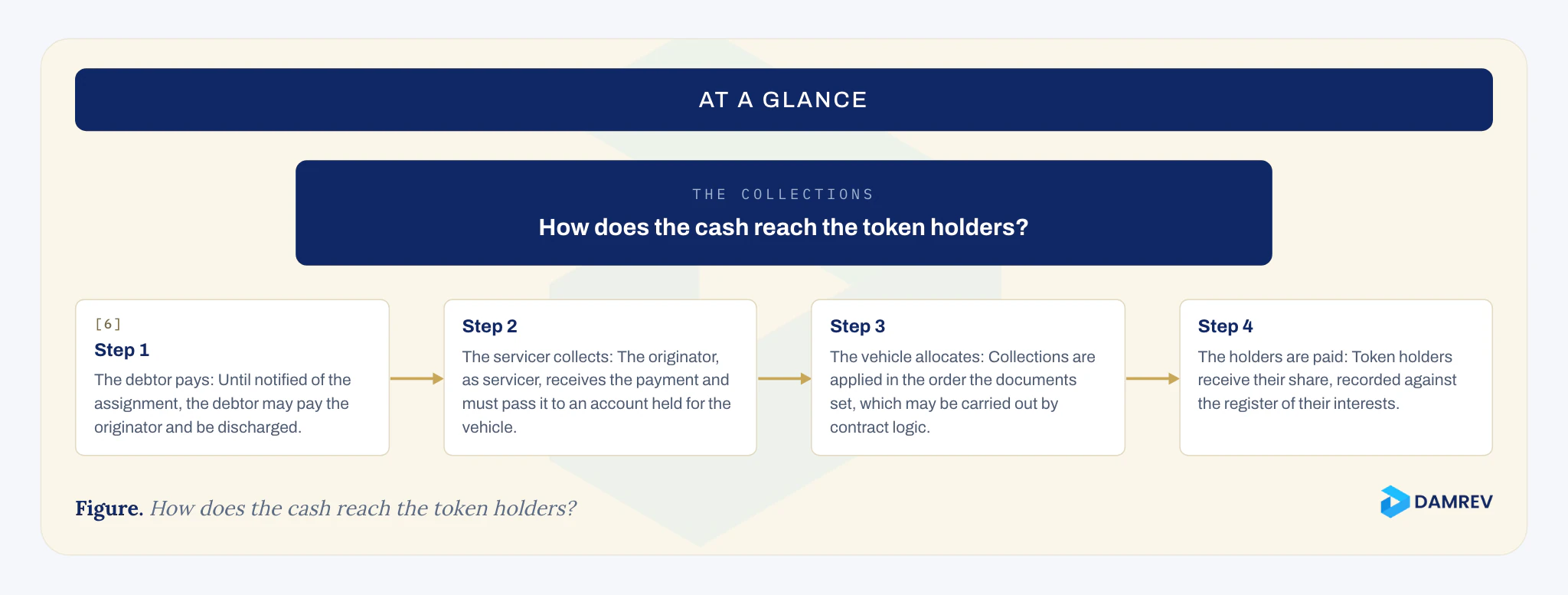
The cash reaches token holders through a servicer that collects from the debtors, usually the originator, because debtors may keep paying the original creditor until they are told otherwise. The servicer's competence and its failure arrangements are part of what is bought6, 7.
Debtors do not pay a token. Under the UCC, an account debtor "may discharge its obligation by paying the assignor until, but not after, the account debtor receives a notification" of the assignment6.
Where a programme does not notify debtors, the cash continues to arrive at the originator, which collects it as servicer for the vehicle. The holder's exposure to the originator does not end with the sale.
How cash moves from debtor to token holder in a typical receivables structure
- How does the cash reach the token holders?
- Step 1: The debtor pays: Until notified of the assignment, the debtor may pay the originator and be discharged. ([6])
- Step 2: The servicer collects: The originator, as servicer, receives the payment and must pass it to an account held for the vehicle.
- Step 3: The vehicle allocates: Collections are applied in the order the documents set, which may be carried out by contract logic.
- Step 4: The holders are paid: Token holders receive their share, recorded against the register of their interests.
The EU's criteria require that the servicer "shall have expertise in servicing exposures of a similar nature to those securitised", with documented policies and controls7.
The US rules also protect the transfer itself: a term in the underlying contract that prohibits or restricts assignment of an account is generally ineffective, with exceptions6.
A buyer that relies on a ledger to tell it what was collected is relying on the servicer's records being put there correctly.

05 · What it does not establish
What does this reading not establish?
As of 7 October 2026, the Uniform Commercial Code, US Bankruptcy Code, and EU Securitisation Regulation provisions read here do not establish that any transfer is a true sale, how receivables governed by other laws are transferred, or that the EU criteria apply to a given deal. The reading sets out the questions, not the answers for any book1, 7.
| Question | Position | Source |
|---|---|---|
| Whether any transfer is a true sale | Not established. That turns on the substance of the transfer under the governing law, and usually on a legal opinion | 1, 2 |
| Receivables governed by other laws | Not established. South African, English, and other laws each have their own rules on cession or assignment | |
| Whether the EU criteria apply to a given deal | Not established. They govern the simple, transparent and standardised label, not every securitisation | 7 |
| The right concentration limits | Not established. They depend on the pool and the investors, and are set by the documents | |
| Exceptions to the anti-assignment rule | Not set out in full. Section 9-406 has exceptions, including for some payment intangibles and consumer obligations | 6 |
| Accounting or tax treatment of the sale | Outside the scope of this article. Take advice from your own auditor or tax adviser |
The UCC is a uniform text that each state enacts, sometimes with changes, so the version that governs a given receivable is the version in force in the relevant state1. The EU criteria are conditions for a label, not rules for every transaction7.
What both texts show is that a tokenizable book is a well-built book first. The sale, the pool, and the servicing are settled in documents and in law. The token can make the holders' interests easier to record and transfer once that is done.
Common questions
What else do people ask?
Short answers to the questions people ask most about this topic.
Is selling receivables the same as pledging them?
No, though US law treats both under Article 9. A buyer of accounts holds a security interest by definition, and the seller of an account keeps no legal or equitable interest in it1, 2.
Whether a given transfer is a sale is decided on its substance under the governing law, and a transfer labelled a sale can be treated as a secured loan.
Does the buyer of receivables need to register anything?
In the United States, a sale of accounts is generally perfected by filing a financing statement; a sale of payment intangibles or promissory notes is perfected when it attaches3. Until the buyer perfects or files, its interest is subordinate to a lien creditor, a position a bankruptcy trustee takes on filing4, 5.
Can a contract term stop receivables being sold?
For most accounts under US law, no: a term that prohibits, restricts, or requires consent to the assignment is ineffective to that extent, with exceptions6.
Do the EU simple, transparent and standardised (STS) criteria apply to every tokenized receivables deal?
No. They are the conditions for a securitisation to be designated simple, transparent and standardised. They are read here as a public statement of what a well-built pool looks like7.
Where should you go next?
The pages below pick up where this one ends. Start with the one closest to where your asset or programme stands today.
- The Waterfall in Contract LogicA securitisation waterfall's arithmetic suits code, but the documents set the order, and someone accountable must reconcile what the code paid.
- Bankruptcy Remote SPV Tokenization: What the Vehicle Must Still Do Off-ChainCode cannot make a vehicle bankruptcy remote. A special purpose vehicle gets there off-chain, through a true sale, its documents, and a separate existence.
- Credit, Receivables & Project FinanceHow loan books, receivables, and project cash flows become tokenized debt that applies its own ranking and eligibility rules, while credit risk stays unchanged.
- A Guide to Tokenizing a Receivables BookHow a pool of amounts owed becomes an instrument carrying its ranking, eligibility rules, and waterfall in code, through five fixed stages.
References
- 1.Uniform Commercial Code, section 9-318, "No interest retained in right to payment that is sold". https://www.law.cornell.edu/ucc/9/9-318
- 2.Uniform Commercial Code, sections 1-201(b)(35) and 9-109(a)(3). https://www.law.cornell.edu/ucc/1/1-201
- 3.Uniform Commercial Code, section 9-309, "Security interest perfected upon attachment". https://www.law.cornell.edu/ucc/9/9-309
- 4.Uniform Commercial Code, section 9-317, "Interests that take priority over or take free of security interest or agricultural lien". https://www.law.cornell.edu/ucc/9/9-317
- 5.United States Code, Title 11, section 544, "Trustee as lien creditor and as successor to certain creditors and purchasers". https://www.law.cornell.edu/uscode/text/11/544
- 6.Uniform Commercial Code, section 9-406, "Discharge of account debtor; notification of assignment". https://www.law.cornell.edu/ucc/9/9-406
- 7.Regulation (EU) 2017/2402 of 12 December 2017 (the Securitisation Regulation), Articles 20 and 21. https://eur-lex.europa.eu/legal-content/EN/TXT/HTML/?uri=CELEX:32017R2402
This article is analysis of public sources, not legal advice. Last updated:




