


Article · Structures, Title & Asset Classes
The Waterfall in Contract Logic
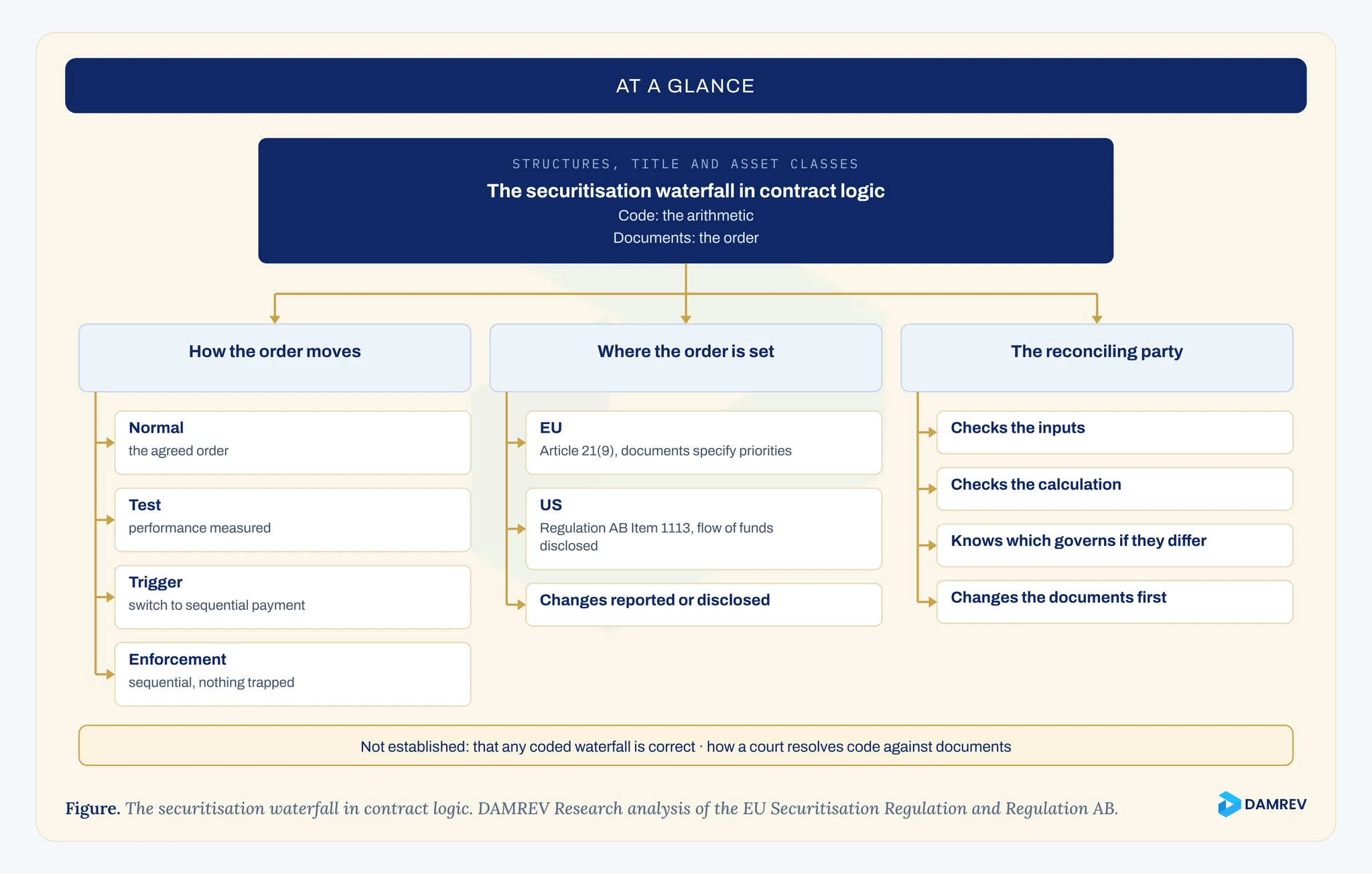
A securitisation waterfall can run in contract logic: the arithmetic of paying each tranche in order is well suited to code1, 2. The order itself is set by the transaction documents, the inputs come from the servicer's records off-chain, and someone accountable must reconcile what the code paid with what the documents require1, 2.


In this article
01 · The answer
Can a securitisation waterfall run in contract logic?
A securitisation waterfall's calculation can run in contract logic: paying each class in a fixed order from a known amount of cash is arithmetic. The order, the inputs, and the accountability all sit outside the code1, 2.
Every securitisation has a waterfall, whether or not it is tokenized. The cash the assets produce in a period is applied in a set order: senior expenses, then interest on the senior notes, then interest on junior notes, then principal, with variations that change when the pool performs badly.
Investors buy a position in that order. A tokenized structure records their positions on a ledger and can pay them from it, which makes it natural to write the waterfall into the token contract as well.
Code applies the same order every time, can be read by anyone with access to it, and produces a record of each payment.
Against that, the documents, not the code, are the contract with investors; the cash figures the code works from come from a servicer; and when the code and the documents disagree, someone must notice and correct it. The rest of this article reads what the European Union (EU) and US rules require of the waterfall, and where code fits.
02 · The documents
Where is the order of payments set?
The order of payments is set in the transaction documents. The EU requires the documents to specify the priorities of payment and the events that change them; US Regulation AB requires the flow of funds and distribution priorities to be disclosed for registered deals1, 2.
Both the EU and the US treat the waterfall as a matter of documentation and disclosure.
The EU's criteria for a simple, transparent and standardised securitisation require the documents to specify the priorities of payment, and require "Any change in the priorities of payments which will materially adversely affect the repayment" of a position to be reported to investors without undue delay1.
Regulation AB requires disclosure of "The flow of funds for the transaction, including the payment allocations" and the "distribution priorities among all classes of the issuing entity's securities"2.
| Requirement | EU Securitisation Regulation | US Regulation AB, Item 1113 |
|---|---|---|
| The order is written down | The documents specify the priorities of payment and the events that change them, Article 21(9)1 | The flow of funds and distribution priorities are disclosed, Item 1113(a)(2)2 |
| Changes to the order | Material adverse changes reported to investors without undue delay, Article 21(9)1 | Changes triggered on default, and liquidation, amortisation, or performance triggers, disclosed, Item 1113(a)(6) and (7)2 |
| After enforcement | No cash trapped beyond what is necessary; principal passed to investors by sequential amortisation, Article 21(4)1 | Disclosure of changes triggered by default2 |
| Presentation | Not specified in the provisions read here | Graphic presentation "if doing so will aid understanding"2 |
Neither text says how the waterfall is to be executed, so neither rules out a trustee's spreadsheet or a smart contract. Both texts assume, though, that the order investors read is the order they are paid in.
03 · The triggers
What changes the order, and how does code handle it?
The order is changed by triggers: events in the documents that switch the waterfall, usually from paying classes side by side to paying them strictly by seniority. Code can switch on a trigger only if the facts that trip it reach it correctly1, 2.
Some deals pay classes partly in parallel while the pool performs, and switch to strict seniority if it does not.
The EU requires that a non-sequential order "shall include triggers relating to the performance of the underlying exposures" that return payments to sequential order, at minimum when credit quality falls below a set threshold1. After an enforcement or acceleration notice, the position is fixed in terms.
principal receipts from the underlying exposures shall be passed to investors via sequential amortisation1
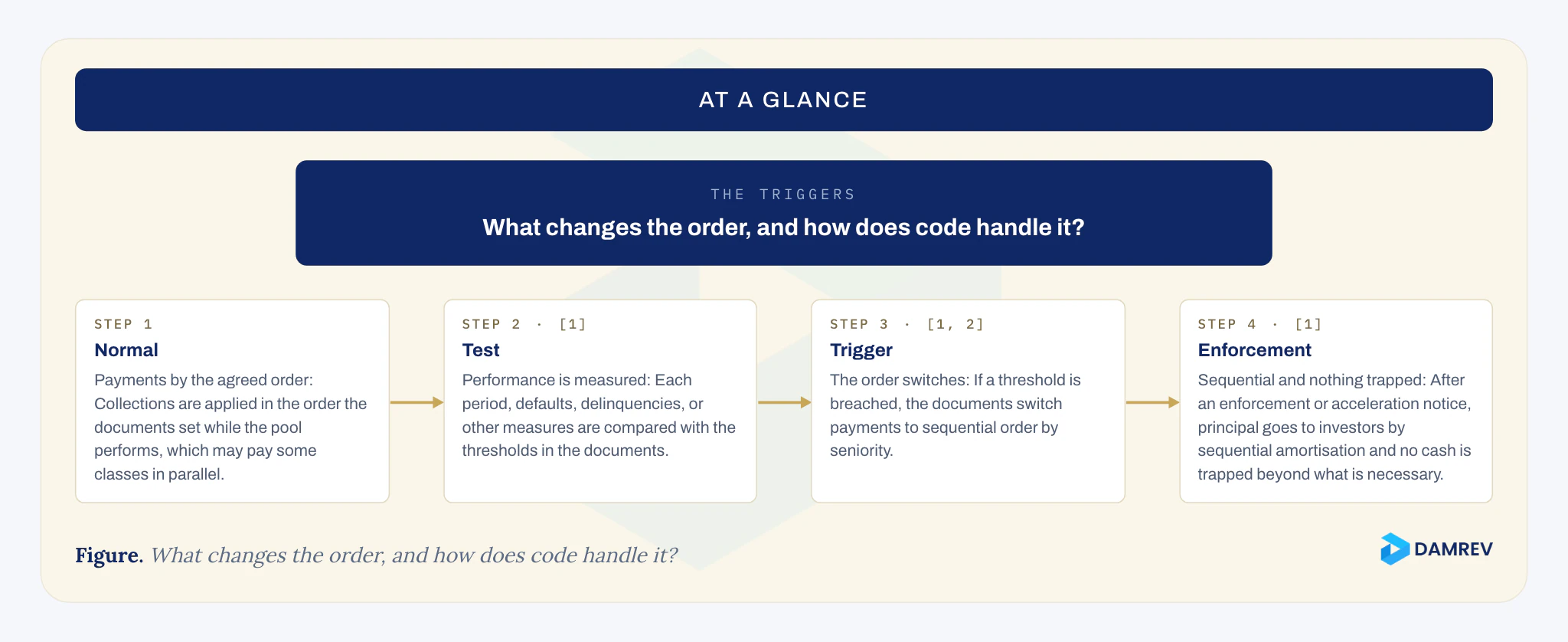
That sentence leaves no room for discretion once the notice is given. The sequence across the life of a triggered deal runs as follows.
How a triggered waterfall moves from one order to another
- What changes the order, and how does code handle it?
- Normal: Payments by the agreed order: Collections are applied in the order the documents set while the pool performs, which may pay some classes in parallel. (Step 1)
- Test: Performance is measured: Each period, defaults, delinquencies, or other measures are compared with the thresholds in the documents. (Step 2, [1])
- Trigger: The order switches: If a threshold is breached, the documents switch payments to sequential order by seniority. (Step 3, [1, 2])
- Enforcement: Sequential and nothing trapped: After an enforcement or acceleration notice, principal goes to investors by sequential amortisation and no cash is trapped beyond what is necessary. (Step 4, [1])
Code handles the switch well once it knows the trigger has been tripped. It does not know on its own. Delinquency and default figures come from the servicer's records, and a trigger fed with a late or wrong figure switches late or not at all.
04 · The reconciliation
Who reconciles the code with the documents?
The code is reconciled with the documents by a named party, usually a trustee, calculation agent, or cash manager, who checks the inputs, checks what the code paid against what the documents require, and corrects any difference. The documents should say which governs when they differ1.
The EU requires the documents to set out clearly the duties of the servicer, the trustee, and other service providers, and to provide for a servicer's default or insolvency1. A tokenized deal adds one more thing to reconcile: the code. The parties who already check the cash now also check the program that moves it.
The inputs
Collections, defaults, and delinquencies come from the servicer and must be verified before the code uses them1.
The calculation
Each period's payments are checked against the documents' order, including any trigger that should have switched it1, 2.
The precedence
The documents state whether the written priority of payments or the code governs if they differ, and how an error is corrected.
The change
Any amendment to the waterfall is made in the documents first, and the code changed to match, with investors told as the rules require1.
The precedence clause matters most when something goes wrong. A holder who was underpaid because the code had a defect needs to know whether the written order or the program defines what was owed.

05 · What it does not establish
What does this reading not establish?
As of 7 October 2026, the EU Securitisation Regulation and Regulation AB provisions read here do not establish that any coded waterfall is correct, that either rule applies to a given deal, or how a court would resolve a conflict between code and documents. The reading sets out where the order is fixed and who checks it1, 2.
| Question | Position | Source |
|---|---|---|
| Whether a given coded waterfall matches its documents | Not established. That is a matter of testing and audit for each deal | |
| Whether the EU criteria apply to a deal | Not established. Article 21 sets conditions for the simple, transparent and standardised label | 1 |
| Whether Regulation AB applies | Not established. Item 1113 governs disclosure for registered asset-backed securities | 2 |
| A conflict between code and documents | Not established. We found no decision on a tokenized waterfall | |
| Accounting for tranches | Outside the scope of this article. Take advice from your own auditor |
The texts read here regulate what a waterfall must be and what investors must be told about it1, 2. They say nothing about code, and nothing in them prevents a waterfall from running on a ledger.
What they establish is that the order belongs to the documents and the investors are entitled to rely on it. Code can make that order run the same way each time. The trustee, the servicer, and the precedence clause keep it honest.
Common questions
What else do people ask?
Short answers to the questions people ask most about this topic.
What is a waterfall?
The order in which a securitisation applies the cash it collects: fees and expenses first, then interest and principal to each class of notes by seniority, as the transaction documents set it.
If the code and the documents disagree, which governs?
Whichever the documents say governs, so a deal should state it expressly. Where it does not, the question is open; we found no decision on a tokenized waterfall.
Can the waterfall change during the life of a deal?
Yes, where the documents provide for it. The EU rules require the events that change the order to be specified, and require performance triggers where the order is not sequential1.
Do US rules require the waterfall to be disclosed?
For registered asset-backed securities, Regulation AB requires disclosure of the flow of funds and the distribution priorities among all classes, graphically if that aids understanding2.
Where should you go next?
The pages below pick up where this one ends. Start with the one closest to where your asset or programme stands today.
- What Makes a Receivables Book TokenizableA receivables book is tokenizable once four things are settled: a true sale to a vehicle, eligibility rules, concentration limits, and competent collection.
- Bankruptcy Remote SPV Tokenization: What the Vehicle Must Still Do Off-ChainCode cannot make a vehicle bankruptcy remote. A special purpose vehicle gets there off-chain, through a true sale, its documents, and a separate existence.
- Credit, Receivables & Project FinanceHow loan books, receivables, and project cash flows become tokenized debt that applies its own ranking and eligibility rules, while credit risk stays unchanged.
- Proof & ServicingKeeping an instrument working for life: distributions, corporate actions, transfers, and reporting follow the encoded terms, and every event is evidenced.
References
- 1.Regulation (EU) 2017/2402 of 12 December 2017 (the Securitisation Regulation), Article 21. https://eur-lex.europa.eu/legal-content/EN/TXT/HTML/?uri=CELEX:32017R2402
- 2.Code of Federal Regulations, Title 17, section 229.1113 (Regulation AB, Item 1113), "Structure of the transaction". https://www.law.cornell.edu/cfr/text/17/229.1113
This article is analysis of public sources, not legal advice. Last updated:




