


Article · Markets & Data
Tokenized Real Estate: What the Data Can & Cannot Show
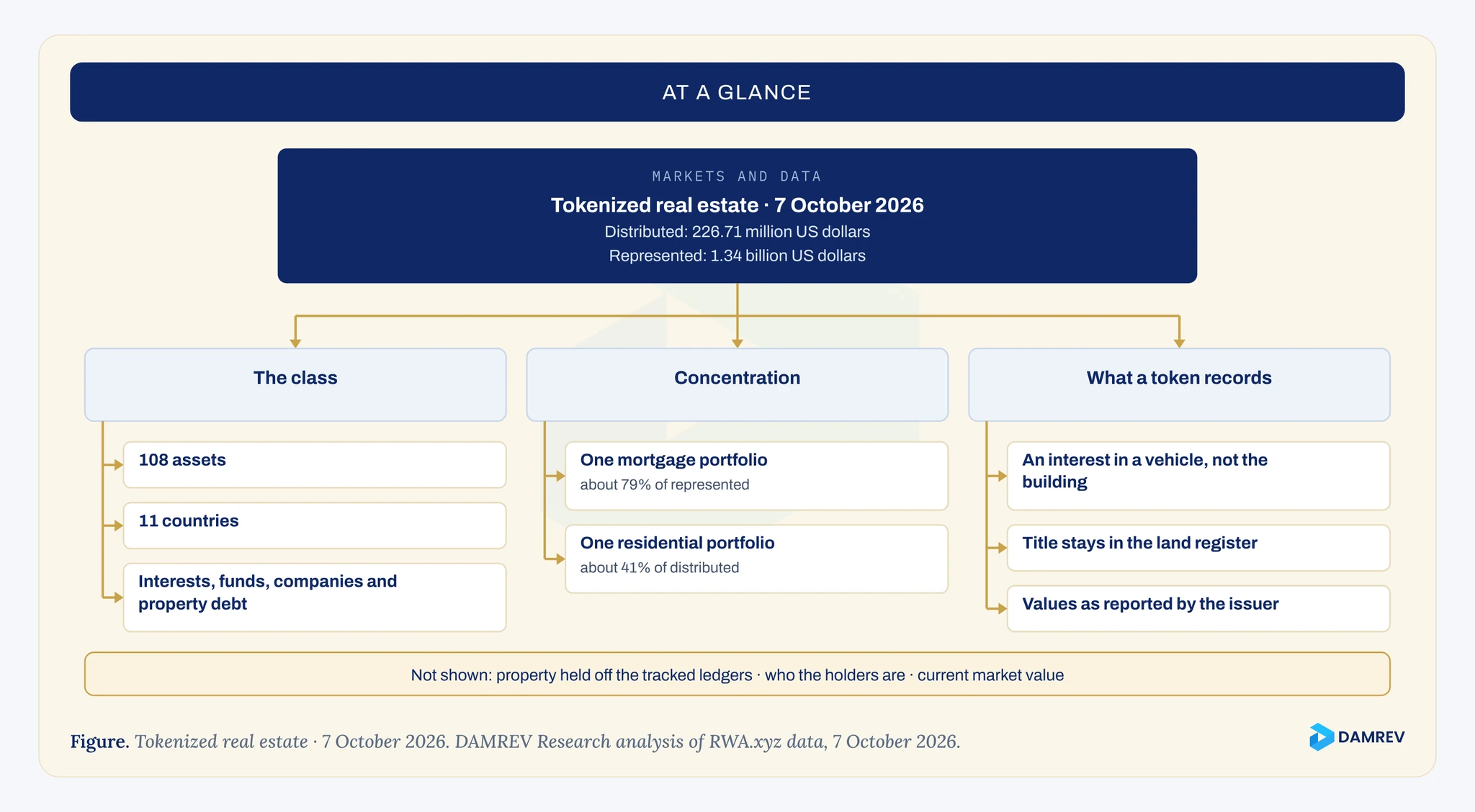
The tokenized real estate market size is very small on the measure of transferable tokens: on 7 October 2026 RWA.xyz showed 226.71 million US dollars of distributed value, with 1.34 billion of represented value reported separately1. Most of the represented figure is a single digital mortgage portfolio, and none of the figures can show who owns the buildings1, 2.

In this article
01 · What is counted
What does tokenized real estate data count?
Tokenized real estate data on the leading tracker counts 108 assets in 11 countries: ownership interests, funds, property companies, and real-estate-backed debt. Together they carried 226.71 million US dollars of distributed value and 1.34 billion of represented value on 7 October 20261.
Tokenized real estate is one of the most discussed uses of the technology and one of the smallest in the data. RWA.xyz describes its real estate class as covering "direct ownership interests, funds, REITs, and real estate-backed debt"1. At 18:50 UTC on 7 October 2026 the class held 108 assets in 11 countries, with 19,380 holder addresses1.
The two value measures are kept apart here, as in every article in this series. Distributed value counts tokens that can move to wallets outside the issuing platform, including wallets limited by eligibility controls. Represented value counts tokens recorded on a chain but kept within the issuer's system4.
- Distributed value of tokenized real estate, in US dollars, at 18:50 UTC on 7 October 20261
- 226.71 million
- Represented value of tokenized real estate, in US dollars, reported separately1
- 1.34 billion
- Assets in the class, across 11 countries1
- 108
Set against the global property market, both figures are small. Set against other tokenized classes, they are small too. On the same afternoon, the tracker's tokenized US Treasury funds carried 15.00 billion US dollars of distributed value, more than 60 times the real estate figure1, 6.
The gap between how often tokenized property is discussed and how much of it the data can find is the first thing the data shows.
02 · Concentration
How concentrated is the figure?
The tokenized real estate figure is highly concentrated: one digital mortgage portfolio makes up about 79 percent of the represented value, and one residential portfolio token about 41 percent of the distributed value1.
The assets table on the real estate dashboard ranks holdings by total value. The largest entry, at 1.06 billion US dollars, is a portfolio of digital mortgages, marked represented1.
It is about 79 percent of the class's represented value on its own. The largest distributed entry is a token over a portfolio of US residential property, at 92.29 million US dollars, about 41 percent of the distributed value1.
Below those two, the entries fall away quickly. The next four range from 22.41 million to 27.34 million US dollars, and three of them are represented1.
| Rank | Asset type, as shown | Country | Total value, millions of US dollars | Measure |
|---|---|---|---|---|
| 1 | Portfolio of digital mortgages | Not shown | 1,060.96 | Represented |
| 2 | Residential portfolio, stabilised | United States | 92.29 | Distributed |
| 3 | Single asset, equity tranche, stabilised | United States | 27.34 | Represented |
| 4 | Portfolio, development | United States | 25.00 | Represented |
| 5 | Portfolio, development | Canada | 23.00 | Represented |
| 6 | Single project | Not shown in our read | 22.41 | Distributed |
The split between the two measures runs against the usual argument for tokenizing property. Represented value is almost six times distributed value in this class1.
Most tokenized real estate on the tracker sits in records its issuers keep, not in tokens that can move between investors' own wallets, which is the feature most often offered as the reason to tokenize a building in the first place.
Activity is thin as well. The tracker showed 869 monthly active addresses across the class, against 19,380 holders, and the figure was 8.81 percent lower than 30 days earlier1. Most holders, in a given month, do nothing with their tokens.
03 · Where the line falls
Where does real estate end and credit begin?
Real estate ends and credit begins wherever the tracker or the study chooses: mortgage debt can sit in real estate or in credit, and that single choice moves the class's size by more than an order of magnitude1, 2, 3.
The largest item in the real estate class is mortgage debt. The largest item in the tracker's credit class is also secured on homes: a home equity line of credit product carrying 23.54 billion US dollars of represented value2.
The two are similar in what they are secured on and filed in different classes. Had the home equity product been filed under real estate, the class's represented value would have been about 18 times larger.
Studies make the same choice in their own way. One widely cited study put tokenized real estate at under 0.3 trillion US dollars in 2024, and its definition takes in loans and securitizations alongside private real estate funds and land under development3.
At its upper bound, that starting figure is roughly 1,300 times the tracker's distributed value. Much of the difference lies in the decision to count property debt, and debt recorded off public ledgers, as tokenized real estate.
A reader comparing figures should therefore ask one question first: is property debt in or out? A figure that includes mortgages measures a lending market. A figure that excludes them measures ownership interests in property. Both are legitimate, and they differ by orders of magnitude.
04 · What a token records
What does a real estate token actually record?
A real estate token records an interest in something that holds or finances property: a company, a fund, a tranche, or a loan. It does not record title to land, which stays in the land register under local law.
The tracker's own fields show this. It classifies each asset by asset type, such as single asset or portfolio, and by strategy, such as stabilised or development1. Those fields describe the property behind a vehicle. They do not say what legal interest the token carries, or whether the holder can enforce anything against the building.
The vehicle, not the building
Most tokens represent shares in a company or units in a fund that owns or lends against property. Title remains in the land register under local law.
Values the issuer reports
The tracker shows each asset's total value as reported. Property is valued periodically, not traded continuously, so the figure is only as current as the last valuation1.
Only what the tracker lists
Assets must have a chain in a core role to be listed. Property tokens on private platforms, or announced but not deployed, are outside the figures5.
This is why the question in the title matters. A market-size figure for tokenized real estate measures tokens, at values their issuers report, on the ledgers one tracker reads.
It cannot measure how much property has changed hands, how much is owned through tokens, or whether any token gives its holder a claim a court would enforce. Our article on what a real estate token holder owns sets out that legal chain.

05 · What it does not establish
What does the data not establish?
As of 7 October 2026, the RWA.xyz dashboards read here do not establish the size of tokenized property ownership, the value of any property, or the legal rights of token holders. The data records one tracker's count of tokens on one day1.
| Question | What the data shows | What it does not show |
|---|---|---|
| Size | Distributed and represented value, by asset1 | Property owned through tokens off the tracked ledgers |
| Ownership | Holder addresses1 | Who the holders are, or what they legally own |
| Value | Values as reported per asset1 | Current market value of the properties |
| Activity | Monthly active addresses1 | Sales of property, or prices achieved |
| Scope | The tracker's class boundary1, 2 | Property debt filed in other classes |
The figures also say nothing on price, yield, or prospects, and this article draws no view on them. It measures what has been tokenized and where the tracker files it.
What the data does show is enough to correct a common impression. Tokenized real estate, measured as transferable tokens, was about a quarter of a billion US dollars on 7 October 2026.
It is dominated by a handful of assets and is only lightly traded. Larger figures exist, but they count lending, records kept by issuers, or assets off public ledgers, and they should be read with that scope stated.
Common questions
What else do people ask?
Short answers to the questions people ask most about this topic.
How large is the tokenized real estate market?
On RWA.xyz at 18:50 UTC on 7 October 2026, 226.71 million US dollars of distributed value and 1.34 billion of represented value, in 108 assets across 11 countries1.
Why do some sources give figures in the hundreds of billions?
Because they count differently. One widely cited study put tokenized real estate at under 0.3 trillion US dollars in 2024, on a definition that includes loans and securitizations as well as funds and land3.
Does owning a real estate token mean owning property?
Not necessarily. A token usually records an interest in a company, fund, or loan that holds or finances the property. Title is recorded in the land register, which the token does not change1.
Are tokenized property holdings traded actively?
The tracker showed 869 monthly active addresses across the class on 7 October 2026, against 19,380 holders1.
Where should you go next?
The pages below pick up where this one ends. Start with the one closest to where your asset or programme stands today.
- Real Estate Tokenization Legal Structure: The Token Is Not the TitleA real estate token is rarely title to land. The holder owns a vehicle interest or a contract right, and the land register decides ownership.
- Is Private Credit the Largest Tokenized Asset Class? It Depends What You CountOn 7 October 2026 tokenized private credit held 8.04 billion US dollars of distributed value, against 15.00 billion for Treasury funds.
- Who Holds Tokenized Assets: Holder Counts, Concentration, & What a Wallet Count HidesOn 7 October 2026 tokenized assets had 5.16 million holder addresses. An address is not an investor, so the count shows only spread.
- Why Tokenization Forecasts DisagreeSix widely cited tokenization forecasts run from about 2 trillion to 30.1 trillion US dollars, mostly because they count different things to different years.
References
- 1.RWA.xyz, Tokenized Real Estate dashboard and assets table, read 7 October 2026 at 18:50 UTC. https://app.rwa.xyz/real-estate
- 2.RWA.xyz, Tokenized Credit assets table, read 7 October 2026 at 18:22 UTC. https://app.rwa.xyz/credit
- 3.Deloitte Center for Financial Services, "Tokenized real estate", Financial Services Industry Predictions 2025, 24 April 2025. https://www.deloitte.com/us/en/insights/industry/financial-services/financial-services-industry-predictions/2025/tokenized-real-estate.html
- 4.RWA.xyz (Bryan Choe), "A New Framework for Tokenized Assets: Distributed & Represented", 21 November 2025. https://app.rwa.xyz/blog/a-new-framework-for-tokenized-assets-distributed-and-represented
- 5.RWA.xyz documentation, "Coverage", read 7 October 2026. https://docs.rwa.xyz/methodology/coverage
- 6.RWA.xyz, Tokenized U.S. Treasury Funds dashboard, read 7 October 2026 at 18:24 UTC. https://app.rwa.xyz/treasuries
This article is analysis of public sources, not legal advice. Last updated:




